



 The Morning After is a recurring column in which our intrepid commentator, Lars Pearson, wakes up, makes the coffee, feeds the direwolves and looks at recent geekery in the harsh light of day.
[Spoilers for Game of Thrones follow. At the risk of getting ahead of ourselves, anyone wishing to log their appreciation for Thrones Season 8 can do so here, on Change.org: http://chng.it/gRsXXfNL]
Well! It’s been such a slow, uneventful, sleepy week, whatever shall we talk about?
Unless you’ve been up a banana tree somewhere (and even then, without your phone), you doubtless know what I’m being coy about. The penultimate episode of Game of Thrones came out, saw Daenerys Stormborn wrest control of King’s Landing from Cersei Lannister… and then go full-on supervillain anyway, destroying the city and tens of thousands of people with dragonfire. For Thrones viewers, it was perhaps the greatest shock of all – and that includes that time a whole family of heroes were slaughtered at dinner, with the added indignity that they probably didn’t have time to finish dessert.
For non-Thrones viewers, it helps to understand: Daenerys had been venerated as a potential ruler who would serve at the pleasure of the masses, dispensing punishment only as necessary. Her going rogue, then, made all the characters who’d believed in her look like total cretins. It was part and parcel of Thrones skirting dangerously close to the worldview that mercy, kindness and compassion are all signs of weakness. The show only pulled out of that moral tailspin in the final episode, when Westeros entertainingly became The West Wing: a country governed by flawed people who actually do care about the pubic.
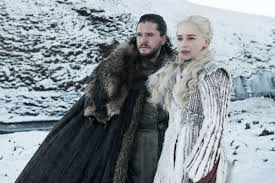 Regardless, Fandom reacted to Daenerys’s brutality with the shyness and restraint for which it is known.
Hahahahahahaha… only joking. Actually, bile and resentment were sprayed everywhere, and a Change.org petition to “Remake Game of Thrones Season 8 With Competent Writers” is fast approaching 1.5 million signatures – a number significantly boosted, no doubt, by widespread media coverage of it. [Just for kicks, I posted a positive counter-petition, linked above.]
You can’t blame the likes of the BBC for reporting on a petition that massive (a bid to remake The Last Jedi similarly got attention last year, with a paltry 116,000 signatures), and yet it A) remains a spectacular example of tilting at windmills, as HBO is never going to blow $100 million(ish) on a do-over, B) leaves utterly vague the criteria by which “competency” shall be judged (good luck getting anyone to agree on that), and C) curiously absolves Thrones creator George R.R. Martin of blame, instead pissing lava on showrunners David Benioff and D.B. Weiss, even though – by most accounts – they were working to Martin’s story. If you don’t like Daenerys going nuts, most of the blame surely lies with the 70-year-old book writer with the impressive beard.
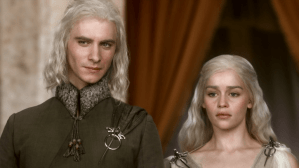 Regardless, I am find myself in the middle on this. I feel empathy toward anyone anguished by Daenerys’s downfall, just as you’d feel empathy for someone who’s lost a close friend. But it’s frustrating because the oft-cited rationales for the grief are such nonsense.
The general refrain from those decrying Daenerys’s “sudden” decision to level King’s Landing – “It came out of nowhere!”, “It didn’t make any sense!, etc – is so obviously untrue, one could easily prove it with graphs. In truth, the show has been ringing the alarm bell about Dany smelting everything in her path almost from the very start. Certainly, her murderous lineage, the times and places that she showed her opponents no mercy, the devastating firepower at her disposal, and – tellingly – the way that Tyrion Lannister, Varys and so many others spent years doing their damndest to convince her not to go full-on Dark Phoenix might have strongly indicated that she was, in fact, in danger of going full-on Dark Phoenix. For anyone who insists that Dany’s Pivot of Unbridled Death and Devastation came out of left field, you have to stop yourself from deadpanning, “Have you ever seen an episode of Game of Thrones, ever, at all?”
All of that said… it’s heart-wrenching when a beloved character goes rogue and disappoints you. Regardless of their rationale, the final two Thrones episodes were a brutal shock to the system. Yes, the show provided justification for Daenerys leveling King’s Landing, and yes, charring it like a marshmallow over the campfire might make for sound military strategy – but it’s still a gut-punch to watch it happen.
I can’t help but cut viewers some slack for being upset about it. They’re entitled to their feelings, even if the stated reasons sometimes don’t stand up to scrutiny. Context and reasoning matters, absolutely, but the anguish people feel is real. This isn’t Harry Potter, which literally (and unironically) ended with the line “All was well.”
 Star Wars, as it happens, has tumbled into this very same Sarlaac Pit in recent years. Whatever one’s views on the relative merits of The Force Awakens and The Last Jedi (for the record, I think the former is pretty bulletproof, the latter should have been a half-hour shorter), Disney/LucasFilm gravely underestimated the toll that butchering Han Solo and Luke Skywalker in such rapid succession would have on everyone’s psyches. They could have (and did) just about get away with slaughtering one beloved character hardwired into the very soul of Generation X, but two, a mere two years apart, simply broke the viewing public.
How well those deaths were implemented was somewhat beside the point – if you’re that savaging of beloved icons, the masses will recoil, and fill in the details later. My wife is the biggest Star Wars fan I know, and could spend an hour convincing you that Luke in The Last Jedi is entirely in keeping with how he’s portrayed in the original trilogy. She’s absolutely right, but regardless of context, it asked too much of everyone who grew up with the property. (Never mind the interlude of Rogue One, in which everyone dies, including an agreeable Force-monk.)
When I’m picking a Star Wars film to rewatch, I have to ask myself, “Am I in a mood to watch Han Solo get shish-ka-bobbed tonight? Or to see Luke become naked air? Or, an entire team of heroes get massacred? No?” On at least two occasions, I’ve rewatched The Force Awakens, but hung it up right before Han gets skewered through the heart in vivid HD.
 It’s a tremendous film. I can say so many nice things about it. I can’t bear to watch the ending too often.
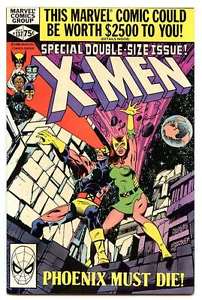
Come to think of it, I mentioned Dark Phoenix earlier, and that’s a pretty apt comparison. The seminal Dark Phoenix Saga that ran through Uncanny X-Men back in 1980 – and apologies as I paraphrase one of the most influential comic stories ever – involved a super-villain working to corrupt the X-Men’s Jean Gray, by way of removing the mental blocks that reduced her planet-wrecking powers to a manageable level. Jean consequently goes insane, switches her costume to red, develops some amazing hair, devours a planet of broccoli people (the D’Bari: entertainingly, their Wikipedia page springs right to the top if you Google “Jean Gray broccoli people”), and finally commits suicide, on the grounds that nothing else will stop her from going mad and killing billions.
At the time, Fandom was grief-stricken, but it couldn’t have played out any other way. We know this, because the story’s creators – Chris Claremont and John Byrne – at first wimped out, and contented themselves with merely depowering Jean. Marvel’s editor-in-chief, Jim Shooter, rightly sensed that matters had gone beyond such utter non-consequences (particularly the aforementioned broccoli people), and told Claremont and Byrne to kill Jean instead. The original ending first saw print in Phoenix: The Untold Story (1984), and whoooo boy… it’s such a damp squib, Shooter made the right call. The result was a magnificent piece of comics history.
But because readers can’t let certain things go, Jean’s death was reversed not even six years later, so she could co-found X-Factor. I am shuddering to think of Fandom’s response to Jean’s death in 1980, if the Internet had been available. The narrative of it being one of the most powerful comic stories might’ve been diluted, if its detractors possessed such a bullhorn. (Side note to say that I wouldn’t expect a backlash if Jean dies again in Dark Phoenix next month. Fandom can get volatile, but here they’ve had 40 years to acclimate.)
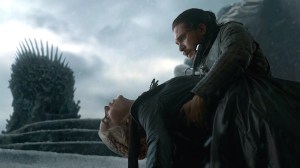 The difference with Daenerys is that Marvel and DC series effectively last forever, whereas this seems it for the Thrones characters. True, Martin has two volumes of the series remaining, but it’s difficult to see him reversing the major beats of Daenerys’s storyline, no matter how much emotional blackmail Fandom lays at his feet.
So these are difficult and awkward days, in which it’s helpful to acknowledge that Fandom’s grief over Daenerys is genuine – as it was with Han Solo and Luke Skywalker and Jean Gray – without validating the more absurd of their arguments and actions, such as a pointless (and “disrespectful,” as actress Sophie Turner put it to the New York Times) petition demanding a rewrite.
We can acknowledge the loss while at least trying to be adults about it.
A few regenerations back, Lars Pearson was a department head at Wizard: The Guide to Comics. Along with Lance Parkin, he recently won an Independent Publisher Book Award for Ahistory: An Unauthorized History of the Doctor Who Universe.

 Sci-Fi Bulletin: Exploring the Universes of SF, Fantasy, Horror and Spy-fi!