The Twilight Zone: Interview: Stephen La Rivière
One of the many areas that sets the new stage version of The Twilight Zone apart is its use of pre-recorded imagery – created for the show especially by Century […]



One of the many areas that sets the new stage version of The Twilight Zone apart is its use of pre-recorded imagery – created for the show especially by Century […]
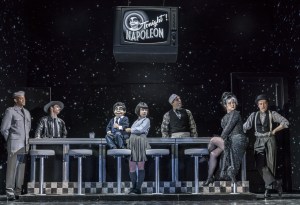 One of the many areas that sets the new stage version of The Twilight Zone apart is its use of pre-recorded imagery – created for the show especially by Century 21 Films. Stephen La Rivière explained to Paul Simpson how this came about.
Firstly, for those who aren’t aware, can you explain what Century 21 is?
We’re a production company perhaps best known for our work in ‘Supermarionation’ – the puppet and miniature form of filmmaking used on shows such as Thunderbirds, Stingray and Captain Scarlet. Our company is named after the original production company that produced those shows. Recent work has included 3 new episodes of Thunderbirds produced in the original style, a Thunderbirds advert for the Halifax, and strangely, an episode of the Inspector Morse series Endeavour. Our work extends beyond puppets though – we’ve also done drama, documentaries – even live music broadcasts. We think we can turn our hand to most things – our only stipulation is that it interests us!
How and when did you become involved with the Twilight Zone production?
The producer of the show, Ron Fogelman, was in the audience when the new episodes of Thunderbirds were shown at the British Film Institute in 2016. He sent an e-mail saying we should get together to discuss projects and we became friends. As The Twilight Zone developed he asked us if we’d like to do the filmed inserts for the show (both the drama sequences and the animations) because he’d been impressed by our work recreating styles from bygone eras. Recent work has required us to match various styles from 60s optically printed titles, to silent turn-of-the-century animation. So it seemed perfect for us.
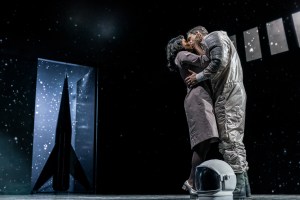
We were also responsible for the rocket props which were built in different scales – a use of the same skills employed on Thunderbirds, but on a larger scale!
 Were you fans of the series beforehand – and were you aware of the particular episodes that have been reimagined for this show?
Andrew T. Smith – who took the lead on the project – was very familiar with the show. Not least because he’d been invited to New York in 2007 to give a paper on Rod Serling! So yes, we were aware. Though our aim wasn’t to recreate those episodes. Unlike our Thunderbirds work, the idea wasn’t to be a slavish recreation. More to come up with something that had the right period feel, whilst working for a theatre audience who are watching the action unfold at random moments on small monitors.
How much latitude did you have with the sequences you were creating – were they very particularly scripted, or more generic and left to your imagination?
They were scripted, but Richard Jones the director was very generous in his admission that he was a theatre man and not a filmmaker. So we were very much left to plan out what was needed from a minimal brief. That’s not to say that Richard wasn’t involved – far from it. The show is extremely well choreographed. But like all good directors, he knows how to get the best out of people and that often involves letting them work out their bit rather than standing over them!
What was the biggest challenge involved with preparing for the Almeida production?
Time! We had one day to shoot it in. Plus there’s always a bit of nervousness from everyone when you’re crossing disciplines such as theatre and film. Beyond that, the bit of drama we shot takes place at a table with a lot of people – so it’s a challenge to make sure everyone is looking in the right direction! Recreating the ‘look’ as such wasn’t a huge challenge – it makes up so much of what we do now. The key is to forget what you would do now – but think how would they do it then. What technical issues would they be facing? And beyond that, why would they shoot something in a certain way – what were their influences?
 How much alteration did you have to make for the run in the West End?
Very little! We reshot the sequence again with new actors – and it was a very smooth operation. It’s always easier once you’ve done it once. That’s true for every production. The animations were refined and tweaked – using period reference technical films for inspiration and guidance.
Are there particular techniques that you’ve had to develop to produce the sequences that you’ll be taking forward into other C21 productions?
No – it’s all continual refinements on stuff that we’ve got pretty well worked out now. But naturally, the more you do something the better you get. Well, hopefully…
 Finally, what’s your overriding memory of working on the project?
Struggling to get to the theatre as I felt so unwell, then discovering I had pneumonia! Mainly seeing it all come together. It was a nice string to add to the bow of the company. We’re enthusiastic to try all sorts of different projects and styles. It keeps us on our toes. Plus it’s nice being a small part of something sometimes as you then get to enjoy everyone else’s work unimpeded by the knowledge of how it was created!
The Twilight Zone is currently playing at the Ambassadors Theatre. Click here to read our interview with producer Ron Fogelman
 Doctor Who News Star Trek News
 Sci-Fi Bulletin: Exploring the Universes of SF, Fantasy, Horror and Spy-fi!