 by Sir Christopher Frayling
St Peter’s Church, Bournemouth
February 20, 2018
Horror and popular culture expert Professor Sir Christopher Frayling discusses the creation and enduring myth of Mary Shelley’s gothic masterpiece during a landmark year and at a very relevant location.
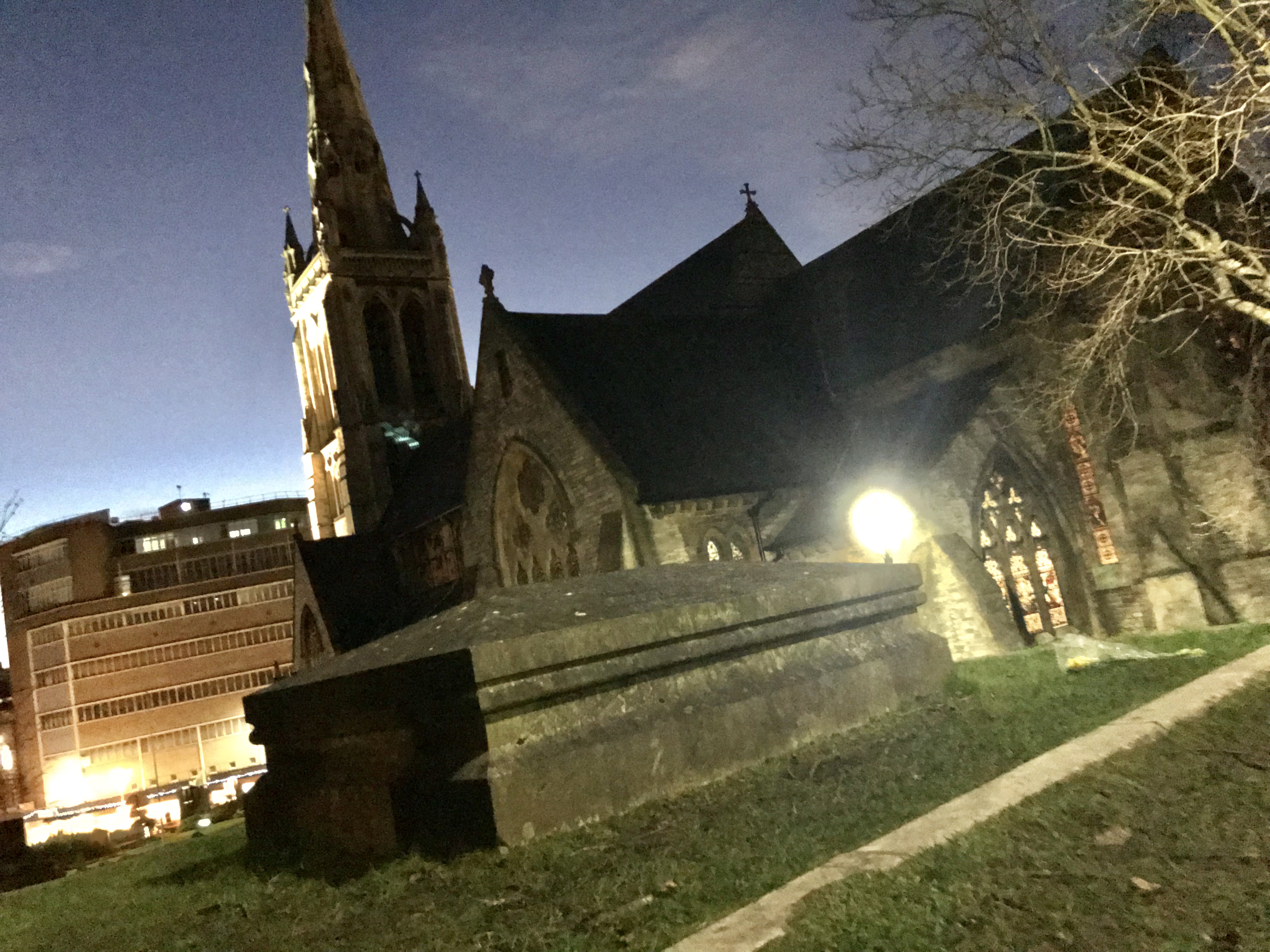
I would imagine that Professor Frayling has delivered lectures in far more exotic locations than a Gothic Revival church on the south coast of England, but it’s the exact location of the venue that probably made it irresistible. Because if you wander through the graveyard of St Peter’s Church you’ll find the shared grave of the Shelleys, including a certain Mary Shelley, buried there in 1851. There’s no reference to Frankenstein on the gravestone (it was considered inappropriate at the time), though there’s now a blue plaque on the church doing just that, which Professor Frayling explained to us was the only such plaque in existence that celebrates a Shelley/Frankenstein connection.
 Presented by the Centre for Media History at Bournemouth University, in association with the Shelley Frankenstein Festival, the free talk was a taster for the full Shelley Frankenstein Festival 2018, running from 20 October – 6 November 2018. The talk also accompanied Frayling’s highly recommended 2017 book Frankenstein: The First 200 Hundred Years.
Delivering his lecture from the pulpit – he confessed that this is the first time he’s talked about Frankenstein in this way – Frayling covered the genesis of the story from the banks of Lake Geneva, its publication as a three-volume limited run book set and eventual adoption by the stage and movies. From cereal boxes to comic books to millions of Google search returns, it’s a phenomenon that was conceived by an 18-year-old woman and completed by a young mother.
Because the Professor has such an encyclopaedic knowledge of his subject, he is able to present it in a deceptively simple narrative, while being able to plunder his recollection of key dates and references when backing up a theory. As with many modern academics, he started with a fascination of the cinema before discovering the literary roots. He fondly recalls the day in September 1958 when the Piccadilly’s cinema manager let an 11-year-old in to watch Hammer’s The Revenge of Frankenstein – he was hooked.
 Even for horror hounds like me, there was so much new insight, facts and figures – why hadn’t I realised that Mel Brooks used actual 1931 props from Frankenstein in his Young Frankenstein? The Q and A session at the end was also enlightening, with well-considered, detailed answers. I asked him about the dedication at the back of his book to Dora Frayling, and he explained that his relative was once a close friend of the last of the Shelleys, another Sir Percy.
Verdict: ‘It’s alive!’ is what Colin Clive’s Frankenstein exclaims to Dwight Frye’s Fritz as his monstrous creation is reanimated. It’s also an apt description for the birth of the double centenary celebrations of Mary Shelley’s The Modern Prometheus, and I challenge you to find a more site relevant and content rich lecture on the subject this year. 10/10
Nick Joy
For more details on the Shelley Frankenstein Festival, visit https://shelleyfrankfest.org





 Sci-Fi Bulletin: Exploring the Universes of SF, Fantasy, Horror and Spy-fi!