Dark Sublime: Interview: Jacqueline King
Jacqueline King is probably best known to SFB readers for her role as Donna Noble’s mother Sylvia in Series 4 of Doctor Who – but that’s just one part in […]



Jacqueline King is probably best known to SFB readers for her role as Donna Noble’s mother Sylvia in Series 4 of Doctor Who – but that’s just one part in […]
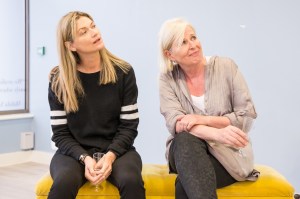 Jacqueline King is probably best known to SFB readers for her role as Donna Noble’s mother Sylvia in Series 4 of Doctor Who – but that’s just one part in a wide and varied career. She’s opening in new play Dark Sublime tonight, alongside Star Trek: The Next Generation’s Marina Sirtis and Sophie Ward, and took a few minutes from rehearsals to chat with Paul Simpson…
Dark Sublime sounds very intriguing. How did you get involved?
The usual audition process. I hadn’t met [director] Andrew [Keates] before, and I was first on the first week of auditions, 9 o’clock or whatever it was. That’s never a good thing – you’ve got all these women behind you going, “I could do it this way, I could do it that way.” Luckily he remembered me and he cast me.
 What attracted you to the part?
It’s one of the best written plays I’ve read for a long time. I’ve got a thing about doing new work – I just love new work and telling new stories, and being involved in theatre where people aren’t sitting there snootily going, “Oh I thought Dame Helen Mirren played this role!” I just like to be involved where people are coming because they want to hear something new and they want to hear the story.
This tells a beautiful story so wittily and so cleverly; it involves women of our age, which is so rare, and it involves gay women, which is so rare, and gay men, but doesn’t make an issue of anything. It’s not politicised. It’s very quietly getting on with it and saying these are delightful people and they’ve all got issues. It was a hoot.
 It sounds similar to the way Russell T Davies writes – these people are all part of what life is rather than the writer going “let us put a spotlight on…”
You’ve hit the nail on the head completely. I’m in awe of Russell T and it might be jumping the gun to put [Dark Sublime writer] Michael [Dennis] in that bracket straightaway but he’s heading that way, he really is. He’s got that same sensitivity, the same understanding of people, and wanting to talk about people in a way that isn’t banging drums.
Who are you playing?
I’m the best friend of Marina Sirtis’ character, Marianne. We’ve known each other forever and we are chalk and cheese. Everything she is, I’m not; she’s flamboyant and an actor and I’m very down to earth. It’s just lovely to see how much we adore each other as friends but how different we are, and our different approach to science fiction, which she was involved in years back, and what she thinks of it now. I don’t want to get too much into the plot.
 The fact it’s about her relationship with a fan has been publicised.
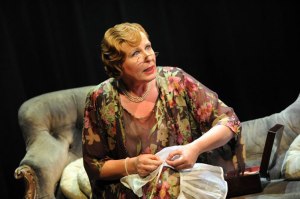
That’s the main theme, and my character is the outside eye with a raised eyebrow going, “Really? That’s what you do with your day?” I just love that.
You’ve been involved with the SF world – not just Doctor Who, but your audio work with Simon Barnard at Bafflegab (The Spanish Ladies Hammer Horror scared the living daylights out of me), and the MR James…
They’re wonderful dramas and so exciting to be part of.
 Do you find with television, stage and audio that you’re using different parts of your craft or is it as some people say, all coming from the same place but the trappings that are different?
I think it’s very different work. Of course you are using some of the same muscles, but if an actor blithely said to me, “Oh I’d like to have a go at audiobooks, I think I’d be very good,” I think I would be grinding my teeth a little bit. It’s not that they wouldn’t do a good job but I don’t think they’re taking into account the work involved – the preparation is enormous.
Where you’re the sole narrator, you’ve got to imbue every character with so much energy without using any physicality, you’ve got to imbue it with a truth that of course all actors are meant to do, there are so many techniques with radio mikes – today it’s easier because the technology is getting better and better. There’s a lot of work that goes into it; it’s not just a swan up into a room, say a few pages and leave. I think that’s what they think!
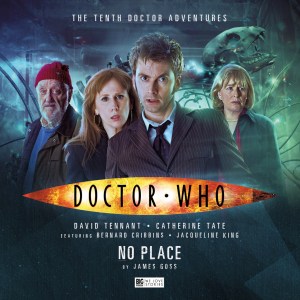 I loved your recent return to Sylvia Noble in James Goss’ No Place with the whole family: you could almost see Bernard Cribbins’ reactions in the background…
It felt like we were straight back where we were. We inhabited those characters for quite a while but there was a huge gap – something like ten years – and I don’t sit watching them on the telly, so we haven’t heard those voices for a long time. It was just bizarre – we got together in the room, had all the lovely emotional, personal catchup, walked into the studio and then suddenly all these voices were coming up. “Oh hello – look we’re back!” It was really exciting.
Was it a challenge to recreate the relationship between Sylvia and Donna on audio – a lot on screen is the physical reactions between you and Catherine Tate? There’s almost contempt from Sylvia to her daughter…
I always say that she loved her deeply.
You can have both!
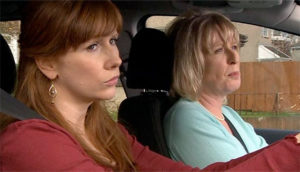 You certainly can. I think she despaired… I wouldn’t say contempt, but certainly despair.
Again, we’re going back to our first subject – as long as you’ve got a good writer, that is away of the media that he or she is writing for, then you’re in safe hands. You can use your voice to express things, little vocal expressions to add to the words, but at the same time, if those words aren’t spot on in character, you’re fighting an uphill battle.
What got you into acting in the first place – was it something you always wanted to do?
I did. I can’t remember a time when I didn’t want to do this. I wasn’t the brightest spark at school, I wasn’t ever going to be an academic, but that was never going to worry me. I was always going to act and I would apply whatever academic qualities I had to acting.
 What was your path?
I left the school I was at a year early so I could go to tech college and take a drama A Level, which our school didn’t do in those days, then went to Bristol Old Vic for two years. In those days you couldn’t become an actor unless you had an Equity card – it was that Catch-22 situation – so I had to wait a year in London while I was doing other things before I got my Equity card and then I was off. First job: Oxford Playhouse.
Has what you look for in a role changed over the years or has it fundamentally been the same?
I don’t think I’ve ever had a career plan; I don’t think you can as an actor. You’re in the hands of everybody else so much. I wanted to have variety, and I’ve certainly had that. I wanted to enjoy all the media, and I’ve certainly been able to enjoy that. I’ve also enjoyed – or maybe it’s post-rationalisation – not being a star, because the people I meet who are deeply famous I think their lives are much more difficult than mine. Mine is very easy; I can wander around my hometown unnoticed and do the shopping, and I like my life that way.
 Are there roles that you still want?
No, because I get excited by things like the play right now – it’s a brand new character that I would never have dreamed would have landed in my lap. I’m so excited to be presented with something that I love doing.
There are roles of course that when I was younger I thought I’d love to do that; but I’m too old now and that’s gone. The older women roles that are famous tend to be good old classical Shakespeare, which my husband specialises in and is stunning, and I wouldn’t want to compete with him in that (not that I would be competition!)
Have you worked together?
We did a whole season up in Scarborough with Alan Ayckbourn – we did a season for seven months called Ten By Ten. Ten actors doing ten brand new plays by ten playwrights…
 That was with Robert Shearman?
Yes, that was one of them. That was my introduction to Big Finish. I owe him!
Would you fancy directing, yourself?
No. I don’t want to minimalize the skill – I think the skill is phenomenal. I’m working with Andrew at the moment who’s considerably younger than I am, but he brings sagacity, wisdom, humour and caring into the room that is way beyond his years. That’s lovely. I think I’d panic!
My husband directed for the first time last year, and I was very scared in case he wasn’t as skilled in that area as he was an actor, but luckily he was brilliant.
Surely though on an audiobook where you’re narrating, effectively you’re self-directing?
Yes, I think inevitably we are. Sometimes you’ll get a really good confident producer who can guide you and say, “just do that one again”, or “you didn’t quite get that”. They’ll guide you in lovely ways. But essentially, you have to arrive ready directed by yourself; you can’t put all that on the producer on the day. They’re too busy – it would be too time consuming. It’s lovely if you do have someone who can help you be better – you can’t always be an outside eye, or an outside ear to yourself.
 What’s coming up for you after Dark Sublime? I presume it’s a limited run.
Yes, it finishes on 3rd August. It is very short. I think it should have legs and go on somewhere, because I think it’s worth it. I don’t always say that – sometimes you have to say, no this is a small play, just a small run, that’s very charming, let’s move on. In this case, I genuinely think a lot more people should have a chance to see it. We lose Marina for a little while – she has to go back to LA – so if people could just plan to house us after a little gap…?
With a new play, are you to an extent workshopping it when you’re in rehearsal?
To an extent… the writing is so good that we really don’t want to change much. There may be a tiny little bit of tweaking.
 Lines under the tongue sort of thing…
You might not be meaning to paraphrase but you’re putting it into a voice that you’ve found. I’m trying to stay very true to Michael’s words because I think they’re beautiful.
Dark Sublime runs from 25 June to 3 August at the Trafalgar Studios.
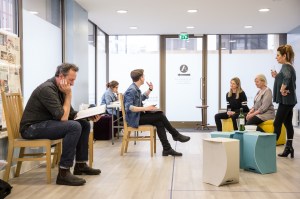
Rehearsal photos courtesy of Scott Rylander
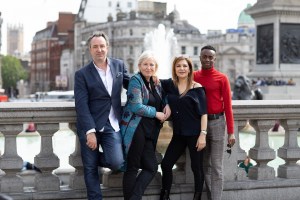
Cast shot (c) PND Photography
Thanks to Chloë Abley at CNC for assistance in arranging this interview
Click here to read our interview with Marina Sirtis about Dark Sublime
 Doctor Who News Star Trek News
 Sci-Fi Bulletin: Exploring the Universes of SF, Fantasy, Horror and Spy-fi!