Review: Zack Snyder’s Justice League
Determined to ensure Superman’s ultimate sacrifice was not in vain, Bruce Wayne aligns forces with Diana Prince with plans to recruit a team of metahumans to protect the world from […]



Determined to ensure Superman’s ultimate sacrifice was not in vain, Bruce Wayne aligns forces with Diana Prince with plans to recruit a team of metahumans to protect the world from […]
 Determined to ensure Superman’s ultimate sacrifice was not in vain, Bruce Wayne aligns forces with Diana Prince with plans to recruit a team of metahumans to protect the world from an approaching threat of catastrophic proportions.
I have a confession to make – I didn’t give the 2017 Justice League release that much of a hard time. I was so excited about such a movie existing that I was far more forgiving than I should have been. Subsequent home viewings have diminished how I felt about it, but it’s only now watching Zack Snyder’s version that I fully appreciate how far removed that first cut was from the director’s original vision.
At four hours, this is a monster of a movie, and I would imagine that most viewers will split it in half or chunk it up into hourly segments, much like the original plan of a four-part miniseries. The film is already conveniently split into six chapters and an epilogue, each chapter being a separate comic book to the movie’s collated graphic novel. But is it that different to the cinematic release, or any better? Yes and yes, in all departments.
Rather than contrast to the two versions, it would be easier to highlight what hasn’t changed. Of the four hours of material, about one hour was used before, meaning that 75% of what you’re watching is new. Joss Whedon’s jokey and tonally at odds material has all been excised, dropping the inappropriate jokes, the forced banter and exposition bombs. It’s also a much more serious film now, in line with Snyder’s Man of Steel and Batman Vs Superman. While I personally have no complaints, those who felt the preceding movies to be too dour and joyless will find nothing new here.
With the extended running time, everything gets a chance to breathe. The exposition is less rushed, and scenes runs longer instead of being edited within an inch of their lives. But most importantly, characters like Cyborg and The Flash now have a back story to justify their presence. No wonder Ray Fisher was so aggrieved with how Cyborg appeared in the original cut – we didn’t get to know him or feel his pain.
Ben Affleck shows just how world-weary he is as Bruce Wayne, even if his Batman doesn’t have an awful lot to do beyond supplying the vehicles. Wonder Woman is much more brutal here, slamming villains against walls, pulverising or decapitating as required, and thankfully Aquaman is less of a ‘duuuude!’ Californian surfer, showing his trident-spearing acumen as an Atlantean warrior. Superman still turns up late in the day, but check out his new threads and hurrah for the lack of a CGI-removed moustache.
As it’s a Snyder movie, there’s lots of CGI slo-mo and hero shots. It’s what he does, and if you’re not a fan of this heightened heroes-as-deities look, you’re in for a hard time. The score by Tom Holkenberg links in well with his work on Batman Vs Superman, with refrains of Han’s Zimmer’s Wonder Woman and Superman themes to add further continuity. I actually liked Danny Elfman’s score for the previous cut, but that was a very different movie.
Villain Steppenwolf is now a far greater defined (visually and in performance) adversary, no longer being the big bad, but the foot soldier for bigger threat Darkseid. We’re even treated to a coherent, detailed explanation as to what the importance of the Mother Boxes is, and where the Parademons have come from.
On a technical note, the movie is presented in what approximates to a 4:3 ratio, meaning that you get black bars down each side of a modern TV screen. The upside is that you get more of the picture and it’s closer to the IMAX experience, and I seem to be in a minority in being distracted by this choice.
The greatest disappointment is that this cut is setting up possibilities for subsequent entries that will no longer come to pass, the Snyder version of these characters now seemingly on course corrections with the subsequent jokey Aquaman and a recast Caped Crusader in The Batman. The epilogue provides a good indication of what might have been, and for now we should settle for that.
Verdict: Against all odds, Zack Snyder gets to share the film of Justice League that we wanted to see all along. In a world of streaming, binge-viewing, its length is no issue, as it can be consumed by chapter or as an epic long-haul. Long live the metahumans. 9/10
Nick Joy
Bruce Wayne and Diana Prince’s quest to unite the meta humans of Earth into a team capable of defending it becomes a lot more urgent with the arrival of Steppenwolf, here to reclaim the awakened Mother Boxes and unleash devastation on the planet in the name of his master, Darkseid.
I am on record as not having thought much of 2017’s Justice League. Huge stretches of it made no real sense, the villain was so generic as to feel more two dimensional than the pages from which he’d been lifted, and a drastic change of colour palette which clashed with the costumes made it as visually incoherent as it was narratively troubled. Whedon’s trademark quippiness of dialogue and moments of levity felt as unearned as the gravity with which Snyder had tried to invest Batman v Superman, and all in all, it was a bit of a dog’s dinner.
I recount this not merely to set the scene for this new cut, but to explain why elements of it took me very much by surprise. The theatrical cut of the film felt so poor that I honestly paid little attention to the stories around its completion, and less to the press surrounding this new cut. I had therefore expected a similar turn of events to the Ultimate Cut of BvS, whereby unused footage from the theatrical version would be re-added, and would maybe fix some plot holes, make the narrative more consistent but ultimately (pun intended) make the movie no objectively better. What I got, therefore, was something entirely unexpected.
It’s also important to record, I feel, that I watched the Snyder Cut in preparation for this review twice, with a viewing of the original cut squeezed between, so I could get a full and proper appreciation of just how different this film is. As Snyder promised, none of the re-shoot material completed by Whedon is included. What I wasn’t prepared for, in hindsight, was just how much material that would account for. I’d say less than half of the 2017 version is in here, and whereas certain of those elements are obvious for the tics and trademarks of Whedon, others are genuine surprises.
But for those already impatient, let me set out the short answer to the inevitable question: Is it better than the original 2017 cut? Yes. Unquestionably. Is it a great superhero movie? That’s a bit more complicated.
 What it absolutely is, is a Snyder movie, to its bones. What that means is that it goes from the sublime to the ridiculous and back again throughout its nearly four-hour running time. It means we get the signature Snyder look – all de-saturated colours which bring out the costumes and sets in a way that the 2017 version, with its gaudy, Marvel-influenced palette, could never achieve. It means we get a Junkie XL score that feels properly matched to the tone, themes and characters of this particular universe in a way that Danny Elfman’s understated, hybridised medley could never hope to achieve. And most of all, it means the movie actually ties in to the various plot hooks laid out in BvS and Man of Steel in a way that the previous version of the movie did not.
It may also be the best work that Snyder has committed to film. Certainly while it has the bombast and energy we’ve come to expect from this unique director, it also shows evidence of growth and refinement. BvS felt like Snyder’s understanding of ‘epic’ was ‘long’. Here, he shows a sense of reverence to the characters with which he is dealing that was absent somehow in that previous work. It’s almost as if, like his own version of Bruce Wayne, having shattered the team he played with in that previous movie, he is working here to glue those pieces back together, stronger.
Affleck’s Wayne, absent here the re-shoot scenes which seemed, between writing and Affleck’s own apparent lack of enthusiasm, designed to signify the imminent retirement of both character and actor, is instead energised. This feels like the same character who was easily the strongest part of BvS, a man who carries emotional trauma and constantly buries it as deeply as he can in order to do what he feels must be done. There’s an edge of lightness to him as well, undoubtedly as a result of spending time with other people, not least of whom is Diana herself. But unlike the previous version, this is expressed mainly through subtext, rather than in goofy quips (a theme that carries through all the characters). It was easy to believe at the time that, having seen the response to BvS, Affleck just wanted out. Now, having seen this new version, I truly believe that had tragedy not struck the Snyder family and seen the director have to step down, we might be seeing Affleck in the cowl for Matt Reeves’ The Batman.
 Diana, for her part, gets so much better treatment here though still has to carry a little bit too much exposition in order to drive forward the plot. For starters, scenes from the theatrical cut which are still used here are cropped effectively, removing the pointed fascination of the camera with Gal Gadot’s backside. There is one scene in particular where this is painfully obvious in a side by side comparison. Additionally, the removal of re-shot footage and reinstatement of Snyder’s original material completely alters the narrative arc and voice of the character. 2017’s version felt like she was almost apologising for being there half the time, and the bungled ‘I’m not sure I want to be a leader’ arc, which tied in with that version’s Bruce Wayne not wanting to be there anymore, felt ill-judged after her solo film. Here, we get instead the Diana we know and recognise – powerful, confident but still prone to the odd mistake, though strong enough as a character to learn and grow from such errors rather than shirk from acting and risking making them. Gadot has always been an ideal choice for the role, and this movie reinforces that, while highlighting some of the weaker choices made by Jenkins for her recent sequel. In fairness, one of the ridiculous moments belongs to her, a throwaway exchange with a young girl that feels so painfully shoehorned in that you’d swear blind it was designed by a committee (of men). But it’s one moment in an otherwise strong showing for the character, in a script which is neither afraid of Diana’s strength or her flaws.
Jason Momoa’s Aquaman here gets an outing which somewhat mitigates against certain elements of his own solo movie. Like everyone else, he benefits from the absence of the reshoot footage, coming across far more like a quirky loner and far less like a surfer ‘dudebro’. The script takes time to acknowledge, in brief but important exchanges, the gulf which should exist between Diana and Arthur, as representatives of different and traditionally antagonistic races, which helps to subtly build part of the narrative of the team coming together. There’s thankfully no need for Arthur drooling over Diana’s looks here, which also helps. We also see more underwater stuff – greater (and different) dialogue exchanges with Amber Heard’s Mera as well as with Willem Dafoe’s Vulko who is returned to this cut. These latter are the parts which slightly muck around with elements of the character established in his solo outing, but since it’s been made clear that the Snyder Cut is a cul-de-sac creatively, that’s not likely to be an issue going forward.
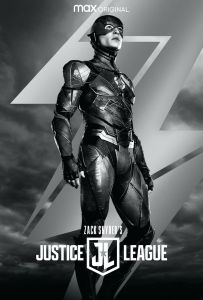 Ezra Miller’s Flash also gets a lot more screen time, and is far better realised here in a variety of ways. Different elements of his power other than just his flat out speed get fully explored for one, with several providing pivotal points to the plot. His own character of Barry Allen is properly done justice as well. We get less out and out goofiness and more of a sense of the awkwardness of the youngest member of the team. Unlike the 2017 cut, there’s less a feeling that Barry is a DC reskin of Peter Parker, and more the sense of a troubled young teen who wants to do the right thing. In particular, there are elements of the character which again change significantly here to give us a hero instead of a bit of comic relief.
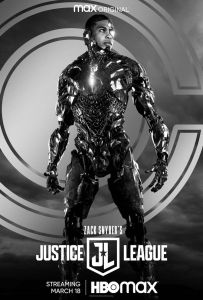
But perhaps the biggest winner overall here is Cyborg. Regardless of whatever personal issues Ray Fisher might have with the studio or with Whedon, having seen the Snyder Cut I can appreciate why the actor might have been disappointed with his character in the theatrical version. Here he has an arc which he utterly lacked in that film. Here, he has a developed character with important parts of his pre-Cyborg life feeding into the person that he becomes. Here, he’s a man in control of his own destiny before he joins the team, a man confident in and in control of his powers rather than at the mercy of them or being cajoled into trying to use them by others. It’s no exaggeration to say that between many more scenes, a strong narrative arc and a fuller, deeper investigation of his powers and capabilities, Cyborg here is a crucial – possibly the crucial – member of the team, where before he was essentially a walking plot device, there to deal with the MacGuffin at the end and say ‘Boo-yah’ where required.
As for Clark Kent. Well, for starters you won’t have that weird, digitally altered mouth to distract you from proceedings – again, all those scenes are gone. I was most concerned about the use of Supes in this because of all the characters in the 2017 version, Supes was easily the best (at least in the last 20 minutes). Watching Cavill get to ‘have fun’ with the part gave an insight into what we might have enjoyed from the actor had he been in different hands. Or so I thought.
Instead, the slightly more serious tone the character adopts here actually works, because it is coupled to an earnestness that is key to the character in whatever iteration. This Clark is not pushed into going to Do The Thing by a Lois cynically deployed by Bruce to calm him down, but instead chooses to go and join the fight once his mind has cleared. And when he arrives, he is alive to the gravity of the situation facing our heroes and approaches it accordingly. In hindsight, 2017 Justice League gave us Superman as a quippy Deus Ex Machina, there to breezily save the day single-handed while quipping away and flying out skyscrapers full of civilians in the moments between. Here, we get a serious-minded, earnest Clark Kent who wants to honour both his fathers and save humanity one more time because it’s the thing to do and he’s got the ability to do it. Suddenly, we possibly get to see the start of an entire arc Snyder had planned for the character, and I’m not as convinced as I might have been that it wouldn’t have looked pretty damned majestic in hindsight.
 As to our villain, while the internet may have laughed that Steppenwolf had simply been made more shiny and spiky, in truth, that’s only the start of the aesthetic differences, let alone the shift in tone and arc to the character. This Steppenwolf is no giant humanoid but a truly repulsively alien creature, with oddly jointed, multi-fingered hands, more pronounced horns and a vicious streak that feels more visceral and believable than it did before. Gone are the constant imprecations of ‘Mother’ (thank goodness) and in their place is the perfect sub-villain – a character who’s vicious and cruel but also subservient to a bigger bully (as all bullies are). Darkseid, in truth, plays little direct part here, being more the Big Bad in the Shadows whose arrival is foreshadowed by Steppenwolf, but the very fact he gets proper acknowledgment here actually serves to raise rather than diminish Steppenwolf as a character. One suspects that, given the way the film ends, Snyder had plans for Darkseid to play a bigger role in the originally planned Part II, but whether that will now see the light of day remains to be seen. Nevertheless, Steppenwolf here just makes more sense, from the details of his actual evil plan to the way in which it is executed, and though he arguably still suffers the perennial MCU villain issue of being one and done, he’s more three-dimensional and interesting here than he ever was in the 2017 version where he was supposedly the ‘sole villain’.
If all this sounds like I am describing the perfect movie, don’t forget that I started this review saying that it has moments of the ridiculous as well. The very opening moments, while certainly tying in to Snyder’s own vision of the universe, are one of the silly moments for me, though in fairness they provide an explanation for something the previous version handwaved away. There’s the aforementioned shoehorned moment with Diana. There’s also the sheer pretentiousness of the periodic title cards arbitrarily declaiming ‘Parts’ of the movie (one to six) plus the ‘Epilogue’ which itself runs to nearly a half hour of screen time and somewhat rambles a little, almost as if Snyder doesn’t quite know how to end it and tie off all his plot points while setting up more.
There are also a few odd plot choices in there. The much-mooted cameo of a ‘surprise character’ is exactly who the internet had predicted and won’t blow many socks off. Worse, the way in which the character is inserted actively undermines a strong performance by a cast member I personally feel has been one of the stronger elements of the Snyder Verse, and that feels like a misstep, given the good stuff here. The other addition – of Jared Leto’s Joker – is disappointing in that it feels as if the actor has been told to try to channel the late Heath Ledger’s version of the character – something which is both outside Leto’s bandwidth and which clashes with his version of the character and the environment of the movie itself.
 Finally, there are some parts of this which are basically just extended scenes which don’t add all that much. Much as I respect the particular vision of the director and his more than understandable impulse to fully reclaim his movie after the weird, disjointed hybrid that was Frankensteined out of his footage by the studio in 2017, there is stuff here that could easily have remained on the cutting room floor for this reviewer. None of it bad, per se, but just unnecessary and adding to a run time that’s honestly a bit too long.
Unlike Endgame, whose three hours and some minutes simply fly by every time I watch it, you really feel every one of the not quite four hours that Snyder Cut delivers. That’s not to say that it’s painful exactly, or even that it drags. It’s narratively dense in many ways, partly helped by Snyder’s refusal to shy away from the mythical gods and monsters elements of the DC universe and its players. But it is a lot of movie, and whereas it’s quite possible to consume it in one sitting, it’ll leave you feeling a little worn out by the end of it. It also has a quite natural midway point that could have easily been used to cut it into two movies rather than the odd slicing of ‘parts’ which serve no real purpose and indeed are all unevenly sized anyway.
Ultimately, if the purpose of the movie was to satisfy Snyder fans, I suspect it won’t succeed. Not because they won’t find plenty to enjoy, I think they absolutely will. But Snyder leaves so many threads to be picked up by a future movie that it feels inevitable – as others had already predicted – that #releasethesnydercut will morph into #returnthesnyderverse. Nothing which has followed – be it Shazam, Aquaman or Wonder Woman 1984 – really fits with the groundwork that Snyder lays out here, and that means that those who love the vision he brought are likely to be left wanting more.
For everyone else? It’s certainly a better movie than its previous version was by any definable measure. It also shows a growth in the director and a long-term narrative intention which is both interesting and intriguing. It’s also, as I said, a Snyder film to its core. It takes itself so intensely seriously that it can’t help but stumble close to parody in its (occasional) weaker moments, and not every decision it makes is the right one. Moreover, it doesn’t (unlike the previous version) even try to compete on the same playing field as the MCU. It’s unapologetically dark, moody and sombre. Its desaturated visuals work for the way the movie was intended to be seen, but feel washed-out and grey next to the vibrancy of both the MCU and the more recent releases from WB/DC. In a sense, it feels simultaneously like a relic and something entirely new – just one of the many contradictions which lie at the heart of it.
 It feels like a movie from which you will take out what you bring in. I suspect those coming to it expecting greatness will see greatness. I similarly suspect those coming to it either not as fans of Snyder specifically or his vision of these characters will not come away having had their minds significantly altered.
But approach it with an open mind, be prepared to accept its moments of sheer brilliance equally with its moments of silliness, and you will certainly get a unique experience from it. There is no other superhero movie out there which is this long, this dense and this committed to its tone and structure. There is nothing so firmly rooted in big ideas that mostly shouldn’t translate well to the screen, and there’s nothing else in the genre that so perfectly exhibits the difference which two separate directors can pull from the same actors and material. It is, if nothing else, a masterclass in what can be done. And if that isn’t the most fitting real-life metaphor for these characters from what many might consider to be a most surprising source, I don’t know what is.
Verdict: An epic, sprawling adventure which surprises in more ways than one while also not quite being the flawless masterpiece that its fans might have hoped for. 7/10
Greg D. Smith
Zack Snyder’s Justice League will be streaming on Sky Cinema and NOW TV in the UK, and on HBO MAX in the US from March 18.
 Doctor Who News Star Trek News
 Sci-Fi Bulletin: Exploring the Universes of SF, Fantasy, Horror and Spy-fi!