Review: Captain America: Brave New World
Starring: Anthony Mackie, Danny Ramirez, Shira Haas, Carl Lumbly, Xosha Roquemore, Giancarlo Esposito, Liv Tyler, Tim Blake Nelson, and Harrison Ford. Directed by Julius Onah Disney, out now Read this […]



Starring: Anthony Mackie, Danny Ramirez, Shira Haas, Carl Lumbly, Xosha Roquemore, Giancarlo Esposito, Liv Tyler, Tim Blake Nelson, and Harrison Ford. Directed by Julius Onah Disney, out now Read this […]
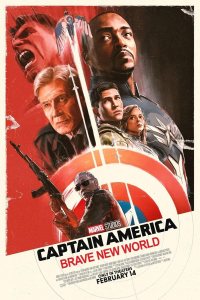 Starring: Anthony Mackie, Danny Ramirez, Shira Haas, Carl Lumbly, Xosha Roquemore, Giancarlo Esposito, Liv Tyler, Tim Blake Nelson, and Harrison Ford.
Directed by Julius Onah
Disney, out now
President Ross summons Captain America to a meeting of world leaders at the White House…
This is the one and only time I’m going to ask you to read what I think before going to see a film. Why? Because Captain America: Brave New World is a film out of time and place with the cultural context into which it arrives. As such it is going to suffer from, I expect, fully half those seeing it in its home market hating it for daring to exist and the other half not knowing how to engage with a film that feels quite so starkly out of kilter with real life.
Except I don’t think it’s out of kilter. At least not in the way you might expect. Sure, there’s a lot of groundwork at the beginning because this is a movie with a twenty-year backstory but it’s handled perfectly adequately.
What’s much more interesting is that this is a movie whose central story is about stopping people fighting. A film where two men of colour get to be strong and kind and compassionate and that makes them the heroes. Yes, there’s plenty of smash, bang, wallop but at its heart it’s a story asking people to talk, to dignify those different from them with time and respect.
Now, some of that feels a little too centrist, especially when two men of colour are the loci for this conflict. Except Harrison Ford plays this straight as a powerful man who’s done some terrible things, been responsible for some heinous acts and who is trying to own them. Now that is a fantasy right there; that a powerful man will accept he’s done wrong and accept the consequences.
This isn’t an easy journey either for Sam Wilson or Thaddeus Ross. For one it’s because as both a Black man and an ordinary man following in the footsteps of a demi-god he faces the pressure of always having to be on point, of always having to be the conciliatory presence, the even toned man when he has every right to be angry.
 Ross on the other hand, has no right to be angry, but can’t help himself when he feels the important man he wants to be is being questioned. Ross’ natural state is to seek revenge, to dish out retribution and make those who differ from him suffer for daring to exist. Except he wants to be someone else, someone better. Like I say, it’s a fantasy.
It also puts this movie over the edge from being centrist both sides nonsense (why don’t we admit that fascists have good points???) to being much more counter cultural, much more about what it’s like to resist angry powerful men who want you to fear them, who want you to bow down and do what they say.
The antagonist in this, Samuel Stearns, is someone who, ultimately, wants Ross to embrace his hatred and desire for revenge, it’s part of the fantasy that despite his past, Ross is capable of change. It’s the weakest part of the film but also necessary for the fantasy to work. Where it does work is in how it charts the inevitability of abuse breeding abuse, of cruelty and revenge hollowing us out and living on as cancerous legacies.
If we want our heroes to win through de-escalation and, ultimately, passive political resistance one version of the story insists that the enemy has to be capable of change, of hearing us.
I’m not sure that stands up given the time and circumstances of where the film has landed but it’s also a bit of a reminder that people who differ from us aren’t inherently our enemy (unless they’re, you know, actual fascists) and can be reasoned with. It can be too easy to forget that other human beings can be reasonable people too.
I’m not going to set the world to rights here (despite my urge to do so), but it’s worth noting that the true counter cultural moment here is for ordinary people to resist, to unify and act together, and there’s no space for that in this kind of story. Its boundaries rely on Sam Wilson being the cool man in the middle of it all, rising above the prejudice he receives, stepping around the abuse of power and shouldering responsibility.
It’s a playbook for how to resist in that sense.
This films cares about the world in which it exists. It also knows just how hard it is to build solidarity and just how easy it is for bad actors to destroy it. I wonder often how easy it is to destroy communities – I struggle with the why of this, the sense that something so strong in some directions is so brittle in others. Brave New World puts it on the screen – people want different things and fear that, no matter how much they have in common with others, in the end we might lose what we want because others do us wrong.
It takes a lot to build community, it’s a fight in which we don’t recognise our victories enough.
Verdict: Brave New World rides against the tide in that it pleads with us to remember that we’re stronger living for one another than we are seeking our own gain at others’ expense.
8/10 counter cultural moments
Stewart Hotston
 Doctor Who News Star Trek News
 Sci-Fi Bulletin: Exploring the Universes of SF, Fantasy, Horror and Spy-fi!