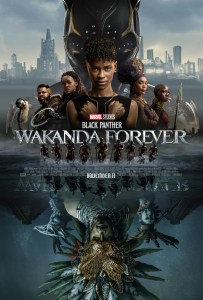
 Starring Letitia Wright, Lupita Nyong’o, Danai Gurira, Winston Duke, Dominique Thorne, Florence Kasumba, Michaela Coel, Tenoch Huerta, Martin Freeman, and Angela Bassett.
Directed by Ryan Coogler
Disney, out now
Following the death of T’Challa, the people of Wakanda face multiple challenges…
There is a long complex shadow over this film and it belongs to Chadwick Boseman. The actor died of colon cancer in August 2020, an illness he’d kept from all but his closest family.
In creating Wakanda Forever, Ryan Coogler has worked through the grief of those who knew Chadwick within Marvel with tact and care.
The first five minutes of this film had me in tears and it is a most carefully dignified tribute to someone who was dearly loved by those who worked with him. It is quite something when an opening crawl can reduce an audience to thoughtful and heavy silence.
The love and memory of Boseman doesn’t stop there though. The entire plot and emotional complexity of this film is one that starts with his death and its impact on those left behind as well as on what it means to die, both for those who grieve and for those who go. It ends with the sun rising on something new. It is a perfect arc.
Shuri, played by Letitia Wright, is a challenging character to walk in T’Challa’s footsteps. She does not ooze the seemingly effortless charm of T’Challa. Nor does she have the open vulnerability of that character. The challenge for Wright is to climb that mountain with a character who, it seems, has only ever had the good life until now.
The film allows Shuri to explore her grief in her own way, and the buttoned-down emotional pain trying to be processed by someone who doesn’t have the tools to manage it? I think it’s handled really well. I’m not sure all audiences will appreciate the fact Shuri’s experience offers no easy answers but I liked it a lot.
With the loss of her father and her beloved brother before the film even really starts Marvel had two choices. The first was to ignore its impact and essentially reboot the franchise or to lean into the pain and emotion of what had occurred and create something worthy of being called legacy.
Coogler and Disney opted for the latter and I think it pays off.
This isn’t light-hearted and in many ways this complexity around the arc of emerging from grief, of processing loss, turns in an MCU film unlike any other. If WandaVision tried to explore the trauma of unresolved grief and loss, this film presents a far more coherent exploration of what it means to process loss, especially the incomparable loss of those we love with all our hearts.
Having said that this complexity is not without its challenges. There are two films here. The first is processing the loss of Chadwick Boseman. It’s everywhere in the fabric and texture of what is on screen and in the (frankly) astounding soundtrack.
At the same time we have more standard MCU themes of conflict and an adversary who threatens everything our protagonists hold dear. This comes in the shape of K’uK’ulkan, or Namor to his enemies.
Namor gets some solid development and, once again, it’s hard not to sympathise with his complaints while also rejecting his bizarre mad villain of the week conclusions about how to deal with those he finds offensive.
To be clear his objections are around the damage of colonialism, how it wrecks those it encounters and then justifies its acts of extraction and ruin in the name of perpetuating itself.
As if the film recognises that Killmonger was right, there are hints and numerous comments about how Wakanda is wise to be suspicious of those around it and their ambitions. Most of all, we see those colonial mindsets in action and I was warmed that rather than simply act to maintain the status quo regardless of those complaints the film addresses them in something that feels bigger than this individual story. The US in particular is shown to act imperiously (in every sense of the word) regardless of the risks to its own safety, as if the imperial mindset cannot see how it sows the seeds of its own destruction in its rampant desire for the world to subjugated to its hegemony.
This also gives Namor depth that Killmonger didn’t quite get and his emotional heft is much more substantial as a result. Rather more lacking are his Talokan friends who are on screen and about as fleshed out as Thanos’ cronies in the Avengers movies. This is a huge shame because this would have further given us insight into why Namor does the things he does.
The problem is that Wakanda Forever is already a very long film. There is no room in its runtime to give these secondary characters more development. The same can be said for many of the Wakandan secondaries too except they benefit from appearing in their second movie and, in doing so, their fleeting appearances start to add up to being actual characters.
In other words, this could have been a ten hour epic exploring Namor’s culture, Wakanda and their interaction with one another and with the US and I would have been glued to every moment.
Instead we have the ‘superhero’ side of the plot woven extremely carefully but lacking the punch that the first Black Panther film delivered because it’s over complicated.
When I say that, I’m not bemoaning films which make you think. What I mean here is that the structure of the relationships are too complex to fit into the film and so both they and the film suffer as a result.
We have the CIA, the French, the UN, the Wakandans and this new nation all coming together and acting largely antagonistically towards one another.
Add in a plot about a young engineer who acts as the fulcrum around whom they all revolve and there are simply too many elements in this script to allow you to rise and fall with the story.
I think we could have lost one of the films struggling to be told here and the film would/could have been the same runtime while being narratively leaner.
That’s not to say it’s bad. Wakanda Forever is fantastic. The action scenes are, largely, weighty and feel meaningful. This is in part because the film takes risks. There was a moment when I turned to the person I’d gone to see this with and said ‘they’re going to die’ and I didn’t know if it was true or not – in a franchise which routinely allows people to survive bizarrely violent but weightless encounters with nothing but a couple of hairs out of place, this is surprisingly good film making.
I wasn’t in any doubt that Coogler would deliver but the complexity of this film, emotionally as well as in its choices about world building and the arc it really wants to follow, have me wishing the superhero elements could have been toned down in order to let the human drama shine.
In other words I’m not sure this film wouldn’t be better if it was simply a political thriller.
And that’s where politics does come into it. The choice to set some of the story in Haiti, the talk about colonisation, the nature of the threats being faced by Wakanda are all political in nature. This is great stuff and, although gentle, it’s also pretty on point.
Adding to this the largely female majority PoC cast and there are risks all over this film and, honestly, all these decisions work. This is a film in which the characters largely exist on their own terms without needing the permission of others and it’s wonderful and uplifting and about bloody time.
It’s right to argue that young women need to see these kinds of role models but it’s both a valid argument that at the same time somehow misses the point. Everyone needs to see women making choices, mistakes and choosing their own lives normalised. My son needs to see this. I need to see this. We all need to see this and rather than make this the point of the film, it’s just there. A matter of fact while the story gets on with telling its tale. That’s the power of what Coogler has done – this is just story telling.
Wakanda Forever is undoubtedly a complex tale. It works almost everywhere except one or two places where it is, as expected, forced into the MCU mould. I’ve talked about that elsewhere so I won’t recap here. Suffice to say it’s worth your time and has a soundtrack that is extraordinary. Not since Into the Spiderverse have I come out of a film and immediately downloaded an entire soundtrack.
Verdict: All in all, Wakanda Forever is a brilliant sequel to Black Panther that makes the right choice in how it handles the loss of Chadwick Boseman. It’s a complex film, emotional, action packed and tells a proper story. I loved it.
Rating? 8 shadows of grief out of 10.
Stewart Hotston




 Sci-Fi Bulletin: Exploring the Universes of SF, Fantasy, Horror and Spy-fi!