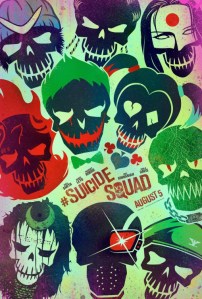
 With the reception for Dawn of Justice proving oddly mixed (an $855million total worldwide box office but mostly negative reviews from critics), WB/DC really needed a firm entry in the ‘win’ column if they were ever to start making up ground on rivals Marvel and their MCU. Gaining the talents of David Ayer to both write and direct a colourful film about some of the more famous villains in the DC canon seemed like a bold move, but early trailers indicated that maybe this could be the DCEU movie that could combine the dark tone of the series to date with some much-needed humour and colour. Hopes were high, but, asks Greg D. Smith, could this be the film that turned around the fortunes of the franchise?
In the wake of the death of Superman, government agent Amanda Waller proposes assembling a taskforce composed of dangerous but talented criminals to do the jobs that need doing for which ordinary measures will not suffice. But when the most powerful member of ‘Task Force X’ betrays them and goes rogue, can the others put a stop to her before it’s too late?
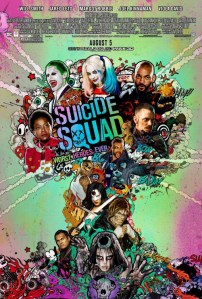 It was no secret by the time Suicide Squad was nearing release that the DCEU project was having issues. Although financially successful on the surface, rumours swirled incessantly about just how much money had been spent on Dawn of Justice in terms of marketing, reshoots etc which meant that even nearing a $1 billion box office takings worldwide, it wasn’t even breaking even for the studio. Many blamed Snyder’s overly dark, gritty take which was suffering badly by comparison to rivals Marvel’s MCU, with its bright colours and more light-hearted approach to its material. The news of a movie about the Suicide Squad, a collection of villains used by the government in the comics to do the jobs nobody else can and be hung out to dry if it goes wrong, seemed to have more than a slight whiff of Guardians of the Galaxy about it. Mismatched bunch of rogues? Check. Powerful soundtrack? Check. Brighter, more outrageous palette than its stablemates? Certainly the trailers suggested so. And most importantly, fairly obscure part of the comics to anyone not actually versed in them? Check.
And yet, when it arrived, Suicide Squad proved just as divisive as its predecessor. Financially successful (even winning an Oscar), it received negative reviews across the board from critics and did nothing to rehabilitate the image of franchise or studio. So what exactly went wrong?
On this re-watch, the first thing which struck me was how the movie has a very similar issue to BvS before it – i.e. it asks the viewer to invest a lot in characters we have only just met. However, Suicide Squad seems to recognise this and try to address the issue in a way that in fact makes it much worse.
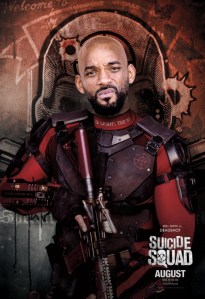 Scattered throughout are flashback scenes which introduce us to certain characters and help to flesh out their back story. Some of these are just done as part of the movie speaking directly to the viewer (mainly Will Smith’s Deadshot and Margot Robbie’s Harley Quinn) while the rest tend to be done as part of exposition scenes from the characters themselves as they reveal themselves to their comrades. All suffer from the same issue – they each suggest far more interesting stories than the main narrative of the film.
It’s no coincidence that the majority of these scenes go to Smith and Robbie, with Deadshot and Harley set up as the main ringleaders of the gang as the film progresses. With Deadshot, one suspects it was the only way that the studio could find to get Smith to sign on – playing villains isn’t usually his oeuvre and so the film tries very hard to make him a relatable antihero, but unfortunately a combination of Smith’s natural screen presence and charm and awfully dissonant, inconsistent writing means that he ends up dropping the ‘anti’ part and just becoming a sort of heroic father figure to the squad. The fact that his motivation revolves around his innocent young daughter and how much he misses her reinforces this impression, and leads to some major dissonance in tine when one considers that the character is also an assassin for hire who we actually see murdering someone about to give evidence against the mob. Smith and the script work so hard to rehabilitate a character who is clearly unpleasant that they even insert a specific dialogue exchange where it’s revealed that he refuses to kill women and children. This is presented as some sort of cornerstone of his underlying morality, rather than an arbitrary distinction in someone who kills people for money, and presumably does so on behalf of people who have no such qualms, and it all just clashes horribly with both the figure the film wants Deadshot to be, and the general vibe of a movie about a team of ‘villains’.
 Robbie is better served, by the script if not by the wardrobe department. It makes sense that Harley’s comic book harlequin outfit wouldn’t quite have worked, but was it really necessary to go for the tiny hotpants, crop top and fetish collar together with high heels and fishnets? As the only woman in the squad (Katana, remember is simply Flag’s bodyguard, not a member of the team itself) it’s disappointing to say the least to see Harley reduced to a visual eye candy role. Though Robbie defended the choice for the character, it’s hardly surprising that she also confessed to feeling uncomfortable in the outfit on set.
However, Robbie’s talents as an actress mean that there is seldom a dull moment when Quinn is on the screen. Suffering to a lesser extent from the flashbacks being more interesting (though they are – who doesn’t want to see the tale told of how a successful criminal psychiatrist becomes so entranced by a master criminal as to become the damaged, spiteful mess that Harley is?), Robbie’s at her best in the role when she gets to bounce off others, declaring she’s after a mind to pry apart and spit into, serving drinks to the others or introducing herself to Katana and insisting to the rest that ‘she seems nice’. Less interesting is when the script wants her to bend over for the camera, or have her remind us how ‘we’re bad guys’, but overall Robbie overcomes the script to be the most interesting thing in the film, and it’s hardly surprising that to date, her character is the only one from the movie with a confirmed next film (Birds of Prey).
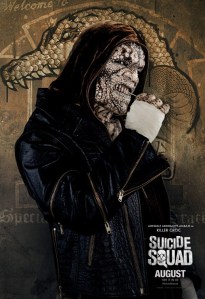 Elsewhere, there’s slim pickings. The rest of the Squad themselves get little in the way of background or character. El Diablo comes off best, relatively speaking, with an actual back story that once again dials up the dissonance by painting a picture of a drug-dealing gangbanger who loses his temper (and control of his powers) one day and murders his wife and children. Portraying the current day Diablo as a man of peace, determined not to raise his fists in anger again, the movie wants us to sympathise with him, not least because that gives meaning to his sacrifice as part of a redemption arc. The main issue I have with that is that we see footage of him murdering an entire prison yard full of inmates which has to have happened after his killed his wife and kids, and the film doesn’t see fit to give us any solid reason why he suddenly decided he didn’t want to be ‘that guy’ anymore, nor any real reason to believe that he’s sincere. Add in that all it takes is Deadshot getting on his case for less than a minute to see him unleash his powers again and it’s just a paper-thin set of clichés masquerading as an arc.
But that’s high art compared to the rest. Captain Boomerang? Well, he has boomerangs and likes pink unicorns. Killer Croc? He looks like a crocodile and eats people. Slipknot? He’s there to get his head blown off and serve as a warning to others. Oh, and he climbs things and hits women. Flag is a special forces soldier who is in love with June Moon (yes, really) and June herself is the dowdy alter ego of Enchantress, a witch whose particular power seems to be standing around hula dancing as she conjures that most timeless of comic book endgame threats – a blue sky beam. Amanda Waller – played here by the supremely talented Viola Davis – is the instigator of possibly the worst and most incoherent plan ever assembled by a movie character, and is also a ‘mean lady’. Talented as she is, the script gives Davis nothing to work with.
 And that plot – well. Leaving aside the nonsense of assembling a team of master criminals and an all-powerful witch to take on ‘meta human threats’ – why is the rest of the team necessary – there’s the ‘gotcha’ moment the movie tries to have about halfway through when it transpires that the team (and the platoon of soldiers they’re sent in with) are there to rescue Waller herself, before going on to defeat Enchantress. Why they do this in this order is unclear. Waller is safely enough ensconced in a secure building. It would make far more sense to go after the actual threat first. This is proven when mere minutes after she’s ‘rescued’ (having shot the other people working for her just to prove how very bad she is) she gets captured by the arch-baddy. One has to assume this wouldn’t have happened had she just stayed where she was.
Quite why it takes Enchantress and her brother Incubus (who we needn’t detain ourselves with here as the movie certainly doesn’t bother) more than half the movie’s run time to concoct their ‘machine’ to destroy humanity, or why it’s so easily destroyed by a conventional explosive (which again begs the question why it takes this ‘Task Force X’ to do any of this at all) is never made clear. Like so many of its odd double standards, leaps of logic and nonsense, the movie just expects you to go with it.
 Oddly, the only vaguely coherent part of the narrative is the sub-plot involving Leto’s Joker and his quest to retrieve Harley. Here we have a character with a motive (retrieve his lover) who instigates a clear plan (bribe one of her guards to slip her a phone so he can get in touch with her and then raid the place that makes the device she’s got implanted in her neck) and follows through on it. As much as many fans railed against Leto’s portrayal of the character (and the absence of the character in much of the movie, given how much he featured in its promotion), the Joker/Harley subplot feels like the only part of the movie that the director wanted to make and the writers wanted to write. More than any other part, this feels like a narrative that would be better served if we had spent more time seeing the lead up to it.
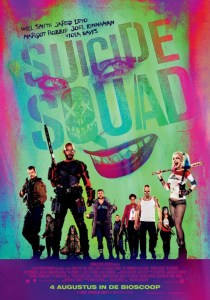 Is it all bad? No. As I’ve said, the performance of Robbie is far in excess of what the script she gets to work with deserves or should be capable of producing. Smith, for his part, turns in the usual reliable Smith performance, all quick wits, quips and roguish charm, which jars horribly with the character he’s actually meant to play. Everyone else is just sort of… there, wandering from scene to ridiculous scene, trying their best to maintain straight and unconfused faces as they pinball from one poorly lit, rain-drenched action sequence to the next, the plot a mere contradictory tangle of ephemeral suggestions wafting in the background as yet another helicopter gets killed (seriously, the helicopter destruction count in this one is ludicrous). Attempts to link it into a wider universe fall flat with Affleck’s Batman turning up in a couple of minor cameo scenes and the rest of the universe-building confined to dialogue nods to other characters/events and the odd intro cards the movie sees fit to provide for each of the bad guys. It feels like so much wasted potential in so many ways, and once again like a film which seriously jumps the gun on where the shared universe had got to at the point of its release.
 Dawn of Justice may have been a messy failure, but it at least felt like an ambitious one. Suicide Squad just feels like a cynical, hashed out mess. It’s exploitative of the few female characters it has, and dismissive of everyone bar its two ‘leads’, who themselves get short shrift beyond ‘looking cool’ from a script that seems less to be challenging the perception of them as villains and more to be simply confused as to what it wants them to be from moment to moment. It’s rare that a film’s tagline sums it up as perfectly as this one’s did – worst heroes ever, indeed.




 Sci-Fi Bulletin: Exploring the Universes of SF, Fantasy, Horror and Spy-fi!