Feature: The Voyage to Aquaman Part 4: Batman & Robin (1997)
With the success of Batman Forever at the box office, Warner Bros were eager to get a sequel made, fast tracking the production and re-hiring Joel Schumacher and Akiva Goldsman […]



With the success of Batman Forever at the box office, Warner Bros were eager to get a sequel made, fast tracking the production and re-hiring Joel Schumacher and Akiva Goldsman […]
 With the success of Batman Forever at the box office, Warner Bros were eager to get a sequel made, fast tracking the production and re-hiring Joel Schumacher and Akiva Goldsman to direct and write respectively. Val Kilmer did not return, with stories varying between a difficult working relationship between him and Schumacher or simple scheduling conflicts thanks to the fast tracked production and his commitments to a new movie version of The Saint. Whatever the reason, George Clooney ended up donning the cape for this instalment, with Chris O’Donnell returning as Robin and Michael Gough once again reprising his role as Alfred Pennyworth. With Arnold Schwarzenegger and Uma Thurman signed on as villains Mr Freeze and Poison Ivy, and the franchise riding high after the exhilaration of Batman Forever, what could possibly go wrong?
Gotham is threatened by the twin menaces of Doctor Freeze and Poison Ivy, whose unholy alliance may see not just Batman’s home city, but the whole world, wiped of all human life. But Batman must face not only the twin threat of his adversaries, but infighting at home as Robin rails against his heavy-handed protectiveness and Alfred hides a secret illness, even from his niece Barbara, visiting from London with the intention of taking her Uncle away from this life of servitude.
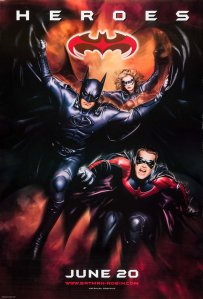 After Batman Forever made decent money and returned broadly favourable reviews, Warner Bros must have thought they had it made. Getting Schumacher and Goldsman back to work their magic again must have felt like a no-brainer. Little did they know that they were about to unleash what would come to be one of the most hated films of all time, with such vitriol directed at it that even the director himself would issue an apology.
A confession – up until now, I had avoided watching Batman & Robin. I tried once not long after it was released on video and I fell asleep partway through and had never especially felt the need to finish it. Of course I have heard all the jokes, read all the thinkpieces and been aware of the general disdain in which the film is held by both genre fans and general movie goers, but I had always assumed that there must be some redeeming qualities in there somewhere.
I was wrong. But to say that Batman & Robin is bad is not really to deliver the full picture. Its failings are legion, its ambitions tiny and its execution flawed in every way in which it is possible to measure. Batman & Robin is a masterclass in how movies should absolutely not be made.
 What hits you first is how derivative of its predecessor the film is. From the visuals to the score to musical cues, for a film that cost $25million more than the last, none of the additional money is on display on screen. Even leaving aside this recycling of aesthetic elements, the new stuff looks cheap and tacky. Bane, a character who carries such menace and presence in the panels of the comic books, here looks like a cartoon character, and is reduced mainly to the function of Poison Ivy’s servant. FX shots from carnivorous plants to car chases over giant statues and even the city itself all look distressingly cheap, all second-rate animatronics, third rate costume design and CGI that would have looked poor in a videogame five years before this movie emerged. Everything about it screams budget cuts.
Even the new Batmobile is a single seater, open topped go-kart of a thing. It seems to have little or no apparent gadgets and lacks the cold lethality of Burton’s or even the weird, Geiger-esque shapeliness of Kilmer’s. This Batmobile looks small, cheap and silly, with its revolving hood mounted light and Batman sticking bodily up from the frame in an oddly upright driving position. Robin fares no better, with his ‘Redbird’ motorcycle looking like one of those cheap props from a Seventies TV show where a vehicle is made to look more ‘special’ by just grafting angular wooden body panels over it to give the impression of a different shape.
 Costume wise, our heroes have each had upgrades of sorts, although Schumacher’s odd obsession with the rubberised fetish angle, drinking in moulded nipples, tightly sculpted buttocks and crotch shots remaining, even for Alicia Silverstone’s Batgirl which is more than a little creepy as she suits up. Again, somehow Clooney’s Batsuit looks less solid and less full of surprises than those of his predecessors, although he does at least appear able to move his head.
Dialogue on this one seems to think it’s aiming at something along the lines of the Sixties television show, puns and gags serving as the padding around large, indigestible chunks of exposition delivered with commendably straight faces by actors who must surely know that every one of them is just… better than this. On this score the film is at least an equal opportunities offender – no single member of the extensive cast has lines which are substantially qualitatively worse than any other, but that’s poor comfort with material like this. Whether it’s Freeze’s endless stream of ice-based… I hesitate to even call them puns, let’s stick with ‘comments’, or Batman and Robin’s almost resignedly delivered series of interwoven ‘gags’ (“No beauty”, “Just the beast”), the script doesn’t ever feel like it sat in the same room as an editor, much less was read by one.
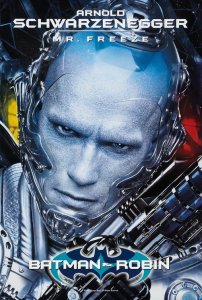 Plotting is also an issue, mainly in that the movie doesn’t really have one. Sure, events unfold and each of the villains has a sort of plan, and they kind of end up working together towards a common goal, but all of this is presented as bare-bones sequences of things happening rather than a narratively satisfying (or coherent) series of events. Stop to think about any of Freeze’s plan for more than a second, for example, and it makes literally no sense at all. He wants to synthesise a cure for his wife, suffering from ‘MacGregor’s Syndrome’, and to get the funding he needs for research to do so, he steals lots and lots of giant diamonds which he plans to use to fuel a giant ice-ray… thing, which will freeze the world so he can hold it to ransom for the millions he’ll need. Why he can’t just sell the diamonds he stole, or even simpler just go and steal the money he needs, or even simpler, approach someone in his capacity as a legitimate scientist who has already figured out a cure for stage one of the condition – which would itself surely be worth millions in patents – is never made clear by a script which seems to be saying ‘Look, we got Schwarzenegger to dress up and have himself painted blue; as long as he keeps delivering ice-based quips we’re happy.’
 Thurman doesn’t get much better – her alter ego, Dr Pamela Isley is a botanist who is trying to develop plant/animal hybrids which will be able to defend themselves. When her unscrupulous colleague murders her after she accidentally stumbles in on his demonstration of a super soldier serum (yes, really) that creates Bane, his choice of method (throwing a table full of chemicals over her and letting her sink into some earth) instead produces femme fatale Poison Ivy, whose plan is… well, not all that clear in fairness, other than kissing people with poisoned lips that kill them and using a pheromone spray to entice men to do whatever she needs them to. Her fixation with Freeze seems based entirely on the fact that he’s not able to be seduced by her charms, and their subsequent joint plan to freeze the whole planet and kill all humans but themselves so that her plants can take over the world just seems daft.
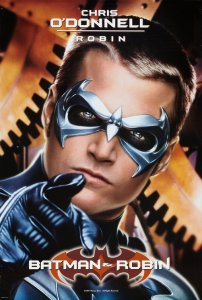
Worse is the threading in of a subplot whereby Bruce and Dick are both swayed by the pheromone spray after an encounter, resulting in yet another thing for Dick to whine about as he insists that Ivy wants him and Bruce is just jealous. That one sits on the shelf alongside his resentment that Batman is a bigger deal than Robin, that he doesn’t get a car, that he doesn’t have his own signal, that Bruce won’t let him do any properly dangerous stuff, and waaa, waaa, waaa. I’m not sure there are many lines in this delivered by the hapless O’Donnell – whose career was seriously harmed by this film for some time – which aren’t cringe-worthy in either delivery, writing or both.
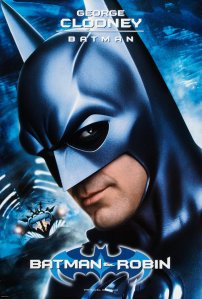 As to Clooney himself, this was never a part which was suited to him. Sure, he may well be a sort of real life Bruce Wayne, and there’s no denying he looks good in a tux (which rather begs the question as to why he spends so much of the film in a turtleneck) but Clooney, much like fellow heartthrob Pierce Brosnan, is an actor whose gifts lie in comic timing, charm and witty delivery. None of these work for Batman in this continuity, which let us not forget stretches back to 1989’s Keaton turn. Clooney does his best, but the script gives him so little to work with. As Bruce, he’s mainly there to deliver half-hearted lectures to Dick or squirm out of talks about commitment with regular girlfriend Julie Madison (played by Elle Macpherson), or stare fixedly at the middle distance as another scene from his childhood with a younger Alfred plays out as a flashback on some window or wall. As Batman, he delivers painful quips which even the legendary Adam West couldn’t have sold – the Batman credit card being an especially painful example. There’s no depth there, no sense of why this man would be capable of physically or mentally going toe-to-toe with the villains gallery of the franchise, and it all just feels like an immense waste.
 Then there’s the inclusion of Alfred’s niece Barbara, played by Alicia Silverstone who had obviously watched Kevin Costner’s performance in Robin Hood Prince of Thieves in order to perfect her English accent. It feels from the way everything plays out very much that Schumacher and Goldsman had thought as far ahead as ‘We want Batgirl in this one’ and then suddenly remembered they’d not written a part for her shortly before filming started. Silverstone essentially phones it in, delivering lines which it doesn’t feel like the character or the actress believes in and apparently resigned to her main role as a bit of eye candy and some token feminism – or at least a pale imitation thereof. When she breaks into the Batcave and is confronted by a virtual Alfred, who then proceeds to tell her he had anticipated her finding the place and has prepared an outfit for her, her lifeless ‘Suit me up, Uncle Alfred’ response seems about as appropriate as anything else.
 The one plot point on which the film dallies with anything approaching seriousness is the denouement as Freeze is informed that his wife is indeed alive still, saved by Batman and Robin and that he can continue his research to find her cure at Arkham, followed by an appeal to his better nature as a scientist and human being to give them the cure for MacGregor’s stage one, which just so happens (what are the odds?) to be the same illness with which Alfred is afflicted. This is the point at which the movie transcends even the Sixties TV show in its camp silliness – nothing in the preceding two hours has had any impact whatsoever. Alfred will be cured, Barbara will be Batgirl and forget all about silly notions of freeing her uncle from a life of servitude to a wealthy man, Freeze will continue his research and presumably one day cure his wife, and Ivy will be locked up with him as punishment because apparently in this phase of the continuity women are there to be either desired or punished. Forget that the two of them destroyed half the city, or nearly killed hundreds or thousands of people (and in Ivy’s case actually did kill some). Forget any of the trauma which any of our heroes have suffered. This is the land of no consequences, where bad guys are just lovably misunderstood rogues and development is something that happens to someone else.
 It’s difficult to be angry, per se at Batman & Robin. In many ways it’s exactly the sort of film that Schumacher set out to make and that the studio wanted. It doesn’t take itself seriously, and it wears its heart on its sleeve as basically an extended children’s cartoon. Except even cartoons usually teach something, or have some sort of lesson for their characters. Dick is no more likely to be less reckless, Barbara has lucked her way into a life as a crime-fighting ward of a multi-millionaire having dropped out of college, Bruce is no more likely to settle down, and Freeze gets basically what he wanted. Nothing here means anything at all, and that’s perhaps the greatest crime this film commits. It is a literal waste of two hours of your time, to say nothing of the millions of dollars and thousands of hours spent on bringing it to life. Small wonder that it would take so long for the caped crusader to appear again on the big screen.
 Doctor Who News Star Trek News
 Sci-Fi Bulletin: Exploring the Universes of SF, Fantasy, Horror and Spy-fi!