Feature: The Voyage to Aquaman Part 3: Batman Forever (1995)
After Batman Returns failed to match the box office returns of 1989’s Batman, Warner Bros decided that the tone and violence of that film, which had raised complaints from parents, […]



After Batman Returns failed to match the box office returns of 1989’s Batman, Warner Bros decided that the tone and violence of that film, which had raised complaints from parents, […]
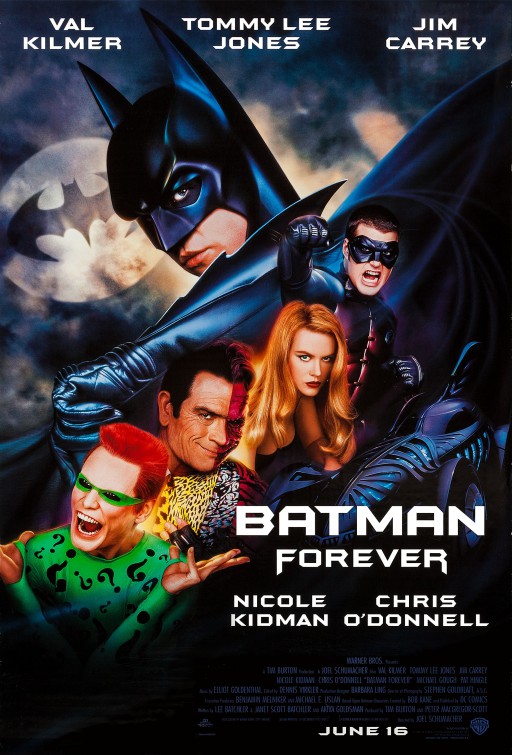 After Batman Returns failed to match the box office returns of 1989’s Batman, Warner Bros decided that the tone and violence of that film, which had raised complaints from parents, had been responsible and decided to shift track. Persuading Burton to step back into a producing role, the studio secured Joel Schumacher to direct, with a mandate for a lighter tone. Michael Keaton had originally signed in for the threequel but dropped out later due to dissatisfaction with the script, leading to the re-casting of the central role. Val Kilmer stepped up, and would star opposite Tommy Lee Jones as a recast Harvey Dent/Two-Face and Jim Carrey – riding high on the recent success of his Ace Ventura and Mask films – as The Riddler. Would this changing of so many factors reinvigorate the fortunes of the franchise or bury it?
As Harvey ‘Two-Face’ Dent terrorises Gotham, Bruce Wayne must also struggle with the duality of his own nature, haunted by a facet of his parents’ deaths he can’t quite place. As he combats Harvey and the affections of psychiatrist Chase Meridian, a new villain arrives in town who is set on the destruction of both Bruce and his alter-ego, and one who may just have the brains and resources to succeed.
 Batman Forever doesn’t get a lot of love from fans of the caped crusader. Joel Schumacher’s first turn in the director’s chair may not be as universally reviled as its follow up, but it is generally viewed askance by viewers who are wedded to the ‘purity’ of Burton’s vision and Keaton’s portrayal of the character. Commercially, it did well, earning enough to overshadow Batman Returns and be the second highest-earning film of its year of release, behind Toy Story, but critically it received mixed to poor reviews and these days the best you will generally find fans have to say is that it isn’t as bad as what followed.
For years, I’ve had a fairly fixed opinion of the film myself. I didn’t dislike it as much as some (indeed fifteen year old me found it rather fun at the time) but I was disappointed by Kilmer’s performance in the title role, felt that the film itself was too silly for its own good and represented a tonal dissonance from its direct predecessors (remembering that this was a genuine sequel, not a reboot, which followed directly on from those films) that was too great to ignore. Happily, on this re-watch I was able to confirm that I was wrong.
Not completely. It’s true that Schumacher’s aesthetic choices were almost obnoxious in their neon-drenched, CGI-laced brightness. It’s also true that certain details – like yes, Bat-Nipples, and the uplit Batmobile with its ludicrous light-up wheel hubs – are just plain silly. However, when you really start to pay attention to the movie, there are hints of not just the large amounts of it lying on a cutting room floor, but also of a more thorough grasp of the character by both director and actors than people tend to credit.
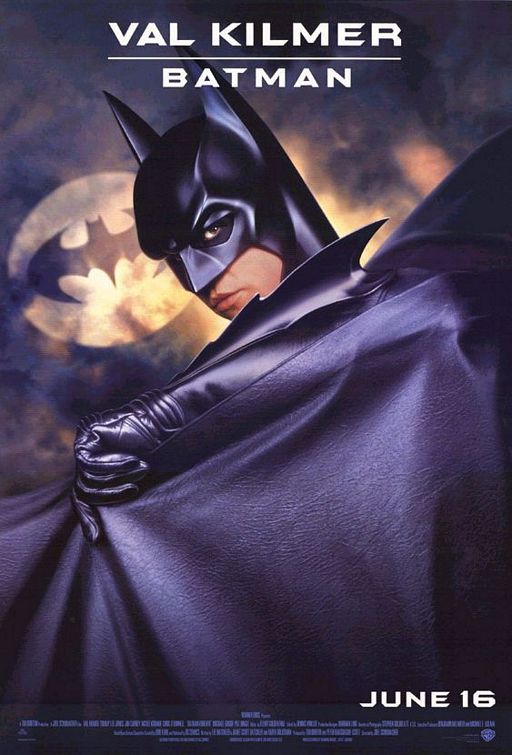 Let’s start with Kilmer. After the outcry which met Keaton’s original casting (which centred among other things on whether he had the requisite Batman jawline), Kilmer seemed a reasonably safe choice. Square-jawed, appropriately muscular and with a reputation as a serious dramatic actor, Kilmer’s recent turn in the critically acclaimed Tombstone as Doc Holliday left nobody in doubt that he had the required chops for the role. Yet to this day the general wisdom is that as Bruce Wayne, Kilmer was too wooden and emotionless, and as Batman he looked the part but felt lifeless. Let’s examine that though.
For starters, let’s recall (again) that this film is absolutely a sequel to the previous two. That means that this is a Bruce Wayne who has faced and killed his parents’ murderer, loved and lost two women, both of whom got close enough to know his secret identity without really getting emotionally close to him at all, and fought an awful lot of bad guys and taken an awful lot of punches on the way. Kilmer isn’t wooden as Wayne – he’s quiet, reserved, much in the same was as Keaton was. There’s an unsettled quality about him – a sense that he’s never quite in the moment of any situation because his mind is elsewhere. That fits perfectly because it is – not only is Bruce wrestling with the dreams which plague him of his parents’ funeral and some sense of unfinished business, but also with the very duality of his own nature, brought even more to the fore by his confrontation of Harvey Dent in his new Two-Face guise. Harvey is Bruce’s duality writ large – a literal two-faced man who is disposed to act with intelligence and calm one moment and unpredictable violence the next. Harvey has embraced his duality – he carries a coin which he allows to dictate whatever he will do from one moment to the next, lost to the vagaries of chance as the only ‘true justice’. Bruce looks at his old friend and must wonder – if he was ever to truly embrace his own duality as both Bruce Wayne and Batman, the billionaire philanthropist and the caped crusader, might he end up as damaged as Harvey or worse? Added to that is an obvious sense of guilt that he was unable to save his old friend, and a pervading dread of facing him because of that guilt (which Harvey himself knows exactly how to use against him).
 This is why one scene which never made sense to me before came into sudden clarity on this re-watch. Bruce’s willingness to stand up and give his identity to Harvey at the circus. He gets up almost immediately to declare he is Batman and I used to wonder why he gave in so easily. Now, it’s obvious that it’s not about giving up – it’s about releasing that guilt. If he can just reveal himself to Harvey he can not only save the people at the circus but also relieve himself of his own burden. It’s a moment of genuine weakness, and knowing that emphasises even more how brave his next actions are, as he realises he cannot make himself heard and so goes to confront Harvey’s goons with nothing more than his fists.
When he’s Batman, you can see that uncertainty leaking through into a persona that he needs to be as solid as a rock if he is to succeed in his self-appointed role. He isn’t awkward because Kilmer is a bad actor (he isn’t) but because he’s having an existential crisis, one that’s been brewing for some time now, and suddenly he’s at a stage where just putting on the cowl and stepping into the Batmobile aren’t enough to stave that off anymore. It’s a layered performance – the man trying to put on a front to cover the fact that the front he usually puts on isn’t working to shore up the fragile personality at the core. This is Bruce Wayne in need of serious help, and thankfully he gets it.
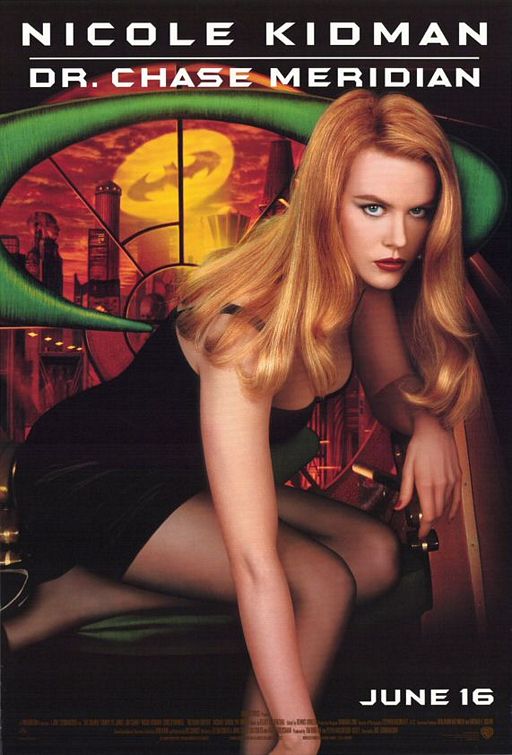 It’s admittedly a little jarring to see the cinematic Batman transformed into a sort of superhero James Bond, with a different girl for each instalment, but there’s little doubt that Kidman’s Dr Meridian is a suitable foil. For all that she throws herself eagerly at Batman, she’s never just an eye candy female lead. She’s sexually aggressive, but also perpetually self-aware. She’s intelligent, allowed agency of her own by the script and more than capable of handling the various curveballs that get thrown at her. Her analysis of Harvey’s psychosis is incisive and insightful, and her verbal sparring with both Batman and Brice go to show she isn’t here to be pushed around. It’s a shame that she doesn’t get more time on screen and also that the film elects to have her kidnapped in the third act, but even that serves a genuine purpose, as the Riddler – flush with the knowledge of Bruce’s secret identity – seeks to use her as emotional leverage not to get Batman to do whatever he wants but to pry apart the two warring parts of Bruce’s psyche and force him to choose one or the other. She might not get to beat people up with a whip, but for my money Chase Meridian is the best female lead of the Batman movies to that point.
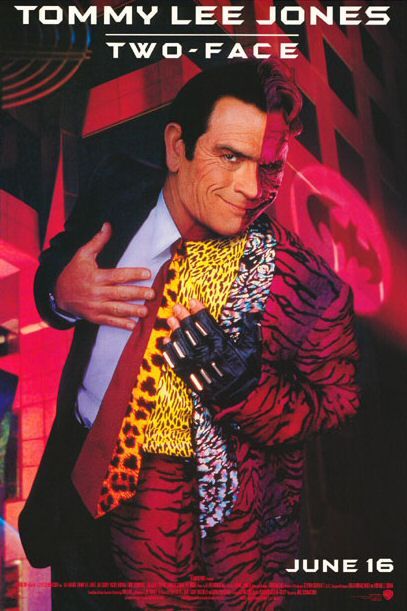 Moving to the villains, it’s often said that Jones seems to think he’s playing the Joker rather than Two Face. Whereas it was a shame to see Billy Dee Williams denied the chance to follow up on his earlier performance as Gotham’s DA, I can’t agree with this assessment. For starters, the Joker in this continuity was an old-fashioned mob enforcer turned psychopath. Jones here actually has a more nuanced performance than he’s given credit for, again hamstrung slightly by the multitude of cuts made to the film before it hit cinemas. It’s true that in appearance he is outlandishly bright and colourful, in contrasting suits and accoutrements designed to heavy-handedly accentuate his dual nature. But the performance itself is where the character is made. When he’s acting criminally, he is gleeful, off the chain, an unleashed primal force full of the savage joy of cutting loose the chains of normal society. When his coin forces him to restrain himself, he is sometimes good-naturedly calm and sometimes hugely frustrated. But it’s in the pivotal moments before the coin is tossed that we see the man who lurks beneath the monster. Harvey isn’t an agent of chaos in the sense of Napier’s Joker (whose chaos was more about his self-serving venality and minute-to-minute whims) but rather a man making sense of the world the only way he can see how. His disfigurement isn’t fair – he was a good man doing good work for his city – and his psychosis manifests in a specific way, making any major decision on the literal flip of a coin and be damned the consequences. He’s broken, and possibly even evil, but he’s not a simple cackling clown of a character. Harvey has made his choices, and perhaps more than any other person in Gotham he’s happy to stand by them, because they’re all the result of the only natural justice in the world – sheer dumb luck.
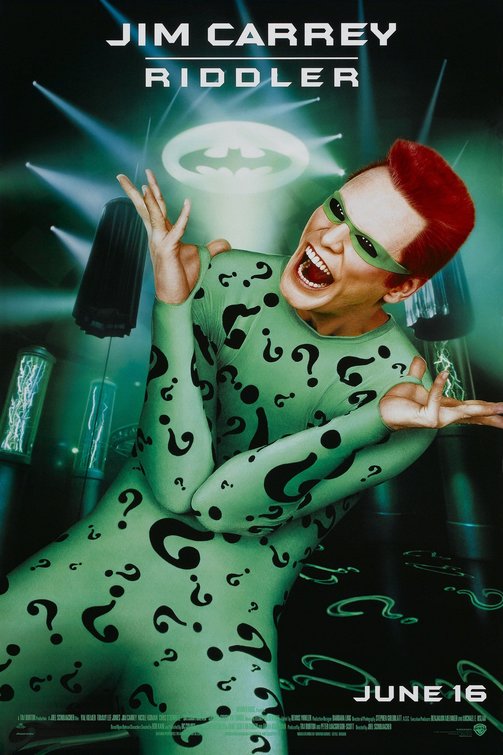 Alongside Harvey is Edward Nygma aka the Riddler. Carrey’s performance is often cited as another factor against the film’s quality – his bombastic, loud-mouthed delivery and over-the-top physical comedy serving to make every scene he’s in a bit sillier than perhaps it ought to be. Then again, I fear that people really only remember the scampering about the Batcave with duck bombs in a green leotard. Examining the performance in the whole gives a slightly more disturbing picture, from the creepy, obsessive stalker attitude of Nygma towards Wayne in his opening appearance to the dark path that obsession takes when he is rejected, the murder he is able to commit and easily get away with and his driven obsession to perfect his invention. Nygma is a true monster – nobody creates him. His parents aren’t murdered and he isn’t irreversibly scarred by acid. All that happens is that he is told no. Like the very worst kind of toxic personality, that rejection leads to a spiral of violence and destruction which Nygma is always able to justify to himself because the world pissed him off first and its biggest mistake was in not recognising his brilliance. Outlandish as his plan with the Nygmatech boxes might seem, is it really any worse than the Joker’s Smilex poison or the Penguin’s plan to murder all of Gotham’s first born sons in the sewers beneath the city, kidnapped by circus freaks? At least Nygma’s plan has a threefold strategy – to gain him access to wealth through the information in other people’s heads, to make him even smarter by absorbing their brain power and to crush Bruce Wayne, the man who he sees as having precipitated his downfall and glorious rebirth. Carrey’s performance is what anyone who had watched his films of the time should have expected, and its loudness and sheer boldness are both a match to the colour palette and general aesthetic of the movie and a welcome relief from the darker undertone of other parts of the movie.
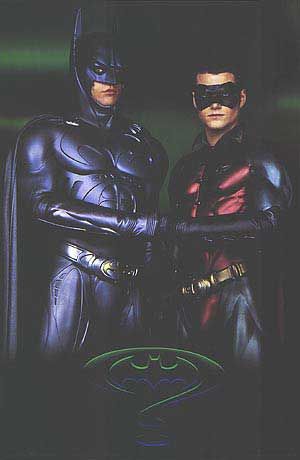
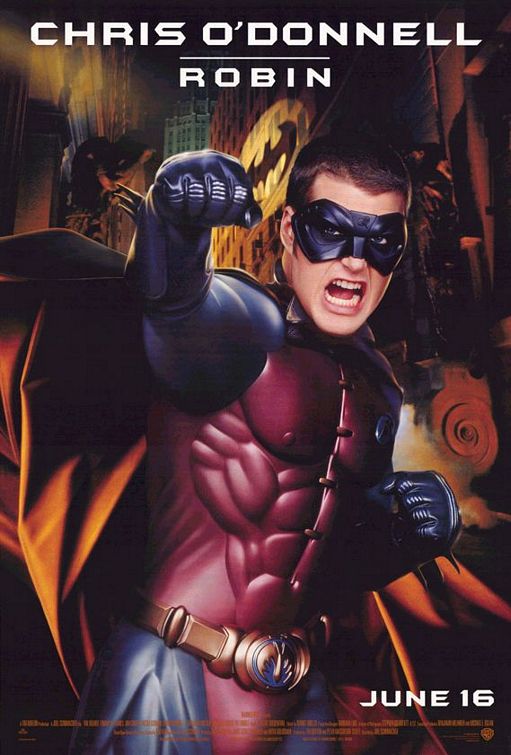 Perhaps what’s most surprising about the film though, is the underlying theme that it’s taken me over two decades to appreciate – that of Bruce coming to understand his own pain and recognising it in others. Most obviously this manifests with Dick Grayson, a young man who also had to witness the deaths of his family before his eyes and who is hell-bent on revenge. Bruce sees much of himself in the young man, and tries to do the one thing nobody was able to do for him and turn him away from the path he’s set on. What he comes to realise over time is not just that every man must forge his own path, but also that he took that path himself despite having the love and support of a paternal figure right there in his life. As Alfred says – ‘Young men in search of vengeance need little encouragement. They need guidance.’ Over the course of the movie, Bruce comes to realise that by simply shutting down Dick, dismissing him as a kid who doesn’t know any better, he isn’t providing that guidance. Far from giving Dick the things he himself was denied, he is denying him the things he was given.
There’s a sense in Batman that he may have meant to drop Napier into the acid, and certainly by the end he’s happy to murder the Joker. In Returns, he doesn’t try to save the Penguin. Here, he empathises with Harvey’s pain from start to finish, as well as Dick’s, and he balances those two as best he can, eventually taking the best path possible, releasing Harvey from the pain of his tormented life and Dick from the weighty potential of avenging himself personally on the murderer of his parents. In the case of Nygma, his last line is telling ‘ Poor Edward’, he says, before explaining to Nygma why it was necessary to save both his lover and his sidekick, because he owns both parts of his personality as one whole.
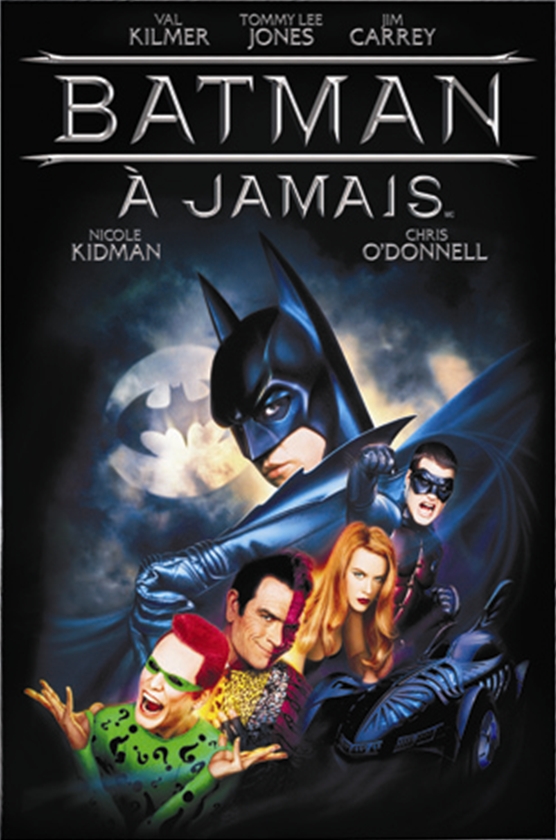 Is it perfect? No. It dates far more than the previous films because in spite of the same cars and vague nods to similar architecture it leans too heavily on CGI and the neon bright colours and odd costumes of regular citizens place it firmly in its time. There are moments when things get very silly, and there are several apparent holes in the plot which become easier to understand when one discovers just how much of the film was hacked out in the final edit.
But it’s a much better, braver and bolder take on its subject matter than it gets given credit for, and a far more mature one than people realise in many ways. Jonathan Ross supposedly may have heaped superlatives on it for the pull quote on the posters for a bet, but damn it if this isn’t a thoroughly solid outing for the caped crusader and a masterclass in blending nuance and subtlety with flat out, kid-pleasing action and fun.
 Doctor Who News Star Trek News
 Sci-Fi Bulletin: Exploring the Universes of SF, Fantasy, Horror and Spy-fi!