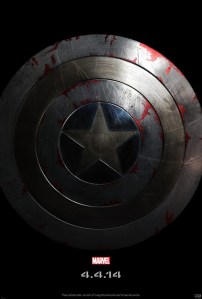
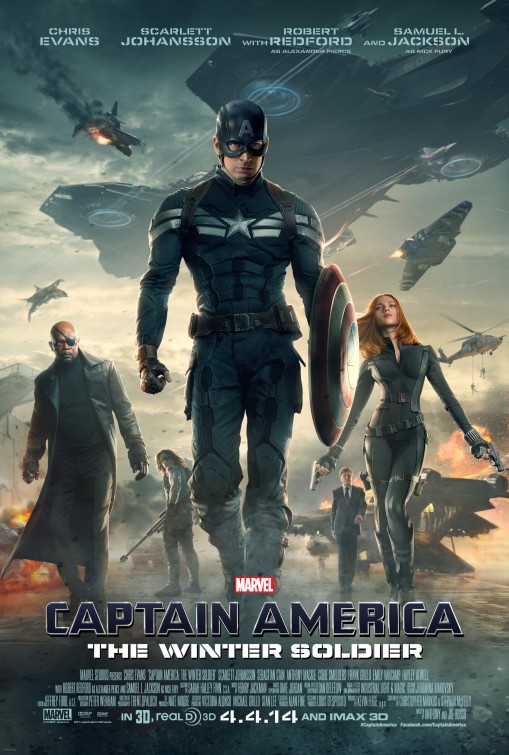
 With Tony Stark and Thor having taken their post-Avengers Assemble bows in 2013, a new year swung round with Steve Rogers’ turn. Showing no signs of slowing down, the MCU had by now established a pattern of two movies per year, and March brought us this as the first. But, wonders Greg D. Smith, could it avoid the curse of Thor’s Dark World debacle, or even sustain a consistent quality over its three acts to surpass Iron Man 3? As Steve Rogers struggles to adapt to life in a world very different from the one he remembers fighting for, a new threat arises from within SHIELD itself that will change everything.
Steve Rogers was always going to be one of the least affected of the gang by the events of Avengers Assemble. Indeed, the one character trait that Whedon nailed consistently in his 2012 bonanza was Steve’s utter refusal to be cowed by events around him, no matter how fantastical or unexpected. Steve is first and foremost a soldier, with a cast-iron belief in doing the right thing. When he’s told that Thor is ‘pretty much a God’ his response is that there’s only one God, and he doesn’t dress like that. When he’s fighting alien invaders in the middle of New York, he doesn’t care where they came from or what they want, all that interests him is protecting people and stopping the bad guys.
This said, he had very little in the way of baggage to carry with him into his follow on film, unlike Tony (suffering from PTSD) or Thor (who had to face up to the revelation that his brother was a) not dead and b) an even bigger asshole than he remembered). The Russos needed to give Cap another bone to chew on – fortunately they had just the thing.
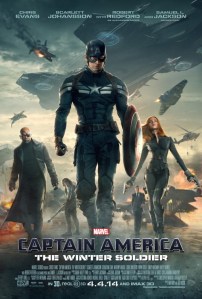 It makes sense that after the events of New York, Steve would agree to work closely with SHIELD. It makes even more sense that working for a spy organisation that hires shady, questionable people and operates above, beyond and sometimes against the law to get the job done would cause him more than a few personal misgivings. It’s the very conflict of Rogers’ training as a soldier versus his instincts as a man that creates a lot of the conflict in the first half of the movie, as he realises a mission to rescue hostages from a terrorist isn’t all that it seems, and is informed by Fury of Project Insight when he goes to confront him. Steve resents the idea of control through fear – and well he might, it being the exact tactic that was used by the enemies he fought in his first war – and is already on edge about SHIELD after discovering Fury’s plan to manufacture HYDRA-style weapons in Avengers Assemble. It won’t take much to push him over the edge.
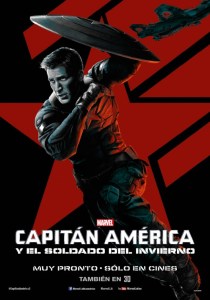 One of the interesting choices that the Russos made was pairing up the character with Black Widow, of all people. The darkest, sketchiest spy of the team (come on, she’s an ex-Russian spy and even at that point we have a good idea she has a dark past) teaming up with Captain America, all round boy scout and he of the inflexible moral compass? It’s an interesting mix, calculated to bring out the best and worst qualities of both and is the first time Romanov really gets to shine as a character. We get to see her up close, realising that the brief impressions of a ‘front’ we had from previous movies were nothing of the sort – Natasha is a woman who trusts literally nobody, and has very little to say about herself, deflecting all the time. This is used to humorous effect throughout the movie, with the running gag of her asking Steve about various women they work with and whether he would be interested. As he’ll later observe to Banner, Steve gets to see Natasha flirt up close, and he is maybe the only Avenger capable of spotting when she means it, and when she’s simply using her charms to distract, deflect and achieve her mission.
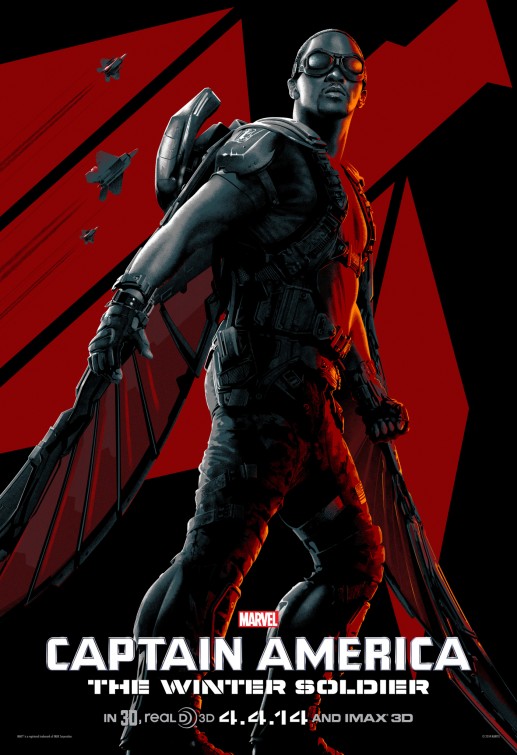
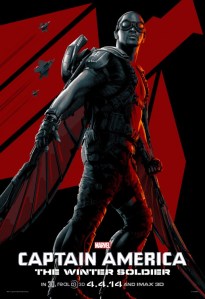 We also get introduced to Sam Wilson, a former veteran who will become Falcon. Some have questioned the way in which these two meet and seem to become instant buddies, but that is to misunderstand the nature of military service, and the bonds it can form, even between people who haven’t served together. Steve recognises in Sam a fellow veteran, and their first encounter is one that enables Sam to impress upon Steve his humour and determination. When he goes to see Sam later, he finds him at a meeting helping other Vets readjust to life in normal society, and is it any wonder that Captain America, the soldier who didn’t get to see the end of his war and a man who has no other purpose than to fight, would feel drawn to someone like that? In Steve, Sam recognises another soldier who never quite came home from his war. The nature of their friendship is easy to recognise, and organically done.
Of course, we can’t talk about this movie without mentioning Robert Redford’s Alexander Pierce, a contemporary of Fury’s though higher up the food chain in the SHIELD command structure. Redford’s involvement alone lends to the Cold War thriller vibe of the film, and it’s clear from our first encounter with Pierce that there is more to him than meets the eye. Redford, to his credit, carries off the part with aplomb – his cold-blooded murder of his housekeeper because she made the mistake of coming back for her forgotten keys and saw and heard things that she shouldn’t is just one example of how well he undertakes the role. Never once does Pierce lose control of himself, even as his plans are turned to ashes around him. He’s the archetypal cool customer.
 That extends to the whole of the spy cast though, and it adds to the image of them as being the very best in the world at what they do. Natasha always seems unruffled, calmly working her way through hordes of enemies as easily as she decrypts information or drops off a bridge with a grappling hook and lands, firing her gun and running without skipping a step. Even Cobie Smulders’ Agent Maria Hill finally gets the opportunity to properly show what she’s made of, as she springs the others from HYDRA custody and directs the operation to take down the Insight Helicarriers in the final act, casually dispatching HYDRA goons who burst in on her as she keeps Cap and Sam appraised of their timetable without pause.
And yes, I said HYDRA, because of course the big twist of the movie revolves around the revelation of HYDRA having been operating secretly from within SHIELD for decades. Cap’s misgivings prove well founded as this comes to light, and suddenly his having become a fugitive from his former employers early on in the film doesn’t seem quite so crazy after all. Again, some have questioned the suddenness with which this storyline seems to have appeared, fully formed, in this film, having had zero setup in previous MCU entries. I would argue there’s a simple reason for that too – apart from the odd appearance of Coulson, Natasha and Fury in other movies, and the Helicarrier in Avengers Assemble, up to this point we really hadn’t spent much time with SHIELD in the series. This film marks the first one in which we see SHIELD headquarters in the form of the Triskelion, the first time we meet any of the actual higher ups, or witness any of the myriad workers who make the spy organisation function. If the story was always planned to be HYDRA having infiltrated SHIELD, it makes sense to have held off on the reveal until we were actually spending time with them, and it fits perfectly the spy thriller tone of the movie that it comes as a complete out-of-left-field surprise delivered wholesale into our laps. It’s also the first time it becomes necessary for them to blow their own cover, their hand forced by the actions of Steve, the opposition of him and Fury, and the machinations of Zola, maintained in eternal life on an old dusty computer in a bunker in the middle of nowhere. For me, it’s executed well, and gives the movie the wider-universe relevance it needs while avoiding Infinity Stones and aliens. It reminds us that there are just as many problems facing humanity in its own habitat as there are threats from above.
 Mainly though, what this movie achieves (as touched on in my First Avenger piece) is to cement Steve Rogers as a character in his own right, and to retrospectively improve the quality of its forebear by highlighting why it was so badly needed. Imagine if we had jumped straight into Steve’s story in the present day – his insistence on following his gut instinct as to what the right thing to do is would be infuriating without context. His automatic opposition to Project Insight before he even realises that HYDRA are running the show would seem quaint. And his victories, such as the opening sequence, the fight in the elevator and the final battle with Bucky (not to mention the revelation of Bucky as the Winter Soldier) would lack the depth of resonance and emotion that they produce. When we see Steve take out an elevator full of burly dudes single-handed, we can’t help but cheer all the harder as we remember him as a scrawny runt in a back alley being kicked around by a bully. When we see his face as Bucky’s mask drops, revealing his identity, we can’t help but remember his despair as his friend fell into the icy chasm from the train. And when he lies back and lets Bucky keep punching him, his face a bloodied ruin, insisting that he’s ‘with him until the end’, it’s a gut punch because we got to see what these men meant to one another, right back to the very beginning.
It isn’t so much that the movie rehabilitates either the character or the previous movie, but it validates them almost as the missing second piece. Seeing Steve run around in a the world to which we can relate, with characters we know and love (and hate) gives us a real sense of his having arrived in the MCU properly, in a way that somehow he didn’t in Avengers Assemble thanks to sharing the screen, having his snark quotient upgraded along with everyone else and that awful costume (sorry Coulson) that thankfully seems to have been relegated to a bin somewhere, never to be seen again.
 And even as the movie’s final act kicks into gear, and we get what could have been a standard MCU finish in the same way that Iron Man 3 did, it cleaves true to itself and the picture it’s painted for the first two acts. Steve and Sam are racing against time to achieve very specific missions that will turn these enormous weapons in on each other, rather than simply trying to find a kill switch or lob a big bomb somewhere. Their mission relies equally on the skills and assistance of Hill, Fury and Romanov as it does on their own action-packed stunts, and when it really comes down to it, the helicarriers blowing the hell out of one another over the Potomac are really just background for the real story to play out – Steve confronting his nemesis/best friend, and Fury doing likewise. The parallels between the two stories are striking, and the link between Pierce and Bucky, who the former has been using as a ‘cleanup man’ act to cement the mirror further. The only difference is that Bucky has been acting against his will, whereas Pierce has made a series of bad choice. But again, credit to the restraint of the directors that Pierce never feels like he’s monologuing, or about to break out into camp laughter. He’s clear-eyed on what he’s done, and the sacrifices he’s been willing to make, and he believes, firmly, that he’s done wrong things for the absolute right reasons.
 As an entry into the MCU, The Winter Soldier stands alone. It captivated critics, including those not generally fans of the franchise as a whole, and it struck a tone that served to re-ground the movie universe after some outer-space based villains and adventures. It also brought back a bit of darkness that had been in danger of vanishing – not to DCEU levels (thankfully) but it strikes a tone more in keeping with the original Iron Man than any other Phase 2 movie. It deals with dark themes, and it does so unflinchingly and with an adult sensibility. Peggy’s onset of Alzheimers is just one example, forgoing a fairytale or painless ending for Steve’s lost love by driving home the simple brutality of aging. It doesn’t lack humour, but like the original Thor and First Avenger, it knows when to use it, and does so sparingly, letting the character be who he is.
His first movie was a great one, let down only slightly by a poorly written, hammy villain. This one is a stone cold classic, with every performance, every line of dialogue and every scene put together as close to perfectly as you’re ever likely to see. I too, am here until the end of the line.




 Sci-Fi Bulletin: Exploring the Universes of SF, Fantasy, Horror and Spy-fi!