 With 2014 delivering a pair of standout hits in Winter Soldier and Guardians of the Galaxy, and the original Avengers Assemble being one of the highest grossing movies of all time, director Joss Whedon had a massive challenge on his hands to live up to the hype as well as producing a movie that could showcase the characters and tie in with the wider universe moving forwards. As Greg D. Smith notes, a lot rested on this one. With HYDRA finally vanquished, Tony and Bruce attempt to use the power of Loki’s sceptre to jumpstart their AI project to protect the world – with disastrous consequences.
I’m going to come out and say it straight off the bat – for me, Age of Ultron is a better movie than Avengers Assemble. I know that’s not the perception of fans generally (certainly not the ones that I have spoken to) but bear with me, and I’ll attempt to explain why.
The first thing to note is that Age of Ultron gets a shorter lead in than its predecessor. Assemble was built on a groundwork of five preceding movies (however much Disney/Marvel might want to pretend that The Incredible Hulk didn’t happen) which had released over a span of four years. Age of Ultron launched off the back of four movies (one of which contained no characters from it and therefore arguably doesn’t count) launched over three years. The MCU was starting to look a little crowded, schedule-wise and when Age of Ultron arrived, it wasn’t to ‘bookend’ the phase as its predecessor had (that honour being left to Ant-Man) but rather as another entry in a connected universe.
 It’s not a short movie either – weighing in at 141 minutes it plays just two minutes shorter than Assemble, and stands as one of the longer entries overall in the MCU. Whereas Assemble had its slower points though, Age of Ultron feels consistently snappy, probably helped by the fact that even sitting still chatting to one another, the cast are entertaining, with one liners and bravado zipping back and forth between the group. It feels like a significantly shorter movie than its predecessor.
And most importantly, it actually comes with a plot that holds up on its own merit rather than just being an afterthought to excuse making a buddy movie. The emergence of Ultron is a natural conclusion to a thread begun all the way back in Iron Man 3, where we witnessed Tony, struggling to come to terms with the things he had witnessed in New York, endlessly tinkering to try to produce the perfect suit. That movie ended with him concluding that he didn’t need to because he was Iron Man, and this movie shows us how that’s not necessarily the healthy conclusion we might have hoped for the character. Now, he’s intent on saving the whole world with the power of his brain. His Iron Legion, a group of drone robots who act as footsoldiers/crowd control for the team, are just the first step. Tony wants AI in the form of the Ultron project – an independent machine that will be able to act as a 24/7 guardian for the world so that the Avengers can take some time off. He’s roped in Bruce and together, faced with the possibilities presented by the Infinity Stone residing in Loki’s staff, they try to utilise and harness that power to finish a project that had reached a dead end.
 People who complain that Ultron isn’t around long enough, or doesn’t do enough really aren’t paying attention – the point of this plot is the hubris of Stark, driven by perfectly good intentions to create something perfectly bad. When Ultron awakens, it’s mere moments before he’s looked at the history of the world via the internet and decided that the best option is to disable Jarvis and then destroy humanity and the Avengers with it. Again, there may be a temptation at this point to accuse the plot of cliché, of ripping off many genre tales that came before it, not least the Terminator series. However, the real difference is that Ultron does not decide that humanity itself is an issue, but rather that there can be no peace while the Avengers exist, and on that he has a point. As exposited by Vision in a later movie, since the appearance of the Avengers the frequency of world-ending threats has increased. Their very existence arguably creates chaos. Ultron is created originally with a mandate to preserve world peace – he just chooses a very particular (and heartless) way to achieve that.
 As for the length of time – within hours, Ultron has formulated his plan, and his very nature as a hyperintelligent AI construct means that he is capable of being anywhere in the world that he needs to be in an eyeblink. He doesn’t need a long time to achieve what he sets out to do (in fact arguably the movie drags things out a bit to give the Avengers a chance of stopping him) and the time in which he holds the fate of the world in one Vibranium hand may indeed seem an age to him, as well as to the people cowering in his shadow.
Kudos to James Spader as well, for an excellent turn as the titular villain. His trademark burr and almost lazy vocal delivery combine to really breathe life into the antagonist. Being a machine, Ultron doesn’t get stressed (although he is capable of anger) and processes things in a fairly uniform way, and the style brought by Spader fits this perfectly. He’s also snarky, which as a creation of Tony’s works perfectly – the exchange of dry one liners between them is just what the movie needs, culminating in the ‘he beat me by one second’ line as they face off for the first time properly on Klaue’s ship.
 That confrontation also gives us our first glimpse of the Maximoff twins, here presented as enhanced people who have been experimented on by Von Strucker using the infinity stone (because of the persisting rights issue with Fox preventing the MCU having ‘mutants’). Their roles in the movie remain much the same from first appearance to last – Wanda the powerful one, who is always serious and one of the rare quip-free characters in the script, and Pietro the extremely fast, extremely sardonic one who particularly strikes sparks off Hawkeye (here actually given things to do as the movie seems almost at pains to rehabilitate the character with audiences after even the actor himself complained about his role in Assemble).
Wanda’s power is of course the catalyst for fresh strain on the team, as she gets into each of their heads in turn – bar Tony (already messed with in an earlier scene). The respective visions of Natasha, Steve and Thor offer insight into their own demons, as well as Natasha’s past and Thor’s apparent future, and Hawkeye avoids it because ‘he’s tried mind control; not a fan’ (also because his actual secrets get splashed all over the screen as a main feature of Act 2). Then as the gang try and regroup on the boat, Wanda’s off to mess with Bruce on the quinjet and suddenly there’s a large angry Hulk running through the streets of a major South African city and Tony trying to stop him in the oversized ‘Hulkbuster’ version of his armour. This is the point at which the movie does lose a little momentum, as a fight transpires that rather feels it was put in there for the sake of it. We know the Hulk is powerful, and we’ve already seen him wreck a city – this scene may as well just have had the title card ‘We wanted to use the Hulkbuster’ on it.
Still, it leads into a decent Act 2 as the gang retreat to spend time with Hawkeye’s sudden secret family that was apparently always there and definitely not just made up to make the character more likeable. The chance for a breather, for the nascent seeds of the Stark/Rogers rivalry to be sown, for Nick Fury to turn up and offer a bit of wisdom and – oh yes – for Natasha and Bruce to show off the most unexpected relationship in recent memory.
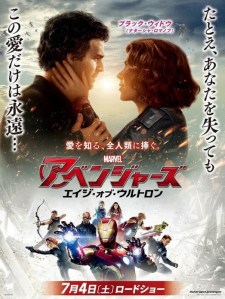 Think back to Assemble, and just how terrified Natasha was of the Hulk. This is a woman who routinely faces death and multiple opponents without blinking and she cowers in a corner in that film after the Hulk is first unleashed. By this one, they’re a pair, she acting to calm him down and bring back Banner when the mission is done. But even given that, the leap to a burgeoning relationship seems… odd. That said, the dialogue that transpires between them gives us a little (controversial) revelation about Natasha and her backstory (the first real development of the character as even having a history that we have had to date). I feel a lot of the anger directed at the scene is misdirected. Specifically, Natasha’s reference to herself as a ‘monster’ after revealing that she cannot have children because of the forced sterilisation of the Black Widow programme. Firstly, she makes the comment in response to Bruce agonising over the fact that the world has seen the ‘real Hulk’ and that he cannot be a normal person who settles down with kids. Secondly, the context is in the reason why she was sterilised in the Red Room – to make her a more efficient killer, to ensure that she would never have anything so important that it overrode her loyalty to the mission. The line she delivers before the divisive ‘monster’ one is to say that ‘It makes everything easier. Even killing.’ Thirdly, the sardonic smile and headshake as she delivers the ‘Monster’ line makes it clear she’s using the term in jest.
 At the same time we have the drastically cut back Thor scene that supposedly serves as a lead in to Thor: Ragnarok (which hindsight tells us it does not) and in all honesty, this is a scene that should have either been cut altogether or lengthened. It’s always nice to see Skarsgard but he gets little to nothing to do here, and the scene acts as a distraction from the narrative.
Thankfully, after not too much longer the movie kicks back into high gear and from the moment the team drop into Korea, to confront Ultron and steal the body he’s having Doctor Cho create for him, until the final scene the action doesn’t let up. In that tail end of the second act and the whole of the third, we are treated to some of the best action sequences that the franchise has done, including the chase through South Korean streets, the introduction of Vision and the final fight in Sokovia. It’s true that the movie does rather lean on the same sort of final fight as its predecessor, with one big bad and an army of identical goons and a fight to get through them all and stop the McGuffin they’ve set in motion. However, the Ultron clones are very different from the Chitauri, Ultron able to see and hear everything that goes on through their eyes and ears (or visual and audio receptors if you prefer) and even taking over various of the bodies as required to get out of harm’s way.
Nor can Ultron’s plan really be compared with Loki’s – the latter wished to rule over humanity, the former wishes to end it, and it’s undeniably impressive watching an entire city levitate together with a massive chunk of its foundational earth and rock. The arrival of the Helicarrier admittedly carries a slight ‘Eagles in Lord of the Rings’ vibe, but it’s one of those moments that you can forgive, especially when considering that this was the post-Man of Steel world where every big budget superhero blockbuster had to show maximum effort at protecting the lives of the inhabitants of whatever fictional city our heroes happen to be fighting over.
 Pietro’s death seems a little token, almost as if the studio and Whedon realise that there really aren’t a whole lot of ways to keep making a speedster character interesting in a series of big budget blockbusters in the long term (witness the diminishing returns of the same character in the Fox X-Men franchise in his second film) and also reminds us that it’s not a Whedon film unless a beloved character (or at least one of the good guys) dies in the end. Had we had more opportunity to spend time with the twins, had the studio been able to wait to pull the trigger on Pietro until the third movie, his sacrifice might have had more impact. Here, it admittedly feels like offing a character for the sake of it.
All told though, despite the odd glitch the plot of the movie hangs together well. It’s never dull, though it throws in so many ideas that inevitably some are more successful than others. More important, it feels more like the characters actually get to be characters this time, with each having humorous moments but that feel more tied in to their individual personalities as established in their respective franchises. Steve’s ‘Language!’ line is a case in point, even if it does end up slightly overused against him by the end. It’s still got a much stronger sense of identity for its cast, a more ‘global’ feel (helped by the globetrotting of the crew), a more coherent plot and a more impressive villain than Avengers Assemble, and whereas it might lack the feeling of ‘freshness’ which accompanied that first film, it’s still the more impressive effort. Or to put it another way, like the hypothetical elevator, it may not be worthy, but it still lifts the hammer.







 Sci-Fi Bulletin: Exploring the Universes of SF, Fantasy, Horror and Spy-fi!