Feature: The Road to Endgame 20: Ant-Man and the Wasp
MCU fans were still reeling from The Snap at the end of Infinity War when Ant-Man’s sequel hit cinemas, with many loudly questioning how they were supposed to care about […]



MCU fans were still reeling from The Snap at the end of Infinity War when Ant-Man’s sequel hit cinemas, with many loudly questioning how they were supposed to care about […]
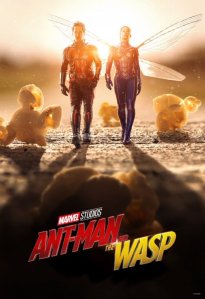 MCU fans were still reeling from The Snap at the end of Infinity War when Ant-Man’s sequel hit cinemas, with many loudly questioning how they were supposed to care about another light and fluffy adventure with Scott Lang and friends after witnessing all that tragedy, and wondering exactly where this latest micro-sized adventure would fit in along Thanos’ murderous timetable. Apparently most of these fans had forgotten that Peyton Reed’s first MCU movie had also served as a palate-cleanser after the events of Age of Ultron. Nevertheless, with the first movie having been a fun, fluffy if slightly predictable entry in the MCU stable, what could this new one possibly offer to try to stand alongside the towering achievement of the Russo Brothers’ latest masterpiece?
If the original Ant-Man had an issue (and to be fair, it had a few) it was that for all the stunning visuals and imaginative uses of the central ‘shrinking’ schtick, it was a movie that played things extremely safe and by the numbers. Our protagonist was a criminal, but one of the nice, Robin Hood-type ones who an audience could feel unambiguously ok about rooting for. Our main villain was a monologuing arms dealer who murdered cute animals in his quest to develop the ultimate weapon. Our female lead was a tough, smart, super-capable young woman who nevertheless wasn’t allowed by the script to actually do any of the heavy lifting for the heroes and instead had to train the straight white male hero and then act as his love interest. There was also a little girl, who was dependably cute when required to be. Though entertaining, the film’s plot had no surprises and no big twist reveals, relying on the snazziness of (admittedly very snazzy) visuals and an endless supply of quips and comedic moments to keep the viewer entertained.
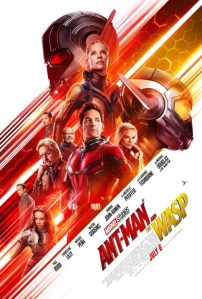 Ant-Man and the Wasp seems to recognise a lot of this, and bases itself entirely around the concept of misdirection, subtly planting the idea early on and then running with it for pretty much the entire length of the movie. Seriously, think about every single major plot point or achievement of our heroes, and they all boil down to the same basic concept – making their enemies look the other way while they carry on with confounding whatever they’re up to.
What’s impressive is that despite working this one core concept solidly for the duration of its two hour run time, the movie never overdoes it somehow. On a first viewing, I found myself pleasantly surprised by what it did time after time, even though on repeat viewings the repetition of the same core concept became increasingly obvious.
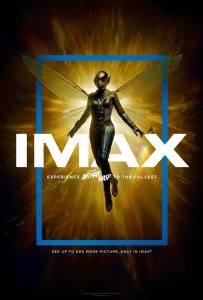
 Most of that boils down to some excellent character work on all sides, starting not with Rudd (who is dependably charming and funny as ever) but with Lilly’s Hope Van Dyne, who gets to be all the things we all knew she should have been and has a hell of a lot of fun on the way. Finally getting to see her in the Wasp suit is a delight, but what’s even better is watching how easily and capably she takes control every time she’s required to. It’s a bold move from a studio with a fanbase a vocal chunk of whom are always on the lookout for an excuse to decry ‘SJW agendas’ and so on, and the movie pretty much gets the balance right in my opinion between Scott’s cleverness and heart and Hope’s strength and capability – although she shows early on that she’s more than capable of dealing with a room full of bad guys, when things get really sideways with the appearance of Ghost it needs both of them to get the job done, neither really operating at full potential without the other. It’s a dynamic we really see in the MCU, which has plenty of team-ups and ensembles at this point but rarely shows us such finely balanced partnerships (the last one I can honestly think of is Natasha and Steve for the bulk of Winter Soldier) and it’s more than welcome given Hope’s treatment in the first movie.
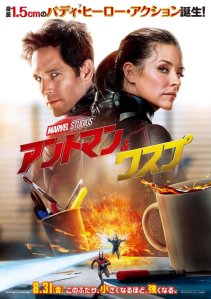 Rudd, as mentioned, is as dependable as ever and it feels like this movie more than the last really dials into a unique conceit for him as a lead. Uniquely of all the current crop of MCU heroes, Lang is not someone who was supposed to be in the position he’s in. Yes, he’s a clever engineer, but not on the same sort of level as a Stark or even a Pym. He doesn’t have money, or any sort of supernatural powers, he’s simply an ex-con who had the luck to be in the right place at the right time. This represents a whole different set of challenges, and the film commits to them – this is perhaps the one MCU hero character who genuinely actually has to deal with the consequences of his actions in a real way. Cap just legs it and carries on superheroing in the shadows with his friends who he busted out of jail. Tony can always throw money at whatever problem he’s caused. Thor can just go back to space. Scott is very much just an ordinary man, and that means dealing with house arrest, worrying about whether his newly set up business will actually succeed or fail, and making the best of his domestic situation by accepting the slightly intrusive affection of his ex-wife and her new husband as they form part of his daughter’s (and therefore his own) life. These are the sorts of mundane concerns which don’t tend to even occur to other characters in the MCU, and are the direct result of Scott’s ‘ordinariness’. The only vaguely relatable character might be Peter Parker, and even he has the benefit of superpowers which Scott lacks.
 Set against them are a pair of very different villains with extremely different abilities and agendas. Walton Goggins’ Sonny Burch is a fairly run-of-the-mill criminal type with a Southern drawl, who thinks a lot more of himself than there actually is thanks to money and some apparent connections with various people including the FBI. It’s pretty much the exact same sort of cookie-cutter two dimensional bad guy that Cross was in the first movie, and it feels almost as if the movie deliberately puts him in there, perhaps as another attempt at misdirection which might have worked better had the publicity for the movie not made it explicit that Ghost would be the main antagonist of the piece. That said, it’s almost as if there’s a double misdirection on that score given how things play out. Regardless, Burch never really feels like a serious threat, more like a comical villain from a different era of superhero media, and it’s difficult not to feel like the film is entirely alive to this and in fact is actually playing up to it, especially in the third act with the chase sequence involving endless cars, motorbikes and so on. Burch is there to provide laughs and prove just how capable our heroes are, outwitting and outmatching him at every turn.
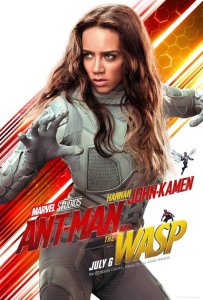
 Meanwhile, Ghost represents the sort of villain the MCU doesn’t have many of, and showcases just how much heavy lifting the movie does for the MCU at large while misdirecting the perception of audiences into it being just another gag-fest. Ava is a person whose whole existence is pain, a condition brought on her by nothing more sinister than a little girl’s love for her father (and it’s hard to not see a direct parallel there with Scott and his own daughter). Taken in by SHIELD (who would have effectively been being controlled behind the scenes by HYDRA as we know) and used for her abilities as a weapon to do what sounds like an awful lot of pretty shady stuff for them, this expands hugely on the mythology of the MCU as a whole, giving us an insight retrospectively into just how morally questionable SHIELD and its actions might have been way before that reveal in Winter Soldier, and at the same time gives us something the MCU often struggles to create – a truly three-dimensional antagonist with relatable motives, who can stop being the villain without losing anything fundamental about the character. Hannah-John Kamen’s performance is heartfelt, and the interplay between her and Laurence Fishburne’s Bill Foster does a lot to establish the character perfectly. It does feel a little like we don’t see quite enough of her, but given how the story ends and especially the dialogue in the first post-credits sting, it seems a safe bet that we will see more of her going forward, and she may be another interesting Black Widow-style character – a hero with a dark past using the skills that past gave her to try to make a better future.
 But even while all this excellent work is being done to make this movie feel so much better and less predictable than its predecessor, it doesn’t forget the key conceit of humour that first entry brought, and it delivers on it in spades. There’s Randall Park’s hilariously odd Agent Woo, Scott’s FBI ‘handler’ while he’s under house arrest who just seems to be the most incredibly socially awkward example of a senior FBI agent ever. He’s a welcome good guy equivalent of Goggins’ villain, and his interactions with Rudd never fail to raise a smile. Better still is the interplay between Rudd and Lilly, especially when the former’s suit is malfunctioning – the sequence where they enter Cassie’s school to retrieve the old Ant-Man suit in particular is comedy gold but importantly it never feels like the comedy comes at the cost of Hope’s character as a whole. She feels betrayed and let down by Scott, and her mocking of him helps her to express some of that while acknowledging that beneath the anger she still harbours some affection for him. Importantly, it feels like Scott actually earns that affection from her this time out, rather than a romantic interest between them just being convenient for the studio.
 And of course there’s Luis, who doesn’t get to do as many of his patented monologues this time around (although the one he gets is brilliant, not least because Lilly really sells her part in it) but does get a substantial part in proceedings as the de-facto manager of Scott’s new security equipment business, alongside the returning Dave and Kurt. Pena makes the most of every scene he’s in, just as the script makes best use of him in those scenes, whether it’s his reactions to being in a shrinking/growing car being chased by bad guys or his constant worries about the business, expressed in his badgering of his colleagues.
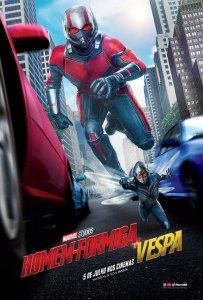
The tech, as before, takes centre stage, this time adding to the excellent work the rest of the movie is doing rather than acting as a crutch to carry it. The gimmick of the cars shrinking and growing in chases is well-used and never outstays its welcome, the building shrinking into a travel case-size complete with handle might have been better served not being revealed in trailers but still looks cool, and the fight sequences, especially those involving Hope in what appears to be a far superior (certainly in terms of combat) suit are all great, making use of decent stunt work as well as imaginative storyboarding with the shrinking/growing mechanic. The Quantum Realm still looks very much like the trippier side of the FX from Doctor Strange and I’m still not betting against a crossover there at some point and overall the movie zips along and looks bloody impressive as it does so.
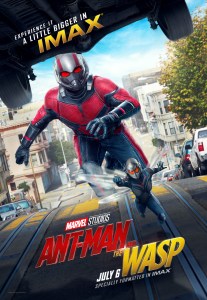 It’s not faultless. That misdirection theme I mentioned permeates everything, meaning that the movie itself is quite often working hard to distract the audience from certain elements of its plotting being nothing really new. There’s a McGuffin to be recovered, an arbitrary time limit to be adhered to, and plenty of last minute saves being pulled off. In its barest bones, the script is a straightforward three act superhero movie, and that means that if you come to it expecting narrative invention to match the visual invention on display then you’ll leave disappointed. It also leaves certain crucial elements of its own plot logic a little murky and confused – why does Ghost’s attempt to draw quantum energy from Janet nearly kill the latter but minutes later Janet can just ‘give’ her the energy? Why is Ghost fighting against Hank and Hope at all when it would seem to have been much easier to approach them for help? There’s a certain point in the third act where you realise (before the characters) that both Scott, Hope and Hank and Ghost and Bill are working to achieve pretty much the exact same thing, and that the only reason Burch even vaguely comes close to stealing the lab for himself is because they’re fighting one another for no real reason. Sure, it’s possibly something you could write off as a typical bit of ‘handwaving’ movie logic, but when a movie is this obviously pleased with its cleverness (and no, having a character point out that everyone seems to just add the word quantum to everything doesn’t make that any less of a silly thing to keep doing) it grates to have elements like this present.
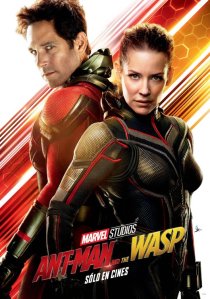 Overall though, it’s a fun ride, a vast improvement on its predecessor in many ways and does a lot better at integrating the characters into the wider universe than it really could ever have been expected by audiences to do, while still serving as the enjoyable palate-cleanser we all needed after being forced to witness half our heroes turn to dust. The question mark added at the end of ‘Ant-Man and the Wasp will return’ at the end is a cheeky final wink to the camera, and it’s difficult to imagine this duo not coming back for at least one more ride.
 Doctor Who News Star Trek News
 Sci-Fi Bulletin: Exploring the Universes of SF, Fantasy, Horror and Spy-fi!