Feature: The Flight to Dark Phoenix Part 9: X-Men Apocalypse (2016)
Days of Future Past was the highest grossing and most critically appreciated entry in the Fox X-Men universe (right up until Deadpool overtook it two years later). In the wake […]



Days of Future Past was the highest grossing and most critically appreciated entry in the Fox X-Men universe (right up until Deadpool overtook it two years later). In the wake […]
 Days of Future Past was the highest grossing and most critically appreciated entry in the Fox X-Men universe (right up until Deadpool overtook it two years later). In the wake of the Merc with a Mouth’s impressive run, and going up against the MCU’s third entry in the Captain America movies, could X-Men Apocalypse possibly hope to better or even sustain that momentum?
Ten years after Mystique protected the President from attack by Magneto on live TV, the world has learned to tolerate, if not fully accept, mutants. But the rise of a new and powerful mutant from ancient history will upset that precarious balance and threaten to destroy all of civilisation at the same time.
 Apocalypse is not a movie which tends to get a lot of affection from critics or fans. Released the same month as the MCU’s Captain America: Civil War, and mere months after the massive success of stablemate Deadpool, the movie arguably faced more obstacles to its success than merely its own quality. However good it had been, it would have struggled in the shadows cast over it.
However, what really makes Apocalypse struggle, in my opinion, is that it’s too many threads for one movie. There’s stuff of genuine interest here in terms of all the various characters, and Apocalypse as envisioned here is a villain with real potential. But for some reason the screenplay squashes in what should have been at least two movies’ worth of material into one, slightly bloated 144 minute run time.
For context, I myself had never seen the movie until I came to write this feature. The trailers hadn’t especially grabbed me, I had a lot on at the time it was at the cinema and I’d just never got around to it. Word of mouth hadn’t persuaded me that I had missed anything. So I came at this one with no expectations.
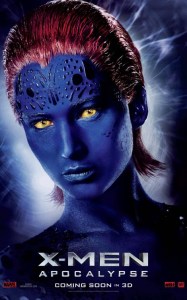 In many ways, the movie carries on the good work done by its predecessor. The returning cast are all excellent, and the narrative around a lot of them is well-written. Jennifer Lawrence’s Mystique is now a full-fledged underground operative, working alone to free mutants who are enslaved by humans in a world that is no longer officially frightened of them but in reality doesn’t treat them any better. This alone is a nuanced take for a comic book property, typical of the franchise. It also reflects the reality of the world in which we live – freeing a group from the oppression of the authorities doesn’t necessarily (or even usually) free them from the oppression of the people. Lawrence by this time had already won an Oscar and it’s clear from performances like this one why that is. She’s assured, confident and calm but there’s always that slight hint of fragility suggested just beneath the surface. In this world, Mystique is a hero to mutants everywhere, and that’s not a weight that sits easily on her shoulders. All she wants to do is keep helping people one at a time, and one suspects that’s because the thought of stopping and confronting her own demons isn’t just scary, but may actually break her.
 The other strong performance is Michael Fassbender as Magneto. As the film opens, Erik has taken a new name and identity, and works as an ordinary man among his fellows in Poland. It’s a shame that the genuine weight and pathos Fassbender brings to the role are slightly undermined by how very obvious the screenplay makes it that his wife and child will be fridged shortly after they’re introduced. Indeed, it’s a same that writers still take this easy shortcut to motivate male characters in the twenty-first century at all, but it’s hard to argue that Fassbender doesn’t manage to make it work. There’s a real pain to watching him make the transition from a man who’s content to live his life in peace to one who wishes instead to rage at the world, and it’s thanks more to acting than writing. It’s that same acting that helps sell the clumsily written turn in the third act climax, as he decides to stand against Apocalypse alongside his old friend Charles, though unfortunately after he’s made his declaration on that count the script gives him little to do.
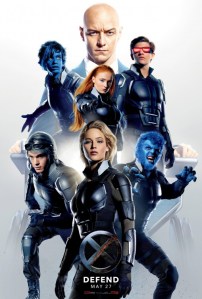 Elsewhere, everyone who returns from previous roles does solid work. James McAvoy still navigates that thin line between Xavier’s earnest belief in the goodness of the human condition and his own personal faults very well. His reuniting with Moira MacTaggert is a great example of this, although it’s a shame that the movie allows him to get away with revealing to her that he’d wiped her memory previously and then just saying sorry. In a franchise like this, which has traditionally *ahem* struggled in its representation of female characters, it perhaps shouldn’t surprise all that much. But damn it, it might have been nice to have slotted in a discussion about violation and consent there.
Nicholas Hoult somehow manages to feel like he gets less to do this time around – odd as I’m sure he gets more screen time – but it’s difficult to escape the impression he’s the ‘Q’ of the X-Men series now. Wheeled out to describe whatever gadget, serum or other plot-related MacGuffin the script requires, Beast gets very little else to do and zero character development.
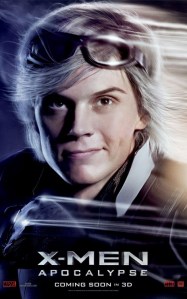 Evan Peters’ Quicksilver gets much more to do this time around than his extended cameo in Days of Future Past, but the script still can’t quite wrestle itself away from the question of why he can’t solve everything. They’ve actually made Quicksilver so fast now that he can save over a dozen people from different locations of a sprawling mansion as it’s exploding and have them all out safely before the explosion itself finishes. Cool as this sequence looks (and it does), it does rather beg the question why any of the other X-Men is ever needed. The attempt in the third act to have Apocalypse answer this by hobbling him is weak. Whatever grab bag of powers Apocalypse might have, speed is never listed as one, so how he pulls this one off is less clear than why the script needs him to. Lucas Till’s Havok returns and is mainly there to introduce little brother Scott Summers before dying so that Scott can have a motivation of his own.
As far as new characters go, this is another area where the narrative starts to feel squashed. The first X-Men trilogy felt like it rushed the Phoenix saga by doing slow, almost imperceptible build-up for two movies and then utterly fluffing the landing. Here, the movie decides it just doesn’t have the time to do anything other than throw Jean at us, have her explain everyone is scared of her and then legit just turn into the Phoenix to kill the bad guy at the end out of nowhere. No build-up, no hints. It’s like Singer knows we know that’s an element of the Jean Grey character so just foregoes any build-up, trusting us to just go for the ride. It’s a shame because Sophie Turner proved over eight seasons of Game of Thrones to be a fantastically versatile actress. Given a better script, she could genuinely have done justice to the nuance and range that Jean requires. Instead, we have this.
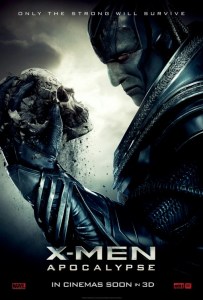 Alongside Jean we have Tye Sheridan as Scott Summers. Again, there’s so much potential here – I like the idea of young Scott being a rule-breaking hothead who will grow into the Cyclops we know through his own trauma and experience. But the movie rushes from his introduction to losing his brother to new, responsible Scott 2.0 far too quickly, and again leaves the actor nothing to work with.
It also shouldn’t surprise me anymore that Storm gets wasted, but she does and it does. Here is an integral member of the X-Men, and one of the more interesting characters in the canon. Again, there’s suggestion of a decent potential arc here. We see a young Ororo, played by Alexandra Shipp, as a thief using her powers in order to be able to eat. Then she meets Apocalypse, becomes one of his four… horsepersons I guess, and gives up any chance at a character arc beyond ‘Will turn good at the end’ and that’s that. New female character Psylocke gets even less. Olivia Munn can’t do anything to salvage a character who has nothing but bits of plot-pushing to do. The fact she slinks off alone at the end suggests that maybe the studio had promised Munn future appearances in the role, but this gives us nothing. Rounding out the four is Angel, played by Ben Hardy. Same issues as everyone else. Interesting idea, utterly wasted. Also add ‘I guess we are just committed to forgetting The Last Stand ever happened and that Angel was already a totally different character then’ to the list. Add Kurt Wagner to that list as well. Apologies to Kodi Smit-McPhee, who I’m sure does his best, but he can’t hold a candle to Alan Cumming.
 To that last point, it gets more obnoxious as these films go on just how committed Singer seems to be to disavow at least one of the X-Men films he wasn’t involved in, and how the studio let him get away with it. We know The Last Stand divided audiences. We know that it wasn’t as strong as the previous entries (in itself a fairly low bar). But there’s something that feels inherently wrong in a filmmaker so actively using his work to disparage that of others. I don’t need Jean’s not-at-all-veiled remark that we should ‘agree that the third one is always the worst’. It’s just aggravating.
If it feels like I haven’t mentioned Wolverine yet, yes he’s in there. No I didn’t find his extremely brief cameo jarring, nor did it take away all that much from the multiple plot threads of the film. Having the X-Men release him from Alkali Lake once Jean has ‘given him back some of his memories’ serves as a nice tie in with what we know about the character from previous franchise entries. It also maybe even serves as some sort of explanation as to why he is so fixated on Jean when he first meets her in X-Men. Compared to his ‘Yes, Jackman is in this one’ box tick of a cameo in First Class, I’m not sure why this was a point of contention for the movie with audiences.
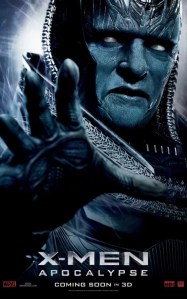 If there’s one character who gets completely under-served by the narrative though – especially given that the movie bears his name – it’s Apocalypse (or En Sabah Nur, if you prefer). Oscar Isaac is a talented actor with some great range, but here he’s buried under an acre of prosthetics and costume and his voice is overlaid and distorted so much it could be anyone. As with everyone else, the character presents an intriguing idea – the first (or at least the first powerful) mutant who can transfer his consciousness to other mutants and cumulatively acquires their powers as he does so. Having this ancient terror emerge into a new world thousands of years after he last saw it presents all sorts of possibilities. Unfortunately, echoing Suicide Squad’s Enchantress, he decides instead to destroy everything with the help of lots of gesturing and swirling debris flying everywhere. His selection of his four seems entirely arbitrary. His granting them fuller use of their powers doesn’t seem anything of the kind. Storm and Psylocke get new costumes. Angel gets his wings replaced with metal ones that can shoot their ‘feathers’ as blades. Magneto gets… a new helmet? Even his plan to assume Charles’ body and powers doesn’t seem to make much sense. A man who wishes to be worshipped as a God seems to ignore the potential to control every being on Earth in favour of… well, it’s not ever really made clear. All we know is that he wants Charles’ body for reasons.
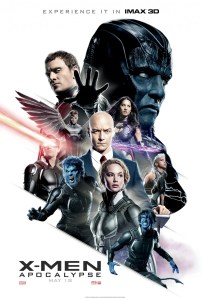 None of it is actively terrible for its genre. It is full of interesting ideas and plot threads which either get rushed or simply discarded altogether. It feels very much like it should have been two films – one setting up the threads on the way, with Magneto, Storm, Jean and others, and the second dealing with the emergence and threat of Apocalypse. That it tries to smoosh them all into one single narrative means that none of what it does feels satisfying. It’s a whole movie full of amuse bouche, with no main course to speak of. When you consider that this was running in theatres alongside Civil War and all of the complexity, world-building and character payoff that film brought to the table, it’s little wonder something this workmanlike gets such a bad rap.
 Doctor Who News Star Trek News
 Sci-Fi Bulletin: Exploring the Universes of SF, Fantasy, Horror and Spy-fi!