Feature: The Flight to Dark Phoenix Part 2: X2 (2003)
With 2000’s X-Men proving to be a success (and acting as the springboard Marvel Studios had hoped for other projects to be greenlit including Incredible Hulk, Spider-Man and Fantastic Four), […]



With 2000’s X-Men proving to be a success (and acting as the springboard Marvel Studios had hoped for other projects to be greenlit including Incredible Hulk, Spider-Man and Fantastic Four), […]
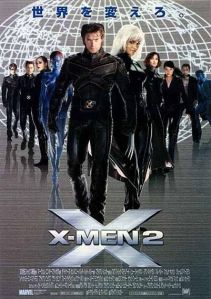 With 2000’s X-Men proving to be a success (and acting as the springboard Marvel Studios had hoped for other projects to be greenlit including Incredible Hulk, Spider-Man and Fantastic Four), Fox almost immediately greenlit a sequel, with the same cast returning and new characters being added. But, asks Greg D. Smith could the film do better than its predecessor in telling an interesting and nuanced story with these characters, or would it tread an easier, less satisfying path once again?
After an apparent assassination attempt by a mutant terrorist on the President of the United States, Colonel William Stryker is given authority to conduct operations to investigate the Xavier School for Gifted Youngsters, which is a cover for Stryker’s much more terrifying plans. The X-Men must turn to old enemies for help to unite against this new threat.
X2 is often considered in genre circles to be one of the best entries in Fox’s X-Men franchise, and it’s certainly true that in this instalment everyone gets a lot more to do, even if once again Hugh Jackman’s Wolverine rather steals the show most of the time. At a full half hour longer than its predecessor, the movie has no trouble in filling that time with a plot that ranges widely and includes more than a few twists and turns along the way. In fact, if the film has a problem, it’s that it almost tries to do too much and introduce too many new players into the game.
 Opening with a frenetic scene in which newly introduced mutant Nightcrawler apparently tries to assassinate the president, the film never really drops its pace from there on, moving frantically from one action set piece to the next. Certainly there are slower, quieter scenes, but they remain in the minority as the film appears to revel in its ability to do more, with Bryan Singer demonstrating a much better, grander eye for filming action sequences than in the first film and apparently deciding to run with this.
There’s a lot more focus on the school this time around as well – both in terms of Stryker’s interest in what it is and how it’s being used as well as just generally actually taking some time to show the children in class, on a field trip and just being around the mansion. This is important, because part of the hook about X-Men as a movie franchise revolves around mutants of previous generations doing their best to make a better world for the future ones, though crucially of course they differ in their methods of so doing. By placing more focus on the young mutants this time around, there is more of a sense of the battle for their souls taking place between Charles and his philosophy of quiet, patient integration, and Erik and his more forceful alternative.
 But best of all, Stryker himself serves as exactly the sort of villain who focuses the attention of both sides of the conflict. His plan – which in fairness almost acts as a sort of reversed version of Magneto’s from the first movie, but on a much larger scale – represents an existential threat to every mutant on the planet, Charles’ X-Men and Magneto’s Brotherhood of Mutants alike. In the face of such a threat, the two factions have little choice but to co-operate, though it is noticeable that the screenplay works cleverly to take Charles out of the equation before this choice is foisted upon them – one suspects that he may have been a little wiser to his old friend’s long game a bit sooner than his proteges prove to be.
But not only does Stryker represent the sort of villain that provides an excuse to tell a story of heroes and villains teaming up to stop him, he’s also actually a very well-realised character in his own right. It actually rather highlights how limited Senator Kelly was in X-Men as an antagonist – a man who simply hates mutants just because they’re different and feels that they should be properly monitored and controlled. Stryker, on the other hand, has a personal stake in the conflict. His own son is not only a mutant, but one who tortured he and his wife to the extent that she took her own life with a power tool. Stryker is also a man who isn’t afraid to get his hands dirty, a lifelong military man who ‘ran black ops in Vietnam’. For him, the conflict is deeply personal, and this is highlighted not just by his plan to murder every mutant in the world in one fell swoop, but also in the way in which he casually uses mutants against their will and is willing to dispose of them as necessary. Indeed, as we learn in one of the plot points that starts to strain the movie at the seams a little, he’s the man responsible for the creation of Wolverine, having sought to make a perfect living weapon to do his dirty work for him. Brian Cox clearly has a lot of fun in the role, and manages to keep the character just at the appropriate tone – never at any point does he even threaten to chew the scenery, delivering instead a cold, calculated and chilling performance as a man who has a goal and will do literally anything, no matter how distasteful, in order to achieve it.
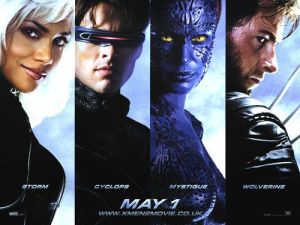 On the heroes’ side, Jackman gets a major slice of the pie in terms of attention and cool scenes, and no amount of snarking by Ian McKellen’s Magneto about how Wolverine always thinks it’s about him can disguise this. Jackman proves equal to the task of course, finding his feet and turning that natural screen presence and charisma from the first movie into a genuinely skilled performance. It’s nice to see the movie give him more (though not too much more) to do this time than simply growl at people and flirt with Jean, and the tension created by the conflict between his own desire to know more about who and what he is and what he feels is his duty to protect the denizens of the X-Mansion is real and effective. He also gets a lot more action this time, as Singer flexes presumably that bigger budget as well as this newfound confidence he seems to have acquired. Granted, it’s still all bloodless, but it’s as brutal as the 12 certificate will allow it to be and certainly leaves us in no doubt as to the man’s talents.
 Elsewhere in the ranks of the good guys, it’s a mixed bag. Jean gets more to do, though it’s hard to escape the notion that’s partly because the script works to take both Scott and Xavier out of the equation for much of the film, leaving her to basically make her own decisions absent the two men who seem mainly to seek to control her ‘for her own good’. There’s also a lot more foreshadowing laced throughout this one on this viewing than I recall from when I first watched it. Yes, we all saw the phoenix shape in the water at the end, but there’s also a palpable sense of something building in Jean throughout the film. The fiery eyes that come out every so often aren’t exactly subtle, but then this isn’t a subtle plot point – Jean is the sensible, buttoned down one, and there is an underlying reason to that which has nothing to do with her own self or abilities and an awful lot to do with people around her (one in particular) who know exactly how powerful she is and what she could do if that power were to ever be truly unleashed. Unfortunately, much as the movie does good work in foreshadowing all this, it still doesn’t really allow Jean to show us much of who Jean actually is. Hopes are high early on when she and Storm are sent off together to try to locate the would-be Presidential Assassin, but amazingly the script contrives to have them speak together hardly at all, and when they do, to talk about other male characters.
This is even worse for Halle Berry’s Storm, who unfortunately gets no forward development at all. Once more she’s there to be wheeled out every time her powers might prove useful to the gang (including at the end a confusing bit where suddenly she can make the environment really cold, which doesn’t seem directly linked to her power set of controlling storms) and otherwise what little personality she is allowed to reveal tells us that she’s kind (which we saw in her interaction with Kelly in the first movie) and she’s angry at a world which has always treated her poorly because of what she is (again covered in the brief conversation with Kelly the first film allows her). It’s little wonder, between this franchise and the execrable Catwoman, that Berry seemed to swear off the genre for years, pursuing more serious roles and depriving action movies of a genuine natural talent.
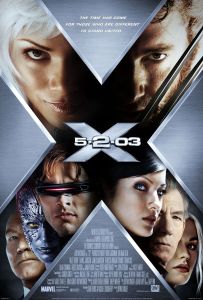 Cyclops, amusingly, doesn’t even get to be in most of the film, and then parts of what he is in involve him acting under someone else’s control. That said, although the display of man-pain between him and Logan as Jean sacrifices herself is a little tiresome on one level, it’s also nice to see that the film allows that nuance – both men loved Jean in their different ways, and where the film could have taken the easy way out of having them come to blows after her ‘death’ it instead allows a bit of realistic emotion, as they both just sort of collapse onto one another in a moment of shared grief that feels genuine, even though one suspects it comes from very different places.
Patrick Stewart gets more to do than the first film, though again spends a decent chunk of proceedings as a mindless zombie. I can see the dilemma Singer had in trying to make an action franchise where one of the main characters is an elderly man in a wheelchair whose powers are all about mind control and telepathy, but it’s difficult to escape the feeling yet again that the vast talent of Stewart is being drastically under-utilised by the script. To his credit, Stewart never commits any less than 100 per cent to every scene he’s in, but he gets so very little to work with.
 Alan Cummings as Nightcrawler is a delight, though again it never quite feels like the film gives us enough of him. Still, what he gets, he works with diligently, giving us a pointy-eared, claw-handed, long-tailed blue protagonist with whom it is impossible not to feel sympathy. The kids get reduced mainly to Rogue, Bobby and new kid John Allardyce aka Pyro who unfortunately is a little too obviously signposted throughout as ‘the kid who will wander off with Magneto at the end’. Anna Paquin once again gets mainly to be a passive object for the plot to happen around – Bobby gets jealous of her obvious affection for Logan, Bobby wants to take their relationship into the physical but she isn’t able to for obvious reasons and so on. The one opportunity the film has for a point of genuine interest for her – when the X-Men are forced to join forces with the man who literally tried to murder her last time she saw him – gets brushed off in a silly scene where Magneto and Mystique giggle together while looking at her and then Bobby stops her from reacting. If there’s one thing this film doesn’t do too well, it’s giving its female characters much in the way of agency, and as before, Rogue’s only ‘choices’ involve stuff she does to save other people (stopping John from burning a gathering of police alive and piloting the X Jet near the end).
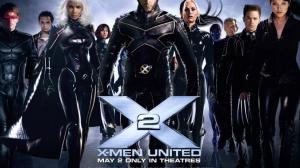 Not that the women on the other side of the fence get much better. Rebecca Romijn-Stamos returns as Mystique and the plot yet again gives us ever more hints as to just how amazingly talented and brilliant the woman is without bothering to give her much to do. She gets to seduce a security guard as part of a convoluted plan for the release of Magneto. She gets to do some proper espionage and she gets to do some fighting, but mostly we are left to assume her brilliance either from the pronouncements of other (male) characters or simple inference. Consider for example, what sort of talents she must possess to not only have assumed the appearance of Senator Kelly for some time, but also his complete identity, doing his job and living his life with nobody being any the wiser. Consider how intelligent she must be to have hacked Cerebro in the first film and to deal so effortlessly with the security systems at the facility in this film. But nope, the movie is content to let us stare at Stamos’ painted frame and assume she must be good for something, while leaving her still the only female representative in the Brotherhood and denying her even one exchange with any other female character.
 And then there’s Lady Deathstrike, Stryker’s newest adamantium-upgraded assassin, who doesn’t even get a mention of anything other than her first name the entire film. Given that we know she’s under the same mind control Stryker uses to coerce information from Magneto, it seems a trifle harsh that Wolverine kills her as brutally as he does, but then she spends the entire film doing very little except stand next to Stryker until that final, fateful fight scene which lasts scant minutes and sees her defeated despite every suggestion that she’s a quicker, more agile and more talented fighter than Logan. As for dialogue – she gets one line, and it’s inconsequential.
McKellen of course gets a lion’s share of the scenes he’s in, and it’s still a pleasure to see his take on the character. His Magneto is by no measure a good man; he’s as prepared as Stryker to use others – even his closest and oldest friend – to achieve his own ends, and he isn’t shy about murder either. But there’s still that sense you can never quite escape that the man has a point, albeit he goes about doing what he does in the most horrific ways.
It’s to the credit of the movie that it gets as much done with its many plots as it does without ever losing clarity on any of them. Of course much of this comes from shortcuts like having certain characters be absent for long stretches, and giving your female cast and quite a few members of the male cast little to do except exist in service of certain story beats, but still, the movie works efficiently and diligently towards a coherent conclusion in its way.
 It’s certainly more fondly remembered than its predecessor, and one suspects this is because it delivers a lot more action and a sense of a bigger scale. However, by a modern standard it pales into comparison with other movies in the genre, not just in terms of its scale and visual fidelity, but in terms of the tools it uses and the shortcuts it takes to pull it off. It’s not a terrible film, by any means – more akin to a conjurer’s trick of a thing, directing the attention of the audience away from certain shortcomings to leave them entertained, if strangely unfulfilled when they think back on it later.
 Doctor Who News Star Trek News
 Sci-Fi Bulletin: Exploring the Universes of SF, Fantasy, Horror and Spy-fi!