Feature: The Voyage to Aquaman Part 1: Batman (1989)
With Aquaman due to grace the big screen soon as the latest entry in the DCEU, Greg D Smith decides to take a look back at the Warner Bros movie […]



With Aquaman due to grace the big screen soon as the latest entry in the DCEU, Greg D Smith decides to take a look back at the Warner Bros movie […]
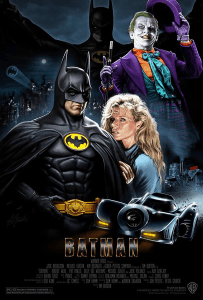 With Aquaman due to grace the big screen soon as the latest entry in the DCEU, Greg D Smith decides to take a look back at the Warner Bros movie project as a whole, beginning with Tim Burton’s 1989 Batman. [For clarity, Nolan’s Dark Knight trilogy will not be included, belonging as it does to its own, separate universe created specifically by Nolan himself around an interpretation of Batman. Nor will we go as far back as the Christopher Reeve Superman movies, which belong to a different, lighter age of WB/DC superhero adaptations.] So how did the quirky, non-comic book-reading director of Pee-Wee’s Big Adventure do with interpreting one of the most enduring comic book characters of all time on the big screen?
As its bicentennial celebrations approach, Gotham City is in the grip of crime boss Carl Grissom and his henchmen. A new masked vigilante – The Batman – is in town, scaring crooks and causing intrigue in the press and headaches for the Mayor and police. But when Grissom doublecrosses his top lieutenant over their shared affections for his lover, it sets in motion a chain of events that will cause havoc in the city, and force the caped crusader to confront some very personal demons.
It’s difficult to appreciate now, in this age of comic book movie ubiquity, but there was a time when superhero movies were difficult to get made. Batman had been circulating as a proposed film project since the late 1970s, with CBS’s preference to make a Batman in Space movie. The television series, though successful, was increasingly seen as too campy, and not fitting with the darker tone that was being taken in the comics. Superman was still seen as something of a lightning in a bottle moment – the combination of Reeve’s innate charm and charisma married to the direction of Donner and the immortal score of Williams (with later sequels being generally quietly ignored) – and the general feeling was that movies based on these characters were difficult to get right on screen and certainly did not merit large budgets.
 What’s perhaps easier to appreciate is the concept of fan backlash. In the modern age it is easier to see and far more prevalent with social media spreading the outrage in seconds. When Heath Ledger was cast as the Joker, social media was still in its relative infancy but the outrage was still visible for a casting choice many saw as simply insane. When Ben Affleck was cast as Batman, the reaction was louder, amplified by YouTube, Twitter and Facebook, as amateur and professional critics alike declared this to be the worst casting decision ever made. Spare a thought then, for Tim Burton and Michael Keaton and their announcements as director and leading man respectively for what would eventually become 1989’s Batman. Having collaborated on Beetlejuice, the two had a good working relationship, but the sort of dark, angsty Batman that the new generation of fans wanted, thanks to Miller’s Dark Knight Returns among others, didn’t seem possible from a director and actor mostly known for their comedy chops. How wrong they all were.
The first thing one notices on a rewatch of Batman (especially on Blu Ray format) is how differently these sort of films had to be made back in the age before CGI. Matte painted backdrops, models and blended animation effects are all visible in HD format, though crucially not to the point of making the film look bad, However ‘primitive’ these techniques might be by modern, computer-powered standards, they stand up remarkably well.
For all the slightly primitive visual work, it has a rather timeless aesthetic, which is not to say that there aren’t factors that wouldn’t date it for a modern audience – there are no mobile phones, no internet etc of course, but there’s also never really a firm commitment to a definite time period. From the sprawling gothic architecture of Gotham, the oddly nourish feel to the villains and even the cars, everything about Batman feels as if it’s calculated to give the most vague hint in the direction of a timestamp, because when it happens is never as important as where. Burton here lays down many of the visual markers that would go on to define Batman in the medium of film and television for decades to come – witness Batman The Animated Series, the Arkham series of games and so on. The darkness, the rundown, beaten up nature of Gotham and the ubiquity of gargoyles and other gothic accoutrements would become staples of the new Batman aesthetic.
 In no one single factor is that visual aesthetic lain down harder than in the Batmobile. Every later cinematic incarnation of Batman’s wheels can trace its DNA back to this sleek, lengthy, brooding monster of a car, replete with its bat wing fins, impractically long bonnet and array of gadgets and weapons. The 1960s TV Batmobile may have started the love affair of Bat-Fans with his mode of transport, but Burton’s creation cemented it, and has arguably never been bettered, only aped in some way.
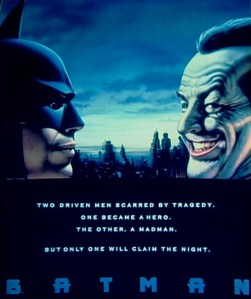
Delving into the character work itself, it’s interesting that, whereas Burton’s narrative does have Wayne and Napier set up as opposites, they have very little in common save the moment their alter egos are created. Forged in violence, Batman and the Joker are each ‘created’ by the other (as explicitly stated in an exchange towards the end of the film). Often in comic books and their movie adaptations, the villain serves as the dark mirror to the hero. But whereas Keaton’s Batman can be argued to stand for order and justice, Nicholson’s Joker is (unlike Ledger’s many years later) less an agent of chaos and more an agent of self-serving venality. When this Joker does anything at all, it’s to satisfy his whim in the moment. From disfiguring his girlfriend to shooting his most loyal henchman dead because Batman took his balloons away, this is quite literally a man without a plan beyond pure self-gratification.
What’s fascinating to see is how nuanced and layered Nicholson’s whole performance is throughout the film. As Napier, he’s icy cool, calm and measured. Though the corrupt Eckhardt describes him as an ‘A1 Nutboy’ and even the police file Bruce reads on him describes him as mentally unstable, what we see on screen is a man who is deliberate and focused with every movement and gesture. None of that precludes outbursts of violence, of course, but the point is that we never see them. All we see is a man totally in control of his emotions, even when he realises that he’s been left to die at Axis Chemical, and when he’s confronted with Batman for the first time. Jack Napier is a stone cold killer. The Joker is murderous too, but there’s an instant change in demeanour and behaviour when that transformation has happened. It isn’t just the raucous giggling, it’s again in every movement and gesture. Suddenly everything is exaggerated, turned up to eleven, and there is a sense that one never knows quite what the Joker will do next, least of all himself. Crucially though, there’s still elements of Napier buried in there. The refusal to be discouraged by failure (‘Where does he get those wonderful toys?’ he calmly exclaims, as Batman escapes his grasp), the turning on of the calm, focused charm when required (his meeting with the mob bosses shortly after Grissom’s death, before he murders one of them, and his TV appearance to announce a ‘truce’ for the bicentennial). If there’s a mirror to the two characters, it perhaps lies in the fact that each of them can only truly be themselves when they wear a mask – for Napier it’s when he applies flesh makeup and dyes his hair that he can reassert himself as the criminal mastermind, whereas with Wayne it’s only when he dons the cape and cowl that he can become the man he is, rather than the man he pretends to be.
 And on that subject, has there ever been a more perfect performance of the Bruce Wayne/Batman central character? What strikes me first seeing this iteration is how much less tortured Keaton’s Wayne/Batman got to be. It’s an oft-repeated critique of comic book characters generally but Batman in particular that we see origin stories too many times. By now, we all know the basics – Bruce’s parents die in a mugging gone wrong, shot dead in front of him when he is a child, and the trauma of the event drives him to become Batman and bring justice to Gotham. Here though, it’s possible to see how badly wrong and exaggerated subsequent takes on the character got this. Keaton’s Wayne isn’t constantly brooding over parents he lost decades ago. There’s no suggestion of a lasting trauma driving him to see the face of his parents’ killers in every criminal he apprehends, nor of him experiencing any sort of internal torture. He simply sees bad things happen and acts to stop them.
More to the point, Keaton doesn’t need a voice changer or to put on a gruffer accent as Batman. Like Nicholson, his performance is all in the nuance and physicality of the two halves of his personality. Wayne is a likeable, forgetful, slightly bumbling character. And there’s a sense that in social situations that isn’t an act (the sequence at the party where Alfred follows him rescuing a pen and a glass he absentmindedly drops serving to illustrate the point). When he’s alone, he’s much more together, but there’s still a sense of repression, of holding back something within himself, walking – as it were – with stooped shoulders. That restraint drops away when the costume is donned. Keaton’s Batman is a physical presence – precise and economical in movement and speech. He doesn’t need to scream at a villain to terrify them – a simple smile is sinister enough – and he rarely speaks more than he needs to.
He’s also not immortal, and this too actually adds to the impact of the character. This is a Batman we see bleed, stumble and get hurt. For all Nolan’s vaunted efforts at realism in his Dark Knight trilogy, there was no escaping the fact that his Batman pulled off superhuman feats of physicality regularly at the height of his powers. Here, we have a Batman who can fight, and who has the range of gadgets and armour to help him, but who is still affected by what befalls him. For the final sequence, having staggered clear of the wreckage of the Batwing, it’s clear that he’s hurt and not operating at full capacity. Again, this isn’t indicated with anything so obvious as a partly torn mask (a favourite of the genre) or gaping wounds and litres of blood – it all comes from his movement. Stiff, slower, slightly more vulnerable. Even the final save as he shoots the grapnel up that will stop himself and Vicki from falling to their deaths, shows a slight awkwardness to the movement that wasn’t there earlier. For Batman to matter, he has to be a man, with a man’s physical frailties, lest he just be some rich invulnerable asshole. Keaton delivers that humanity with every part of his performance, and it’s why to this day his take on the character is remembered so fondly.
 As to other characters, it’s incredible in hindsight just what a fantastic cast Burton assembled in an era where comic book movies were not the sure thing they are today. The towering Jack Palance makes the perfect Carl Grissom, his massive frame and distinctive voice adding credibility to his ever having been Nicholson’s boss. Basinger – for all that she was drafted into the role on the literal basis that she was readily available after first choice Sean Young injured herself shortly before filming began – does well in a role that gives her very little to do beyond screaming and being kidnapped/rescued (reminding us of just what era from which the movie springs). Importantly, she feels like a believable version of her character – an intrepid photojournalist who is always thinking about the story and has got to the top of her game because of her talent and in spite of her looks. Robert Wuhl’s Knox serves capably in reminding us how the latter might hamper her in her chose profession, albeit Wuhl does manage to keep the character just the right side of sleazy and it’s easy to see why the director liked him enough in the role not to kill him off as originally planned in the script. Pat Hingle does solid work as his own version of Commissioner Gordon – a character that would unfortunately be watered down in subsequent entries – but the biggest waste must surely be Billy Dee Williams as district attorney Harvey Dent, who barely gets to do anything here. The original plan of course was that Williams was getting his character seeded here to become Two-Face in a later movie – it’s tragic that never got played out.
But mainly, this is a film about two characters – Batman and the Joker – and their fight against one another. Burton’s decision to have the Joker be the man who killed Bruce’s parents was one disliked by purists, but here it makes absolute sense, tying the characters together in a way that prevents a need to try and artificially make them similar to one another for the dark mirror effect. It’s enough simply that each creates the other, and the inevitable conflict that flows from this can only have one eventual victor.
With Keaton’s still the strongest portrayal of both Bruce Wayne and Batman together to this day, and with so many iconic aesthetic roots that would inspire onscreen interpretations of the character for years to come, it’s not hard to see why this is considered by many to be the strongest big screen Batman outing to date. And I happily count myself among that demographic.
 Doctor Who News Star Trek News
 Sci-Fi Bulletin: Exploring the Universes of SF, Fantasy, Horror and Spy-fi!