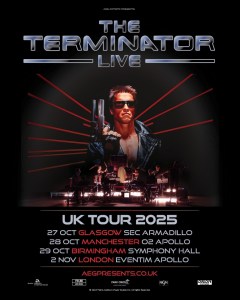
 James Cameron’s The Terminator is being presented live in concert and brought to life this Autumn on a 4 date UK tour by the AVEX Ensemble. Pierre O’Reilly (Producer) and Pete Billington (Musical Director) from the AVEX Ensemble chatted recently with Paul Simpson about the show…
Why choose The Terminator?
Pierre O’Reilly: From an AVEX point of view, we’d been doing the films with live orchestra, and we had a good relationship with James Cameron having done Titanic and Aliens. The sci-fi films, they have phenomenal scores, and also they have a phenomenal fanbase.
Then, because it’s not an orchestral score, it’s synth based, you put your thinking hat on and you’re like, ‘OK, let’s make something of this’, so you introduce elements like taiko drums. You have your three synth players on stage and you have a bigger percussion section and then you have an electric violin thrown into the mix.
We went with that. We were looking at other films as well, like , so it made sense to focus on that size of ensemble with films that would cater to that.
In practical terms, what did you have to work with? Did Brad Fiedel have the full score written out, was it just stems, or were you actually having to sit down and transcribe it?
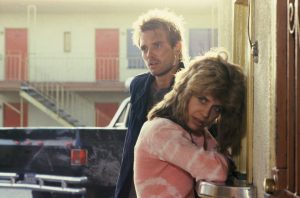 Pete Billington: The latter. It was never written down. Luckily, I didn’t have to do it but that was the first big job, to sit down and try to translate that into musical language, bars and beats and things like that, because a lot of it was just freely played at the time. That was the first big challenge, to work out how to communicate that so that we’re all on the same page and how to sync that up with the film before you even get to worrying about sounds and orchestration.
Once you’ve actually got that transcript in front of you, do you work through it? Or do you look at it and go ‘These are the iconic moments and we will voice these with the ensemble we’ve got and then use that voicing to work outwards for the other sections’?
Pierre: Brad Fiedel used specific synths on the first score, The Prophet. There was no ambiguity there as to what sound was what.
 I think the biggest concern with us was we were introducing elements like taiko drums: aesthetically they’re incredible, they’ve got a big impact, but would they make sense within the score? And they do. You’re also looking at the percussion section because we had these fifty gallon drums on stage, but every drum doesn’t sound the same unfortunately. Rust can affect it in various ways so you’re making sure that the timbre, that sound, is also carrying through and making sense within the score.
Pete: The synth programming obviously is a big part of it to get those sounds and at least you have the reference for what they should sound like, but things like the percussion are always a challenge, especially having done it in different venues. You do have those insane moments where you’re trying to go ‘OK, that oil drum just doesn’t sound right, have you got any other oil drums?’ (laughs) ‘No.’ A niche request!
That was the challenge of putting it together after the writing and programming phase was done.
For a very savvy audience who know the score and the movie, what things might they spot that are different? What might you have given some more emphasis to than got lost even on a 5.1 or Dolby Atmos mix?
 Pierre: AVEX Classics, who are the producers of this, how we operate is: we need to always do these how they were presented in the cinema. That needs to always be the guiding star. There are productions out there that sometimes put the music front and centre, and that really is not how directors envisage it. The film is its entire package so, to answer your question, there might be audience members that will be like, ‘Oh, I wish the music was a bit more to the fore in this section’ because they are going to see a film with a live orchestra but we try our best to present it how it would have been done in the cinema, i.e. Foley, sound effects, dialogue and music hold their space individually and correctly within the film.
What is the most challenging aspect of bringing The Terminator to the stage compared with say Aliens or Blade Runner?
 Pete: Blade Runner has similar challenges to Terminator but Aliens is a written score so it is [different]. I think the challenge is of understanding: if you’re playing a synth part, you might be making quite an unusual noise that you don’t understand necessarily what the context of that is within the score. If you’re playing a violin part there’s a very established hierarchy of how that works and what you do.
I remember the first time we did this, we just got together with the synths to do the synth sounds and to check that they were all sitting correctly and everything was working. That was a very strange experience because we weren’t even doing it really with the film, we were just playing through the patches and to understand how that was going to make sense – but until you do it with the film, you don’t. That’s when you understand the soundtrack and why it’s such a good soundtrack and why it works so well.
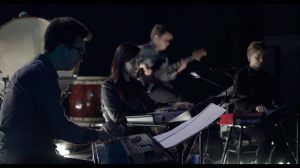 I think [the challenge is] that process of understanding what it’s meant to be doing with the music and what your role is at any given time, what should be to the fore. We work with a great sound engineer because we don’t always know, on stage, what is working and what isn’t. So to create that soundscape as accurately as possible, that’s the challenge. And that’s when you appreciate it as well.
I think that’s why it works as a live thing because if you are watching it then you suddenly realise what the music is doing for the film and you can see moments that you might not notice when you’re watching it not in a live context.
One of the things Brad Fiedel has said was that the score has that 80s feel of ‘if the Terminator is hitting something the music is echoing that action’. Does that make it more complicated for you, when you’re performing it? Or is it just quite simply ‘That note is on that beat, it has got to hit that’?
 Pete: In terms of being synced up with the film? We’ve got time codes and we’ve got some click and we’ve got some streamers. We’ve had to adjust bits as we’ve gone to make sure that it does feel correct but we have a decent idea now that we’ve done the process. It’s not seat of the pants on the night, we’re not having to coordinate every punch, because that work has been done and we’ve finessed that. So hopefully we got it.
Is this basically the score as per the film or have you had to do a little bit of massaging here and there to make it work in this context?
Pierre: No, I’d say it’s definitely the score, because if you were to, like you’re saying, ‘massage’ it, the nature of the score doesn’t allow for that. It would be very obvious that had happened. So, to answer your question, no it’s very much the score as in the film.
The soundtrack is I think 68 minutes or something like that, how much music actually is there for you guys to perform on the day?
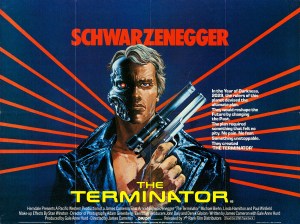 Pierre: I wouldn’t use the soundtrack as a guide. If you talk to Brad, we were only talking to him last week, and he tells that ‘Oh I created this version for the soundtrack’ which is much more elongated, extended, whereas if you go into a dubbing stage and a cutting room, they’re just chopping left right and centre and putting things together for the final dub.
Basically he’s taking the suite method for the soundtrack.
Pierre: More or less, yes.
So there are a lot of tiny cues?
Pete: There are. There’s quite a few bits where it’s just a small bit of music or a small sound effect as well. We’re not sat around doing nothing for that long!
Pierre: I think for a film that’s say an hour and a half to two hours long, then we don’t really look at one that has less than thirty five minutes of music because otherwise it’s kind of pointless. It’s quite boring. But with The Terminator, it’s actually much longer than that, there’s a lot of music in this [checks]. There are 68 minutes of music.
 With any piece of music if you go into it more deeply and you study the score, listen to different performances of it, you discover something yourself about the music. Is there stuff from this, having done this deep dive, that you’ve learned about the way that it was scored or the way that it’s presented that surprised you, that you wouldn’t have thought of, going in?
Pete: I think appreciating the pioneering nature of doing a score this way: not the traditional way of writing some bars and working that out but actually doing as Brad does. There’s basically minimal scoring, some stuff that was sequenced, trying to keep early synthesisers in time with one another, but most of it was just what he felt reacting to the film; almost, really, semi-improvising a score. It made me think, why don’t more people do that today? With more technological sophistication, that would be a really interesting approach to scoring which has mostly gone back to a sort of orchestral thing.
I’ve just been watching my way through all of old Doctor Who, and the evolution of the music – the early BBC Radiophonic Workshop. I just got to Colin Baker and I’m starting to hear The Terminator in that which is interesting.
You got even more of it once you got into the Sylvester McCoy era, composers like Kev McCulloch and Mark Ayres, where The Terminator influence is front and centre, very much.
Pete: That’s it. It’s partly driven by technology but partly driven by what was around, and I guess this is a film that because it was so huge, it really influenced what the future sounded like, on film.
 The Terminator at the time wasn’t as big a hit – T2 was the one that really pushed things. And interestingly, the music of that almost feels slightly more production line than Terminator. Terminator has an independent movie feel to it.
Pete: I think that’s fair. The theme is 13/16 in that, but not by Terminator 2, I think.
No, Fiedel says he put it back to 6/8 for that and I’ll bet every cover of it does a 6/8 version!
Pete: It makes it simpler.
Are you working with the same players all the time for the tour or do you have to bring others in?
 Pete: More or less. The first Terminator we did pre-Covid, and I think this might be the first time that that entire team has been back together but in the interim we’ve done quite a lot of stuff with nearly every player. So yes, sometimes either because of geography or other people’s schedules or whatever, it hasn’t [been possible]. That was the vision of the AVEX Ensemble, and doing these kinds of films. You didn’t want to do it by going, ‘OK, here’s the scores, here’s an orchestra, here’s a conductor who knows it. There you go.’ It’s a different way of doing things and you do need a team. So it’s been quite a consistent team but yes there’s always challenges.
We’ve been saying this is recreating the cinematic experience but with live music; what should audiences who come to this expect? Or what would you want them to come away with?
Pierre: What’s amazing, when you produce these shows, is just observing the audience. We do Amadeus and we do that in the UK, worldwide and America. If you look at a UK audience vs an American audience, the Americans are so like ‘Whoop, yeah!’ They whoop at everything and it’s all very positive and then an English audience or an Irish audience are maybe more reserved than all that.
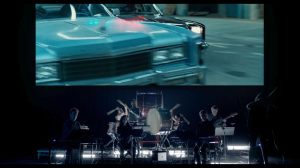 We did Terminator in Chicago last week and the T-shirts, the jackets… maybe it’s a thing with sci-fi, cosplay’s a thing, it allows them to express something in them that otherwise they can’t do maybe outside of a concert hall or a cinema.
As soon as the opening credits happen and there’s Brad Fiedel themes, whether it’s the percussion theme or the main love melodic theme, people just go batshit crazy and it’s great, it’s infectious.
So what can you expect when you go to this? I don’t know, you should just be like, sit down and you hear the music and you see the film and you think ‘Oh my god, I can’t believe I’m here and I can’t believe I’m witnessing this, this is so cool.’ It’s nostalgia and it’s epic.
Pete, I’m sure you can phrase it much better than I can.
Pete: Oh, I have to come up with something pithy to end it, do I? It is that, it’s a different experience from going to see a more classical thing.
 Hopefully people can come and on one level just enjoy the film as a film because it’s a great film to watch and if you haven’t watched it for a while or you love it, that’s always good. Maybe you’ll have more of an appreciation of the role of the music and have lots of fun. If you want to dress up as Arnie, go right ahead – just be careful what scene you pick to dress up as; some are more appropriate than others!
The Terminator Live will tour the UK in October and November, tickets and further information are available at AEGPRESENTS.CO.UK
Thanks to Deacon Communications for their assistance in arranging this interview.




 Sci-Fi Bulletin: Exploring the Universes of SF, Fantasy, Horror and Spy-fi!