Review: Three Monster Tales of Sci-Fi Terror
Eureka Video, out now As the name implies this is release comprises a set of three relatively unrelated Universal Monster movies, all with a science fictional bent, spread across two […]



Eureka Video, out now As the name implies this is release comprises a set of three relatively unrelated Universal Monster movies, all with a science fictional bent, spread across two […]
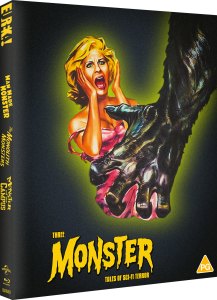 Eureka Video, out now
As the name implies this is release comprises a set of three relatively unrelated Universal Monster movies, all with a science fictional bent, spread across two discs.
None of them are top-ranked classics that viewers might automatically think of when they hear the words “Universal Monsters” – there’s no sign of Frankenstein, Dracula, the Wolf Man, etc. nor do the likes of Lugosi or Karloff show up. We do, however, have Lon Chaney Jr., and if you pause in the right place, a brief Gill-man Easter egg. What the films do have in common is interesting places in the development of both Universal’s movies, and of the SF monster genre.
First up is one of the earliest movies in Universal’s second cycle of monster flicks (the first having included Frankenstein, Dracula, and the Frederic March version of Jekyll and Hyde) – Man Made Monster. Whether the title should be hyphenated is open to question, as it is in the pressbook and posters, but not on the title card, and the alternate grammar does still fit the plot. That said, although this was the original release title, it was written as The Electric Man, and circulated for years on TV as The Atomic Man.
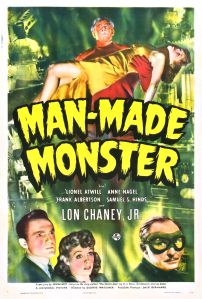 Here, Lionel Attwill – best known as Moriarty in Sherlock Holmes And The Secret Weapon, and as the one-armed police chief in Son Of Frankenstein – is a mad scientist, Dr Rigas, who discovers that a carnival showman – Lon Chaney Jr. in his pre-Wolf Man horror debut – is basically immune to electricity and can be charged up with electricity, proving his theory that life is electrically-based. However, when his superior and landlord wants to take the research slowly, the naughty Attwill murders him, persuades Chaney that he did it, and programs him to go with that line. Unfortunately that electricity has to get out somehow and soon he’s a rubber-suited glowing killer who accidentally zaps things. Hilarity ensues. Sadly the plot’s simplicity requirements to meet the set-pieces actually act to the detriment of several characters and their performers- most notably Anna Nagel as the heroine whose inability to notice that Attwill is a wrong ’un even after she’s found his diary and after his confession, is mind-boggling.
This is Attwill’s show all the way, and he clearly loves it, while Chaney is affable and gives a decent early look at his tragic monster persona that will be fully formed in The Wolf Man. He’s much cheerier here though, but is largely paired with a scene-stealing dog. The rest of the cast give solid performances, whether the script serves them well or not. The real value in this movie is the transition from the more Gothic European type of traditional horror as seen in the first Universal Monsters cycle, to the contemporary and more science-fictional era to come.
Visually, this doesn’t look anything like as old as the film is; aside from the restorations, the preservation of the print gives it a head start on looking crisp and sharp. As, in fact, does the cinematography, particularly in the second half, when Attwill is in full nutcase mode, and the cinematography is going towards a proto-Noir vibe, with lovely light and dark contrasts.
Plenty of elements have been borrowed from earlier films, most notably the impressive glowing effect having been developed and perfected from The Invisible Ray, while it provides a kind of mid-stage in between the earlier The Walking Dead with Bela Lugosi, and the much later Indestructible Man which also starred Chaney, at the end of his career. More directly, Chaney’s performance had him slotted nicely into The Wolf Man later in 1941, and Attwill’s lab equipment is all new, more modern-looking looking instruments which would go on to appear in the rest of the Frankenstein/Dracula/Wolf Man crossover series all the way up to Abbott And Costello Meet Frankenstein and beyond.
Although the film is somewhat stagey, and the pacing inconsistent – frequently slow when it needs to be fast, and fast when it needs to be slow, something all three films here have in common – there’s plenty to enjoy. Chaney is a likeable enough fellow, the effects for the era are excellent, there’s a sensible reason for the monster’s costume, and the whole picture just looks like it was filmed and printed yesterday. And at a mere hour long, there’s no danger of it outstaying its welcome.
The commentary on Man Made Monster is by Stephen Jones and Kim Newman, and is a fun appreciation of the film, with lots of background and links to other related movies, which is a joy to listen to, especially if you’re a fan of the genre or the era.
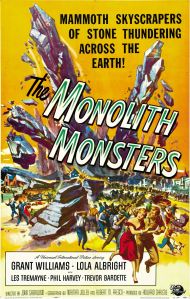 The second film on Disc 1 is something actually really special, both in and of itself, and for its placing in how we view the SF and horror genres. The Monolith Monsters is another very simply-plotted film, in which mysterious rocks found scattered around an eerie desert area have the ability to seemingly turn people to stone, and to grow… How can the local Sheriff and newspaperman prevent them from spreading across the world?
This one’s an underrated classic, even though the turning to stone plotline kind of gets dumped before the end, and there are a fair number of shots made of stock footage from earlier movies, most notably It Came From Outer Space. It has problems, and its director, John Sherwood, is an inexperienced one with a very short-lived directorial career, which leads to some rather stagey dialogue scenes, but beyond that that, the model effects are great by any era’s standards, passing the test of making floodwater look convincing – always very difficult because thanks to its physical properties water never scales well in model shots – and it has the benefit of avoiding the usual US 1950s Reds-under-the-beds thing in favour of basically a force of nature. The shots of the monsters growing, and the long shots of them looming over the landscapes are iconic.
This may be the only movie in which the monster is a natural process, with no nudging from unwise science. In many ways it feels more a British SF movie, in the Quatermass vein, where the problem is unknowable nature, and the scientists and doctors are professionals due respect for problem-solving. In that sense it feels like the antithesis of the US-made SF horror films in which scientists tend to be portrayed as meddlers who need to be carefully watched because the sympathise with, or at least enable, whatever the current Communist avatar is. Seriously, just watch a bunch of Hollywood SF B-movies and see how many of them – The Thing From Another World is a poster-boy for this – are anti-science and pro-firepower.
It’s true that the monsters aren’t really threatening here, but they are fascinating, there’s a wonderfully eerie atmosphere to much of it, and it works best if viewed as proper SF rather than horror. Watch out for an uncredited William Schallert as the weatherman, and be very careful to not watch the trailer before the film, because it totally spoils the ending.
The commentary this time comes from Kevin Lyons and Jonathan Rigby (who is perhaps more associated with writing about Hammer films). This commentary has its fun moments, mainly from Rigby, but comes across as almost apologetic for enjoying the film, as they repeatedly criticise it then add that they love it anyway. Both provide interesting information and links to other films too, though Lyons’s obsession with giving the age at the time of every person he mentions comes over as a little strange.
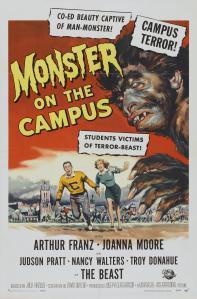 Finally, Disc 2 contains two versions of Monster On The Campus, one of the last hurrahs for the Universal Monster cycles. One version is full-frame, the other cropped to 16:9, but they’re otherwise identical, with the commentary playing over either, and there seems little reason for offering a choice.
This is basically Universal’s response to the AIP type teenage monster movies – even borrowing Whit Bissell (best known for The Time Tunnel TV series) from AIP’s I Was A Teenage Werewolf, but rather than try to compete with their own set of rebellious teens, Universal and director Jack Arnold instead went with having the main characters be the teachers and professors at the campus, with the exception of Troy Donahue’s character, who seems to be the ultra-square prototype for Fred in Scooby Doo.
Again, you can see elements of earlier films being reused here: at base this tale of a professor (Grant Williams) who keeps accidentally getting contaminated by irradiated (by one Dr Moreau on a Comoros island!) blood from a frozen coelacanth and de-evolving into a hostile caveman is really a Jekyll and Hyde story, but one that ultimately makes no sense. Despite seeing him be affected early on and the film making no pretence about his being the monster, there’s a whole bunch of cops and academics interacting with the Professor as if this was a whodunnit. The monster’s appearance is a pull-on rubber mask, and the means by which he keeps accidentally being contaminated get increasingly absurd and comedic. His eventual fate makes no sense even in a Jekyll and Hyde sense, because he has no addiction to it, he gets nothing from it… Literally all he has to do is burn the fish and its blood and keep his trap shut.
That said, the film isn’t without its charms – it must surely have been made as a comedy. The contrariness of making a teen campus monster flick be about the staff; the Easter eggs such as the collection of hominid bas-reliefs including Gill-Man, Piltdown Man, and George Washington; even the cheapo mask for the monster is a mask of Frederic March’s Mr Hyde! As well as following the footsteps of the March Jekyll and Hyde by way of The Neanderthal Man, one can’t wonder if the obvious mask inspired the use of a Shatner mask by Michael Myers in Halloween.
All the cast are likeable enough, but the direction doesn’t really feel like Jack Arnold direction. Picture and sound-wise everything is as crisp and clear as you’d expect from Eureka.
Stephen Jones and Kim Newman return for this final commentary of the set. Again, they bring us an entertaining commentary, with plenty of valid criticisms and information about the film’s place in Universal International’s development, as well as fun trivia and fan-casting.
As usual, the first 2000 copies come with an O-card slipcase and a collector’s booklet written by Craig Ian Mann, which has a good bunch of information about the films, and sets them well in the contexts of their places in the Universal canon and the genre, along with some great stills too. There are also some good stills galleries on the discs, with Man Made Monster being especially good on that front. And the art for the slipcase is tonally just spot-on.
Verdict: This set is pretty decent: Man Made Monster is somewhat of a hidden gem despite its flaws – and gems always have flaws somewhere – while The Monolith Monsters is absolutely an underrated classic, or, if you prefer, a guilty pleasure. Monster On The Campus is, sadly, a rather derivative clunker, but does have some value for its place in genre history, and for its amusing Easter eggs and divergence from the tropes of teenage horror flicks that the studio’s rival, AIP, was having more success with. If you’ve doubts as to its entertainment value, let them be assuaged by knowing that this reviewer’s wife has become hooked on them while the screeners were playing! 8/10
David A McIntee
 Doctor Who News Star Trek News
 Sci-Fi Bulletin: Exploring the Universes of SF, Fantasy, Horror and Spy-fi!