Review: The Long Walk (updated)
Starring Cooper Hoffman, David Jonsson, Mark Hamill, Charlie Plummer Directed by Francis Lawrence Vertigo / Lionsgate – in Cinemas now In a near future America, the county is united behind […]



Starring Cooper Hoffman, David Jonsson, Mark Hamill, Charlie Plummer Directed by Francis Lawrence Vertigo / Lionsgate – in Cinemas now In a near future America, the county is united behind […]
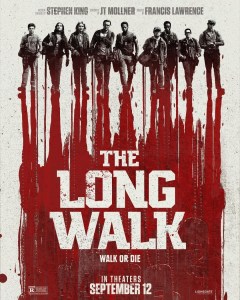 Starring Cooper Hoffman, David Jonsson, Mark Hamill, Charlie Plummer
Directed by Francis Lawrence
Vertigo / Lionsgate – in Cinemas now
In a near future America, the county is united behind an annual event called The Long Walk. One boy from each state is chosen at random to walk until only one is left. The winner gets any single wish. The losers are executed.
Based on the infamous Stephen King/Richard Bachman novel, directed by Hunger Games veteran Francis Lawrence and adapted by JT Mollner, the author of the superb Strange Darling, The Long Walk is crammed with talent at every level in front and behind the camera. The cast is just as impressive. Hoffman and Jonsson we’ll get to in a moment but every level of the cast is stacked with some of the best young actors working today. Ben Wang, excellent in the recent Karate Kid Legends, and Roman Griffin Davis, of Jojo Rabbit, are both especially great, as is Tut Nyuot as Arthur, a kind-hearted boy whose faith is sorely tested and who is the perfect foil for Wang’s peppery, fast-talking Hank. You like all these kids. They all feel real. You see almost all of them die.
Mollner’s script sits in a very unusual space between abject horror, tragedy and lightly romanticised Americana comedy. The deaths, and they come quickly, are brutal and cruel and the camera never really leaves the boys trudging along the endless road. King was reportedly adamant that the executions be on screen and it’s a smart choice. You know all these kids as they start to fall and the few deaths we don’t see directly are cleverly used as dramatic and emotional devices as boys take back the last choice they have and choose to die on their feet, on their knees, alone or with friends. Everyone walks. No one wins, we don’t look away, just like the immobile, traumatised snapshots of American life the boys walk by and the monolithic face of bored, stupid right wing evil embodied by Mark Hamill’s Major. Even the frequent humour is tinged with pain and regret. These characters laugh so they don’t scream and in the end that’s all they have.
The heart of this movie beats in two chests. Hoffman, the son of Philip Seymour Hoffman and excellent in Saturday Night which I also saw recently, plays Ray as a big, calm guy who is quietly seething. He’s convinced he’s the hero of the Great American Novel when he might, at best, be the protagonist. Hoffman brings real emotion to the role (the point where Ray talks about his dad being his hero is especially raw) and finds something very nuanced with Ray. He’s broken, not just by his world but by his upbringing and the way he realises and confronts that is heartbreaking.
But, yet again, this is David Jonsson’s movie. As Pete, the gentle, scarred softly spoken leader of the Walk, he has a natural authority and kindness that commands the screen. He’s also the perfect balance for Ray. The big furious country kid is an open wound. Pete’s scarred face speaks to how hard he’s worked to seal his own wounds. The friendship the two have is poignant, brutally honest and very sweet. It’s also very, very easy to read as a romance and I’m very curious to see reads of the movie that adopt that lens.
All of this is impressive but, in a darkly appropriate beat, the movie stumbles a little at the finish line. The ending is different from the book and, if anything, darker but it also complicates something we learn earlier just enough to throw you out of the movie a little. Allegory and ideal become reality and that reality is only partially enforced when we’ve been told it’s brutally controlled. It’s also hurt by how much time we spend in Ray’s head and how little we spend in Pete’s. What we see isn’t quite earned, at least in the theatrical cut.
Verdict: That’s a very minor quibble though. The Long Walk is relentless, brutal, funny and tragic. It’s enormously impressive at every level and even if it does stumble a little, the journey is more than worth taking. 9/10
Alasdair Stuart
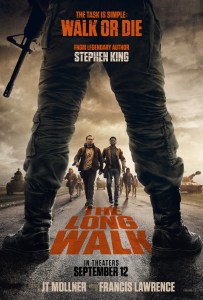 A group of teenage boys compete for cash – and a wish come true – in an annual contest known as ‘The Long Walk’ where they must maintain a walking speed of 3mph… or be shot.
Before Squid Game there was The Hunger Games; before The Hunger Games there was Series 7: The Contenders; before Series 7: The Contenders there was Battle Royale; before Battle Royale there was… well, what?
The fact that the latest Stephen King big screen adaptation, The Long Walk, is just another in a long cinematic tradition of movies following impoverished contestants in a dystopian fight to the death as they attempt to escape penury may hardly be a startling revelation. Screenwriter JT Mollner and director Francis Lawrence may well have simply thrown their hats into the ring to cash in on this arguably overworked zeitgeist. But that list bears examination. There’s more going on here than meets the eye.
The Japanese classic Battle Royale (released in 2000) is often cited as the progenitor of the genre with school children forced to fight to the death in the wake of the country’s economic recession of the 1990s. Series 7: The Contenders moves the idea to the world of the American Gameshow and Reality TV, as did the far more successful and mythically spectacular Hunger Games franchise, of which Francis Lawrence directed the majority. While Squid Game taps into South Korea’s particular cultural preoccupation with social inequality, it has become a global hit, so there is clearly something in the air.
In light of this, one might have thought Francis Lawrence would have had enough of such miserabilist fun and dystopian games. What makes The Long Walk such an interesting addition to the genre is that while the movie has only just been released, the source material pre-dates Battle Royale by two decades, with Stephen King’s original novel hitting the bookstands in 1979. It’s Lawrence who is going back to first principles here.
Gone is the operatic spectacle of The Hunger Games. This dystopia is a washed out endless road, through an equally endless rural rustbelt, with only the occasional onlooker staring out from their own hopeless poverty, lacking the energy to even care about the fate of the young men – not fighting each other, but simply walking until they quite literally drop, only to be punished by a bullet in the head. As the drama of the contestants’ terminal exhaustion unfolds, it’s these tableaux, reminiscent of the iconic Depression era photography of Dorothea Lange that show us that Lawrence wants one last chance to tell this story in a real world, with real consequences, and real hunger.
But The Long Walk has its roots in a story that pre-dates even King’s original book. Sydney Pollack’s 1969 movie They Shoot Horses, Don’t They? told the story of Depression era dance marathons where impoverished couples circled the floor until they crumpled from exhaustion, treated with less humanity than starving equines – and the source material for that film was a 1935 novel by Horace McCoy.
The Long Walk is the same story, only going in straight lines, not circles, and with real bullets – real executions – not metaphorical ones. Director Francis Lawrence nods to this cinematic antecedent as horses run unscathed from the human horror unfolding before them, as if to say, 90 years after the Great Depression, in post-industrial rustbelt America: ‘They shoot people, don’t they?’.
The Long Walk isn’t original. Indeed, it’s almost painfully predictable, quite literally trudging towards its depressing conclusion, but despite the grind of it as a film, and because of the richness of its imagery and thematic depth – along with some excellent performances from Cooper Hoffman, David Jonsson and the rest of the young cast – it’s surprisingly watchable.
Verdict: About an hour in, the seasoned cinema goer might be craving some twists, turns and plot development, but my advice is: ‘Don’t get your hopes up’… which is kind of the point. 7/10
Martin Jameson
 Doctor Who News Star Trek News
 Sci-Fi Bulletin: Exploring the Universes of SF, Fantasy, Horror and Spy-fi!