Review: The Long Walk
Starring Cooper Hoffman, David Jonsson, Mark Hamill, Charlie Plummer Directed by Francis Lawrence Vertigo / Lionsgate – in Cinemas now A group of teenage boys compete for cash – and […]



Starring Cooper Hoffman, David Jonsson, Mark Hamill, Charlie Plummer Directed by Francis Lawrence Vertigo / Lionsgate – in Cinemas now A group of teenage boys compete for cash – and […]
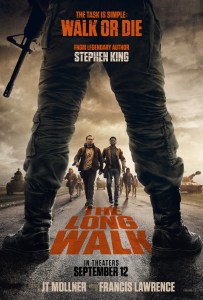 Starring Cooper Hoffman, David Jonsson, Mark Hamill, Charlie Plummer
Directed by Francis Lawrence
Vertigo / Lionsgate – in Cinemas now
A group of teenage boys compete for cash – and a wish come true – in an annual contest known as ‘The Long Walk’ where they must maintain a walking speed of 3mph… or be shot.
Before Squid Game there was The Hunger Games; before The Hunger Games there was Series 7: The Contenders; before Series 7: The Contenders there was Battle Royale; before Battle Royale there was… well, what?
The fact that the latest Stephen King big screen adaptation, The Long Walk, is just another in a long cinematic tradition of movies following impoverished contestants in a dystopian fight to the death as they attempt to escape penury may hardly be a startling revelation. Screenwriter JT Mollner and director Francis Lawrence may well have simply thrown their hats into the ring to cash in on this arguably overworked zeitgeist. But that list bears examination. There’s more going on here than meets the eye.
The Japanese classic Battle Royale (released in 2000) is often cited as the progenitor of the genre with school children forced to fight to the death in the wake of the country’s economic recession of the 1990s. Series 7: The Contenders moves the idea to the world of the American Gameshow and Reality TV, as did the far more successful and mythically spectacular Hunger Games franchise, of which Francis Lawrence directed the majority. While Squid Game taps into South Korea’s particular cultural preoccupation with social inequality, it has become a global hit, so there is clearly something in the air.
In light of this, one might have thought Francis Lawrence would have had enough of such miserabilist fun and dystopian games. What makes The Long Walk such an interesting addition to the genre is that while the movie has only just been released, the source material pre-dates Battle Royale by two decades, with Stephen King’s original novel hitting the bookstands in 1979. It’s Lawrence who is going back to first principles here.
Gone is the operatic spectacle of The Hunger Games. This dystopia is a washed out endless road, through an equally endless rural rustbelt, with only the occasional onlooker staring out from their own hopeless poverty, lacking the energy to even care about the fate of the young men – not fighting each other, but simply walking until they quite literally drop, only to be punished by a bullet in the head. As the drama of the contestants’ terminal exhaustion unfolds, it’s these tableaux, reminiscent of the iconic Depression era photography of Dorothea Lange that show us that Lawrence wants one last chance to tell this story in a real world, with real consequences, and real hunger.
But The Long Walk has its roots in a story that pre-dates even King’s original book. Sydney Pollack’s 1969 movie They Shoot Horses, Don’t They? told the story of Depression era dance marathons where impoverished couples circled the floor until they crumpled from exhaustion, treated with less humanity than starving equines – and the source material for that film was a 1935 novel by Horace McCoy.
The Long Walk is the same story, only going in straight lines, not circles, and with real bullets – real executions – not metaphorical ones. Director Francis Lawrence nods to this cinematic antecedent as horses run unscathed from the human horror unfolding before them, as if to say, 90 years after the Great Depression, in post-industrial rustbelt America: ‘They shoot people, don’t they?’.
The Long Walk isn’t original. Indeed, it’s almost painfully predictable, quite literally trudging towards its depressing conclusion, but despite the grind of it as a film, and because of the richness of its imagery and thematic depth – along with some excellent performances from Cooper Hoffman, David Jonsson and the rest of the young cast – it’s surprisingly watchable.
Verdict: About an hour in, the seasoned cinema goer might be craving some twists, turns and plot development, but my advice is: ‘Don’t get your hopes up’… which is kind of the point. 7/10
Martin Jameson
 Doctor Who News Star Trek News
 Sci-Fi Bulletin: Exploring the Universes of SF, Fantasy, Horror and Spy-fi!