Review: The Kitchen
Starring Kane Robinson, Jedaiah Bannerman, Ian Wright Directed by Daniel Kaluuya and Kibwe Tavares Streaming on Netflix In a dystopian London, Izi, a monosyllabic loner, has finally saved up enough […]



Starring Kane Robinson, Jedaiah Bannerman, Ian Wright Directed by Daniel Kaluuya and Kibwe Tavares Streaming on Netflix In a dystopian London, Izi, a monosyllabic loner, has finally saved up enough […]
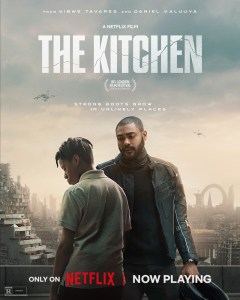 Starring Kane Robinson, Jedaiah Bannerman, Ian Wright
Directed by Daniel Kaluuya and Kibwe Tavares
Streaming on Netflix
In a dystopian London, Izi, a monosyllabic loner, has finally saved up enough cash to escape a run-down social housing project, but his plans change when he encounters an orphaned 12-year-old called Benji.
It wasn’t until about half way through The Kitchen that I finally put my finger on what was bugging me about it. I’d been looking forward to this very much. Daniel Kaluuya is one of my favourite actors – a riveting screen presence even when the movies around him don’t quite hang together – and alongside co-helmsman Kibwe Tavares, Netflix’s latest dystopian drama marks the actor’s directorial debut.
The Kitchen of the title is London’s last social housing estate, about to be cleared for gentrification by anonymous riot police acting on behalf of an equally anonymous elitist, racist state. So far, so dystopian… except as dystopias go, it’s peculiarly feeble; so much so, that the connoisseur of cinematic dystopias could easily argue that it’s far less dystopian than current reality.
As I say, it took me a while to twig, but for reasons that eluded me, Kaluuya (who has also co-written the film with Joe Murtagh) has created a high tech future full of police spy drones and impersonal AI, and yet strangely devoid of guns, knives or mobile phones. In a 21st century where we’re familiar with Black Lives Matter rightly protesting the deaths caused by trigger-happy racist police, it’s hard to get excited by baton charges and catapults, where the worst weapon on call appears to be a taser. I assume there must be a narrative rationale for this, but if there was one, it was beyond my paygrade, and I was left feeling that that both sides in this conflict needed to grow a pair, tool up, or at the very least show some ingenuity.
Running alongside this dystopian commentary is a story of family desertion, as Izi slowly forges his relationship with the newly orphaned Benji. The problems with this strand are twofold. The outcome is blindingly obvious from the outset – the only thing getting in its way for ninety minutes is a lot of brooding and scowling – and, more problematic, this emotional throughline feels entirely divorced from the film’s dystopian holding form. Ideally each should be narratively dependent on the other. As it is, the family story could just as easily be played in a familiar contemporary reality. We’re left feeling that there are two quite separate movies fighting for the same space.
On the plus side, the visual realisation of The Kitchen is effective, and Kane Robinson and Jedaiah Bannerman as Izi and Benji are convincingly committed to their roles even when the script and the languorous editing let them down. They are left exposed during the frequent longueurs, where the absence of a named antagonist, or clear narrative objectives for our heroes leaves the film with nowhere to go.
Verdict: The Kitchen may be a frustrating watch, but it is worth a visit – not least for Ian Wright making his feature film debut as the estate’s resident DJ – and to show support for new directorial talent who, I hope, will apply a lot more attention to the fundamentals of narrative next time. 5/10
Martin Jameson
 Doctor Who News Star Trek News
 Sci-Fi Bulletin: Exploring the Universes of SF, Fantasy, Horror and Spy-fi!