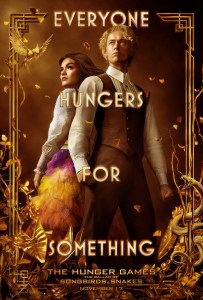
 Starring: Tom Blyth, Rachel Zegler, Peter Dinklage, Jason Schwartzman, Hunter Schafer, Josh Andrés Rivera, and Viola Davis
Directed by Francis Lawrence
Lionsgate, in cinemas now
Sixty-four years before Katniss Everdeen wins the Hunger Games and catalyses a revolution, this prequel sees a younger Coriolanus Snow take the lead at a time at which his presidency remains mere aspiration. Is it possible to have some sympathy for this particular devil?
Although Suzanne Collins’ novel on which this is based is told exclusively through Coriolanus Snow’s first-person narration, the film has multiple perspectives. Yet despite this, it is still clear to see the unreliable narrator you might expect shine through, thanks in no small part to Tom Blyth’s cleverly nuanced portrayal. It perhaps does not help that even had he been presented as a hero from the start, despite evidence provided that he is not entirely to blame for what he becomes, the viewer is always going to have a certain emotional bias from knowing his trajectory.
It would have been little different had it been a ‘Young Palpatine’ movie in that no matter how benevolent an action Snow takes, we can never trust his motivations to be in any way altruistic. The aforementioned mitigating defence for Snow is that his surroundings of Panem and a privileged upbringing of entitlement is already well established, and broken beyond sensible repair. The entire institution from which he has no escape, especially his birthplace, the Capitol, makes no attempt to hide its insidious evil. It shapes him, claims him as its own from the start. To an extent, the film attempts to disguise that early on, hiding his worst tendencies in the guise of mere self-servitude. From his very first appearance, in a world in which starvation is central to the setting, Snow quickly establishes himself as an apex predator in the food chain.
The unrelenting grimness of the world never leaves the viewer either. Although the Hunger Games themselves were certainly no better in their infancy than when we are first introduced to the future iteration of them (decades later in setting), these ‘modern’ games are sanitised in some part for the sake of retaining viewership, one of the state’s instruments of societal control. This in itself is a major plot point as their original viewer base is critically suffering and the Games fall close to being dismantled. The Capitol’s young elite are tasked with the essential role of mentoring the tenth anniversary Tributes, and for them, the stakes are high because success here will see them take the next step on that societal ladder.
In Snow’s self-centred world, he finds himself, as do many others exposed to her, captivated by his own Tribute, Lucy Gray Baird. She is both the songbird and at first, the bearer of snakes the title might suggest. Her magnetic presence in the film enhances that nagging feeling of Snow attempting to find mitigation in his own narrative, even outside his direct point of view. From the moment we first see her, she is almost supernaturally charismatic, as seen with her interactions everywhere. How could Snow possibly not fall in love with her; how could anyone? Snow, though, recognises the opportunity she presents, and this is the early basis of their relationship; he’ll stop at nothing to protect his asset. The more this relationship strengthens, the more the innate ruthlessness and capacity for destruction also reveals itself. Those going in thinking there is going to be a love story similar to that of Katniss and Peeta? This is very much not a retreading of that tale.
Similarly, Snow’s relationship with his family and best friend follow much the same arc. Initially he and his best friend, Sejanus Plinth, appear to be loud voices for change. Plinth is more iconoclastic, which Snow encourages, yet seems to be lacking either the gravitas or the will to see his own actions through. Again though, we find ourselves asking whether this is our conclusion or Snow’s. Plinth’s is a child of both wealth or status, yet Snow identifies a lack of guile to use either effectively on his friend’s part. The trajectory of that relationship is a real indicator as to Snow’s more predatory side, whilst his family continue to anchor him to the institution Plinth protests from the start.
Panem is a state full of contradictions and hypocrisies, which is reflected well in the film design. The state remains raw due to its proximity to the cataclysmic war which led to the foundation of Panem. As mentioned, the early Hunger Games are raw savagery without the production values we see in the first film; the selection of Tributes would simply massacre each other in minutes and everyone is done for the year. If anything, the brutality of the Games appears yet more visceral in this era; more straightforward in that they are clearly just children being sent to their deaths. Viola Davis is excellent here as the endlessly cruel Games designer Dr Volumnia Gaul. She could easily have been a two-dimensional comic book villain but manages to be a captivating, though utterly monstrous presence. Her perceived problem is, “how can we increase viewership?” rather than anything else. The Peacekeepers are somehow even more drenched in fascism, their older uniforms more directly obvious and their behaviour wasting no time showing what they are beyond their attire too. Nothing is subtle about them, no matter how small their part in a scene. Meanwhile, the contrasts between dieselpunk, shades of art deco and total desolation throughout really help to emphasise the disparity between the Capitol and everyone else.
Dean Casca Highbottom serves as an antagonist for Snow, pushing, threatening and opposing him at every turn. A question raised about him from his very first appearance is answered at the end with a very worthwhile payoff thanks in no small part to Peter Dinklage’s delivery. There may be a small criticism to be had in that there might be some slight overuse of one of the songs in the final act, but there is good reason for it.
Verdict: On occasions nauseatingly well done in terms of the immersion into a world which works strongly as a dystopian fantasy world – just made worse with the thought that there’s very little here far enough from reality for us to leave the theatre comfortable in the knowledge we are safe from such things. We’re not supposed to be comfortable or come out of this happy in any way other than having seen a good film and a powerful warning. This is about how the foundations are set for the world’s evil to bite down even harder, and Snow’s somewhat pivotal part in this. 8/10
Russell A. Smith




 Sci-Fi Bulletin: Exploring the Universes of SF, Fantasy, Horror and Spy-fi!