Review: Oppenheimer
Starring Cillian Murphy, Emily Blunt, Matt Damon, Robert Downey Jr, Florench Pugh, Josh Hartnett, Casey Affleck, Rami Malek, Kenneth Branagh, Benny Safdie, Jason Clarke, Dylan Arnold, Tom Conti, James D’Arcy, […]



Starring Cillian Murphy, Emily Blunt, Matt Damon, Robert Downey Jr, Florench Pugh, Josh Hartnett, Casey Affleck, Rami Malek, Kenneth Branagh, Benny Safdie, Jason Clarke, Dylan Arnold, Tom Conti, James D’Arcy, […]
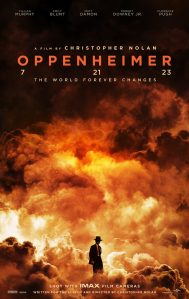 Starring Cillian Murphy, Emily Blunt, Matt Damon, Robert Downey Jr, Florench Pugh, Josh Hartnett, Casey Affleck, Rami Malek, Kenneth Branagh, Benny Safdie, Jason Clarke, Dylan Arnold, Tom Conti, James D’Arcy, David Dastmalchian, Dane DeHaan, Alden Ehrenreich, Tony Goldyn, Jefferson Hall, David Krumholtz, Matthew Modine, Gustaf Skarsgård, Michael Angarano, Jack Quaid, Josh Peck and Olivia Thrilby
Written and directed by Christopher Nolan
Universal, out now
The world forever changes…
The most crucial moment in Oppenheimer is one of negative space. The first time the Oppenheimer brothers and Doctor Ernest Lawrence visit Los Alamos, it’s described as a beautiful, empty vista.
Ranchers used the area constantly. They were moved off it via eminent domain before the Manhattan Project could begin. This is a polite way of saying that they were evicted from land that was their own and that land, and their lives, would be poisoned forever. This story is not commonly known, but it is known. If you want to know more, begin with the term ‘downwinders’ and go from there.
The movie does not discuss this. The kind way of looking at that fact is that it ties into the film’s exploration of Oppenheimer’s singular vision and fragile, mutable morality. The unkind way is to say this is an act of creative moral cowardice. The film asks you to decide on both counts.
Oppenheimer is a Christopher Nolan film to its electrons. Its starkly lit by Hoyte van Hoytema, the camera is often locked off and the entire movie is serious men in serious rooms discussing serious matters and ignoring their colossal emotional and psychological damage. Its fractured narrative runs two stories in parallel: the confirmation hearing for Lewis Strauss (Robert Downey Jr) and Oppenheimer’s appeal against his post-war security clearance being removed. Oppenheimer’s sections are in full, stark, colour. Strauss’ are in black and white. We don’t know the two interact until the final 40 minutes of the movie as time rearranges itself.
Downey Jr is going to be Oscar-nominated for this work, and his Strauss is plausible, kind, charming, fragile and malicious by turns. He’s unfettered here and there is a strong case for this being his career best work. Cillian Murphy too, whose Oppenheimer is an increasingly pained, skeletal presence barely in control of his brain. Murphy is stunningly good, and also headed to Oscar shortlists, but there are moments where he becomes something truly extraordinary. Oppenheimer’s speech to the successful project is presented from inside his own perspective, doused in atomic light, one foot in the chest cavity of a flash-incinerated body. The other staff members are euphoric, horrified, grief-stricken. The explosion has blown apart their tension, their resolve, themselves. It’s terrifying and it ties into one of the best flourishes Nolan has ever achieved. The entire movie revolving, in the end, around a single conversation we don’t see until the closing seconds. This is fiercely, technically impressive film-making that, when it works, builds itself on the shifting, flawed sands of its intensely flawed subject.
It is also flawed itself. Nolan continues to be indescribably terrible at writing women. Here, Florence Pugh, Emily Blunt and Olivia Thrilby fight to be seen in perhaps fifteen combined minutes of screen time across a three hour movie. All are dismally served and all do very well with what they have. As Jean Tatlock, Oppenheimer’s lover, Pugh is spiky and panicked. As Kitty Oppenheimer, Emily Blunt is grounded and pragmatic in the exact way her husband isn’t. As Lilli Hornig, whose life is movie worthy of itself, Thrilby barely warrants being named onscreen. There’s a read on this being, again, inside Oppenheimer’s head and under his shadow. Again, it doesn’t help. Moments where the world becomes how characters see it rather than what it is often leave a nasty aftertaste. In the case of the post-coital first arrival of the ‘I am become Death’ quote, they get within seconds of farce.
The rest of the cast have a complementary problem, in that all of them are people you recognise and most of them are on screen for a minute. The excellent Alden Ehrenreich, who anchors the Strauss scenes, doesn’t even warrant a character name while the equally impressive David Krumholtz as Oppenheimer’s close friend Isidor Isaac Rabi shows up for four scenes. In some cases, most notably Jason Clarke as Oppenheimer’s prosecutor Roger Robb, Jack Quaid’s Richard Feynman and Tom Conti’s effervescent Einstein, this works. In a lot of cases, it feels odd and distracting.
Verdict: To say a Nolan film is technically astonishingly and emotionally cold feels like stating the obvious, or perhaps in this case, the elemental. Oppenheimer is fiercely impressive, inherently contradictory and almost impossible to like. The fact that maps onto the man’s own reputation doesn’t excuse his, or its faults. That choice is left with you. 8/10
Alasdair Stuart
 Doctor Who News Star Trek News
 Sci-Fi Bulletin: Exploring the Universes of SF, Fantasy, Horror and Spy-fi!