Review: Everything Everywhere All at Once (updated)
Starring Michelle Yeoh, Ke Huy Quan, James Hong, Jamie Lee Curtis, Stephanie Hsu Directed by Dan Kwan and Daniel Scheinert A24, out now A laundromat owner is swept up in […]



Starring Michelle Yeoh, Ke Huy Quan, James Hong, Jamie Lee Curtis, Stephanie Hsu Directed by Dan Kwan and Daniel Scheinert A24, out now A laundromat owner is swept up in […]
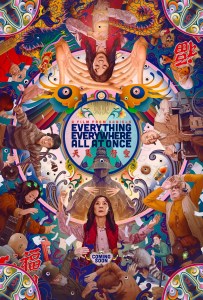 Starring Michelle Yeoh, Ke Huy Quan, James Hong, Jamie Lee Curtis, Stephanie Hsu
Directed by Dan Kwan and Daniel Scheinert
A24, out now
A laundromat owner is swept up in an insane adventure, where she alone can save the world by exploring other universes connecting with the lives she could have led.
Two mainstream movies about the multiverse have been released this month, but only one features Jamie Lee Curtis as a terrifying, frumpy ogre… oh, and sometimes she has hot dogs for fingers. Yes, you read that right, and anyone who saw writer/directors Dan Kwan and Daniel Scheinert’s Swiss Army Man will know what off-the-wall humour to expect.
Evelyn Wang (Michelle Yeoh, Star Trek: Discovery) and her husband Waymond (Ke Huy Quan, Indiana Jones and the Temple of Doom) are preparing for the arrival of her father Gong Gong (James Hong, Blade Runner), but she also needs to supply receipts to an officious tax auditor (Jamie Lee Curtis, Halloween) and try to connect with her estranged daughter, Joy (Stephanie Hsu). That’s the straightforward bit. It’s when she’s on her way to the auditor’s office that things take an unexpected turn and she’s introduced to the multiverse and the role she’s expected to play within it.
I won’t say any more about the plot because much of the fun is derived from not knowing what happens next. As its title suggests, this movie not about one single thing, rather a simultaneous collusion of multiple genres, with a healthy dose of 12 Monkeys and The Matrix to drive the plot. Along the way there’s some impressive martial arts choreography (Michelle Yeoh is the lead, after all) and nods to everything from 2001: A Space Odyssey’s The Dawn of Man to an alternate version of Pixar’s Ratatouille.
With so much being flung at the screen, it’s inevitable that not everything sticks, and there are a couple of recurring gags that outstay their welcome. But there’s such an abundance of big ideas that I can’t fault a film for having such lofty ambitions, and I defy anyone to suggest that it’s predictable. Most importantly, at the heart of this movie is… a heart! Strip away all the multiverse madness and it’s a story about relationships and being the best person you can be, and that’s as valid a reason for a movie to exist as any other.
Verdict: A kaleidoscopic explosion of clever ideas, daft jokes and soul-searching, how wonderful that in this particular corner of the multiverse films like this get made and are given a mainstream release. 9/10
Nick Joy
 Spoilers right at the end – they will be flagged so you can bail if you wish!
The multiverse is in fashion. As with many things scientific it’s hit the popular imagination several decades after physicists and mathematicians first started talking about it and with about as much adherence to science fact as Star Wars has to interstellar travel.
Which is to say there are books, television shows and movies collectively basing their plots around the idea of there being many different versions of our world all ripe for exploring and all slightly different to the one we call home.
Everything Everywhere All At Once, written by Daniel Kwan and Daniel Scheinert steps into this ring with a story about the multiverse that’s about everything except the multiverse. By doing so they deliver what is, to my mind, the very best kind of movie and certainly the best movie about many-worlds theory I can remember (and this in a month where this is the second blockbuster featuring the multiverse).
Why does it work when notable others don’t? Because this film is about its characters, about their stories and triumphs and sadness. The McGuffin of the multiverse is central only in that it’s crucial for these characters to understand themselves. Unlike some other approaches to the multiverse which use it as a lazy way of delivering plot, Everything Everywhere All At Once root the possibilities right in the heart of the central characters’ emotional journeys. It takes the possibility of infinity and demands from us a response about that concepts impact on the idea of our lives having meaning. After all, if everything probable is out there somewhere, what meaning, exactly, does the life I’m leading right here and now actually have?
Most importantly, the Daniels (as the credits list them) centre these very fallible humans in a story so bizarre that a sequence in which two giant dildos are used in a tremendously choreographed fight don’t even register in the top ten strangest things thrown at the screen.
What that means is there’s an emotional heart to this film that grabs you early and solidly and doesn’t let go right until the last frame. In short – I cared about these characters because their fates weren’t certain, because their travails were ones that I could understand and, perilously, know as part of my own lived experience. Action works best when the outcome isn’t known and you’ve come to care for the protagonists – Everything Everywhere All At Once gets this.
The story, as far as it matters in a review where I don’t want to spoil it for you (and you really want to see this knowing very little about how it unfolds), is about motherhood and loss and family and joy and what makes life worth living. It’s about what we do for the things we love and the damage we cause one another because our view of the world is always going to be limited.
Michelle Yeoh is simply fantastic as a mother who is 100% definitely living her worst life. She inhabits the role which in another’s hands might have ended up steering right into cliché but instead leans into the authenticity that I have witnessed of so many women who arrived in a foreign country with nothing but the clothes on their backs and then proceeded to work their socks off to provide stability for their children. She carries the tragedy and pathos of that experience in her bones and the film never loses sight of this core emotional treasure. However, from Jamie Lee Curtis to Stephanie Hsu to Ke Huy Quan there isn’t a single member of the cast who delivers anything less than their entire heart to this rambunctious and technicolour piece of theatre.
What is particularly gratifying is that this is a movie with a predominantly non-white cast set in the US but told absolutely from an immigrant’s point of view. It’s about leaving home, about the way one generation can put their anxieties and neuroses on the next and how that cycle can prove to be almost impossible to break.
In some ways it is part of a trend through stories such as Encanto and Turning Red about our parents apologising to us for the mess they caused. It’s not the first and I don’t think it will be the last but Everything Everywhere All At Once is a high water mark.
Then, when you least expect it the film layers on something even more – a ridiculous and really very moving exploration of grief and depression. So visual and striking is this metaphor that my family has agreed to start talking about depression using the imagery contained in this film rather than the terms we were using before we walked into the theatre.
Through it all, whether it’s the silliness, the strange running gags, the exploration of loss and tragedy and mental health, the script never loses its grip on a strand of humour that lifts it from being mawkish and sentimental or sour and self-important. This is so well balanced I found myself admiring the craft as much as what was on the screen.
There is so much here that I find that beyond talking superlatives and giving you a very high level sense of the themes (motherhood, loss, meaning and family) I don’t want to say too much more in this section. It’s enough that you need to find this movie and see it now. It’s not been widely released, which, honestly, is a travesty given that it’s far inferior kin, Doctor Strange, is plastered everywhere. So please, do me, the movie and yourself a favour and hunt this down and give yourself the lift you didn’t know you needed.
I warn you though – take tissues because the last twenty minutes take all that character work and turn it back on you, demanding you take the subjects of the film seriously and it will leaving you crying and laughing and cheering all at the same time.
BEYOND THIS POINT THERE ARE SPOILERS
So, Everything Everywhere All At Once deals with a mother who loses everything and has had the very worst possible outcome for her life. Everything is going wrong and she’s left desolate. In this way she runs exactly the same arc as Wanda in Doctor Strange.
The difference between this and Doctor Strange is that Michelle Yeoh’s character, Evelyn, is allowed to explore what that means for her. She’s given time to express her rage and frustration, her grief and loss not with ridiculous acts of evil but with human acts that resonate emotionally and intellectually. The script dignifies her at every step of the way so that when she’s faced with the choice of accepting the world might actually be entirely meaningless and her life with it we are right there with her, not judging but understanding her plight and empathising with her situation.
Sam Raimi’s movie fails on these points because it puts Wanda in a position of acting so incredibly irredeemably that Wanda’s motivation ends up being nothing more than a cypher for yet another powerful woman in a long line of powerful women who can’t be trusted to hold power.
Another key difference between this and the less impactful Doctor Strange is that Evelyn’s real enemies are not other women but versions of two specific men in her life – her husband and her father. They have crushed her dreams, rejected her, let her go and she has lived with the loss of that her entire life.
What’s even more fascinating is that rather than simply paint these two men as evil or malicious we’re given enough time to understand that they acted out of their own failings just as Evelyn does and it’s this interconnectedness which drives the emotional heart of the film. Given the chance they blossom and, strangely and wonderfully, it’s Evelyn’s strength and becoming that gives them the space they didn’t know they needed to let go of their own baggage.
Everything Everywhere All At Once asks what we would do to save what we love, to fight for it and the answer in this film is startling and, for me at least, so very needed. It offers us hope that there is meaning and that meaning is found in each other.
You might say that Wanda lost those people who gave her meaning… well yes, possibly, except that you might also ask just where was Vision in her story? What annoys me most is how her arc is engineered to leave her the antagonist, draining nuance and the possibility of emotional depth right out from under her.
Put it another way – if Doctor Strange is about fighting against enemies, Everything Everywhere All At Once is about fighting for what we love. You can fight an enemy without knowing them at all, in fact it might be better and easier if that is the case. You cannot fight for what you love without understanding it first and in my mind it’s these two contrasting philosophies that separate the two films emotionally.
Wanda deserved the treatment Evelyn gets in Everything Everywhere All At Once. Wanda deserved to have a script that gave her dignity and didn’t just relegate her to third bad woman on the left. Don’t get me wrong, without Elizabeth Olsen the film would have been properly bad – Olsen’s performance is superb and she wrestles a poor script and virtually one-dimensional emotional motivation back into something watchable and, importantly, that left me wanting more from Wanda Maximoff.
When you watch Everything Everywhere All At Once you realise what centring a woman can look like in a fantastical action adventure movie. You can see Michelle Yeoh on screen and see her struggles and wish along with her for a different outcome. You can see the impact of depression, of loss and grief and know there might be no way through it. You can watch as some surrender under the weight of that knowledge while others fight to their last breath.
Coming out of the endlessly inventive Everything Everywhere All At Once I can say that I think my experience of it brought into sharp relief just how unsatisfyingly anaemic Doctor Strange was, how poorly it treats its female cast and how mundane its version of the multiverse is.
As far as Everything Everywhere All At Once is concerned – if you come from an immigrant family or love action or love science fiction or love movies about families and love and loss and grief and hope and happy ever afters then this movie is for you.
As I talked to my teenage daughter about this review she said it was important for me to say that she thinks Everything Everywhere All At Once has changed her life – on subjects such as family and depression, and we are already arranging to go and see it again.
I look at it and wonder if it will have the some of the same impact upon her generation as The Matrix had on me and mine.
Rating? 10 multiverses out of 10.
Stewart Hotston
 Doctor Who News Star Trek News
 Sci-Fi Bulletin: Exploring the Universes of SF, Fantasy, Horror and Spy-fi!