 By Simon Frangen
The long-gestating sequel gets a slightly different sort of score…
The original Avatar score had been composed by longtime fan favourite, James Horner, but Horner’s death in 2015 meant the sequel needed a new composer, and that job fell to Horner’s frequent producer and collaborator Simon Frangen, who had worked on the previous movie, and had completed Horner’s unfinished score for the 2016 version of The Magnificent Seven.
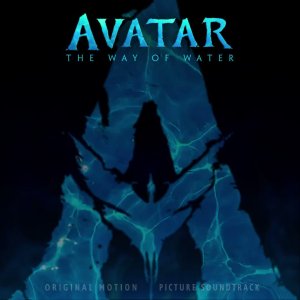
There are in fact two albums for The Way Of Water: a 32-track Original Score album which doesn’t include the end credits song by The Weeknd, and this 22-track Original Motion Picture Soundtrack which does, but is missing 11 orchestral tracks from the score.
Despite the song “Nothing Is Lost (You Give Me Strength)” being the end credits song, it opens the album, perhaps because it was released as a single as well, and the producers thought it’d sell better as the lead attraction. In any case, sung by The Weeknd, it’s a pleasant enough ballad, but ultimately completely forgettable. You won’t remember this the way you’d remember a Bond theme, or even the way you’d remember the closing songs from The Shadow, Mask Of Zorro or The Mummy Returns though the 90s were really the peak for that kind of closing epic ballad on a soundtrack.
The album also closes with a song, “The Songchord” sung in character by Zoe Saldana as Neytiri, and she has a good voice, although, again, the song itself is totally unmemorable, which means the album both opens and closes that way.
Having Na’vi characters sing and play music led Frangen to publicise having created new Na’vi instruments for a more alien and marine sound, 3D-printed especially for use in the score. If there are such new instruments, however, they don’t come out distinctly in the score – unless the tracks with their use have been confined to the 32-track release, of course. Here there is a distinctive set of motifs and themes for the Na’vi, which are clearly introduced and presented, but nothing that sounds like a completely new instrument.
There is familiarity here, though, as some elements and themes of Horner’s music for the previous film are woven in with the greater amount of new themes and motifs that Frangen composed to expand the world of Pandora and the sequel’s range of new characters. This mix gives it a little bit of a Horner air, especially in the exploratory world-viewing sections.
“Into The Water,” for example, has a soaring yet flight air to it, with some sparkly light moments, and vocalisations that are in effect carrying the same ethos as the motifs for the world in Willow back in the day. Pandora’s alien paradise nature is also brought out through some maraca-like sounds, glockenspiel and a hint of tropical intrumentation layered over some Horner-ish orchestrations that hint at Willow and also return from the first Avatar in “Happiness Is Simple” before we get a militaristic intro with a threatening four-beat note and slippery snare drums for the human forces in “A New Star”.
The rest of the album then basically mixes these two soundscapes in varying arrangements and proportions: beautiful ethereal magic music for Pandora and the Na’vi, and militaristc snare and four-beat for the humans. Sometimes the former is to the fore, and the latter quieter and more flowing as character representation, sometimes the other way round, but regardless of the leitmotif they’re basically a recipe combined from these two sides.
Action cues are, of course, basically pounding orchestrations, though “Bad Parents” is a noteworthy highlight on the snare and four-beat turned into a really powerful threatening piece, while “Knife Fight” mixes in some effective discordance. Highlights of the magical worldbuilding and emotional tracks are – along with “Bad Parents” – “Into The Water,” “Happiness Is Simple,” “The Way Of Water,” “The Mighty Eywa” and “Spirit Tree”.
It’s a score that follows and builds upon Horner’s prior score very well, and catches his style from that score without sacrificng what Frangen brings to the mix. There’s a good mix of beautiful exploratory and emotional cues, and decent action tracks, though it must be said that none of it quite breaks into the uniquely memorable level- though that’s probably more to do with the expected formulae for big productions nowadays. This does work within a formula, therefore, but it does it well and enjoyable, and benefits from maintaining the connection to its predecessor. 9/10
David A McIntee




 Sci-Fi Bulletin: Exploring the Universes of SF, Fantasy, Horror and Spy-fi!