Review: A House of Dynamite
Starring Idris Elba, Rebecca Ferguson, Jared Harris Directed by Kathryn Bigelow Netflix – in Cinemas now Some Nuclear Spoilers Nuclear déjà vu all over again: When a single, unattributed nuclear […]



Starring Idris Elba, Rebecca Ferguson, Jared Harris Directed by Kathryn Bigelow Netflix – in Cinemas now Some Nuclear Spoilers Nuclear déjà vu all over again: When a single, unattributed nuclear […]
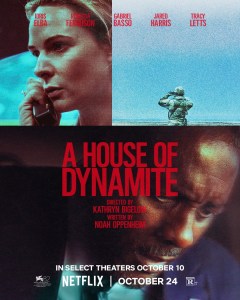 Starring Idris Elba, Rebecca Ferguson, Jared Harris
Directed by Kathryn Bigelow
Netflix – in Cinemas now
Some Nuclear Spoilers
Nuclear déjà vu all over again: When a single, unattributed nuclear missile is launched at the United States, a race begins to determine who is responsible and how to respond.
One of the inevitable side-effects of reviewing cinema in one’s seventh decade is the creeping sense that surely I’ve seen this movie before. Sometimes, of course, it’s merely encroaching geriatric déjà vu but gripping my armrests during Kathryn Bigelow’s stomach-churning nuclear thriller, A House of Dynamite I realised that I was now on my third trip around this particular narrative bunker.
I must have been about twelve when I was first scared witless by Sidney Lumet’s nuclear thriller, Fail Safe. The movie had been released eight years earlier, in 1964, in the wake of the Cuban Missile Crisis. A computer error sends a USAF bomber on an unstoppable mission to release its payload on Moscow. Hawks surrounding the President (Henry Fonda) try to persuade him to authorize a full-on nuclear attack. To do nothing, they argue, would allow the Soviets to retaliate in force, so better to get their own retaliation in first. Fonda (fresh from confounding bigotry in the jury room in 12 Angry Men) overrules them, and sacrifices New York as a Biblical quid quo pro in return for peace with the USSR, thus saving the planet. Phew. If you’ve never seen Fail Safe (it has been largely forgotten) then it is well worth searching out.
Kubrik’s Dr Strangelove had been released the same year, and was based on the same premise, albeit with a lunatic triggering the attack rather than a computer glitch. It was a lot funnier, but lacked Fail Safe’s more upbeat ending (the word ‘upbeat’ doing a lot of ironic heavy lifting here) and the inherently escalatory nature behind the concept of Mutually Assured Destruction was played out to the strains of Vera Lynn. Thankfully it was all just in the name of satire. Phew again!
Nearly twenty years after the Cuban missile crisis, in 1983, US/Soviet relations were getting tetchy again with the deployment of cruise and Pershing II missiles in Western Europe, and while the BBC was busy making the terminally depressing Threads (where Sheffield was to be blown into the middle of next Wednesday), over in Hollywood, a young computer hacker (Matthew Broderick barely out of short trousers) accidentally does what computer glitches and fundamentalist lunatics had done two decades before and triggers a nuclear attack. Luckily for the planet, when the supercomputer in charge has the principles of M.A.D. explained to it, it decides that ‘the only winning move is not to play’. Phew a third time!
With the collapse of the Soviet Union, and the rise of Islamic extremism, culminating in the 9/11 terror attacks on the United States, twenty years after Wargames the movie zeitgeist was hijacked (in more awful ways than one) by different concerns. A whole generation grew up barely worrying about nuclear Armageddon at all.
But spool on another two decades, and the pendulum is swinging back like a sledgehammer. Putin’s Russia is threatening the west with nukes over Ukraine; India and Pakistan are intermittently waving their missiles at each other; and both North Korea and Iran are keen to show they can annihilate millions as happily as any superpower. It’s as if the Nuclear zeitgeist is making up for lost time.
Bigelow’s offering to the genre shares the same premise as its forbears – an attack seemingly without meaning threatening to trigger the apocalyptic logic of Mutually Assured Destruction. But in House of Dynamite there is none of the biblical humanity of Fail Safe; the satirical excess of Dr Strangelove; or the YA life-lesson optimism of Wargames. This is a cold, technical dissection of our political and military complex’s unpreparedness for the realities of nuclear conflict.
In Bigelow’s account, all the pieces are there, but faced with imminent attack, few of the participants – least of all Idris Elba’s well-meaning but poorly informed President – have really thought through the full horror of the consequences. Structured around the 19 minutes it takes from detection of the incoming missile to its predicted impact on Chicago replayed from three different perspectives, the sheer narrative velocity of this movie is hard to fault.
But… but… while I was convinced by the nuts and bolts portrait of system doomed to fail when faced with the unthinkable (after all, by definition, how can you plan for that?) I found myself praying (atheistically) that Bigelow was talking through her earnestly efficient cinematic backside. Are the people in charge of blowing up the world really this thick, and cowardly, and ignorant? Would trained military personnel really just run away and throw up in terror? The former, perhaps (Jared Harris’s incompetent Secretary of Defence is horribly believable); the latter, I wasn’t so convinced. Either way, by predicating the scenario on human inadequacy, A House of Dynamite is by far the bleakest assessment for our chances of avoiding nuclear Armageddon, I can remember.
I seem to have run out of ‘Phews’.
Verdict: A House of Dynamite is an utterly compelling and terrifying 112 minutes of nuclear terror. My only hope is that even if I don’t make it through the next two decades, the planet will still be here and some wry hack will be able to scribble a few pages on the inevitable fourth cycle of nuclear chillers to come sometime in the 2040s. Fingers crossed, peeps. 8/10
Martin Jameson
 Doctor Who News Star Trek News
 Sci-Fi Bulletin: Exploring the Universes of SF, Fantasy, Horror and Spy-fi!