Review: A Big Bold Beautiful Journey
Starring Margot Robbie, Colin Farrell, Phoebe Waller-Bridge, Kevin Kline Directed by Kogonada Columbia Pictures, in cinemas now After David meets Sarah at a friend’s wedding, unable to decide whether or […]



Starring Margot Robbie, Colin Farrell, Phoebe Waller-Bridge, Kevin Kline Directed by Kogonada Columbia Pictures, in cinemas now After David meets Sarah at a friend’s wedding, unable to decide whether or […]
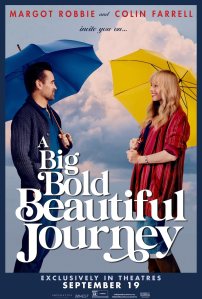 Starring Margot Robbie, Colin Farrell, Phoebe Waller-Bridge, Kevin Kline
Directed by Kogonada
Columbia Pictures, in cinemas now
After David meets Sarah at a friend’s wedding, unable to decide whether or not to go on a date, their Satnav sends them on a fantastical road trip, stopping off at a series of magical doorways.
The first ten minutes of Korean-American director Kogonada’s romantic fantasy A Big Bold Beautiful Journey are promising enough. David Longley is middle-aged, lonely and unhappy. He’s also fabulously, craggily good-looking and irresistibly charming – he’s Colin Farrell for God’s sake! – but go with it. Anyway, setting off for a friend’s wedding, his car is clamped and he has to rent a replacement. Eschewing established rental brands he opts for a back-alley hire company – through a tiny door into a huge empty hangar – staffed by Phoebe Waller-Bridge and Kevin Kline, who are clearly WEIRD, albeit observant enough to intuit the Nietzschean void that is Farrell’s emotional life. Clearly he’s not about to get any old motor for his journey. For the 1960s bookworms out there, this is satisfyingly reminiscent of Norton Juster’s children’s classic The Phantom Tollbooth and surely David is about to embark on an odyssey of inner redemption similar to that undertaken by young Milo in the aforementioned book.
So far, so fun! Indeed, if you make for the exit now you’ll have had an extremely brief but enjoyable outing at the cinema. However, should you decide to hang around you will follow David to the wedding where he encounters Sarah (Margot Robbie looking very shiny and not craggy at all). She too is (implausibly) lonely and unhappy, and declines David’s approaches on the basis that any kind of relationship will end miserably as there is ‘no version of this that doesn’t end without me breaking your heart’. Bloody hell, Margot, he’s only offering to get you a drink!
I may be lacking in the romance department, but surely I’m not the only person who would respond to Sarah with ‘get over yourself, love’ before finding someone less annoyingly self-obsessed to talk to. Kogonada, writer Seth Reiss, and Ms Robbie seem to be labouring under the misapprehension that Sarah is enigmatic and irresistible… rather than just plain rude.
Anyway, David isn’t deterred, and with the help of a magic Satnav (don’t ask) he and Sarah are thrown together on a ‘magical’ road trip between random doors that lead them, magically, to supposedly significant moments from their pasts, allowing them to relive their mistakes and offer lengthy commentaries on the essentially trivial hiccups in their comfortable, privileged lives. ‘Life is shit,’ Farrell’s David comments sagely to an iteration of his younger self, who seems to come from a well off, secure and loving middle class family. It’s a good job he’s not in Gaza, or Ukraine or Sudan, although to be fair, being mildly unlucky in love is a source of universal trauma. I know! I’m such a killjoy.
Of course, the experienced cinema goer is quite reasonably expecting David and Sarah to learn something from this magical emotional retrospective, but an hour later Margot is still wanging on about how Colin can’t possibly risk getting involved with her, because she’s going to hurt him so much, break his heart blah blah blah. Of course the real danger is that he’s going to be bored to death by her saying the same thing over and over and over again. I actually lost count of how many times this tedious idea was repeated, until, in the last five minutes, she changes her mind (for no particularly good reason) and (SPOILER ALERT!) they give it a go.
Perhaps this is what is going on in the heads of Giant Pandas which would explain why they find it so hard to reproduce.
I know, I know! If you can’t say something nice… okay, so on the plus side, Benjamin Loeb’s cinematography is extremely pretty, and the green screen car interiors are some of the most convincing I can remember. Seriously, I became quite entranced by the sophistication of some of the reflections on the windscreen. Farrell to his credit gives it everything, despite Robbie’s strangely glassy performance, as if she’s not quite listening to him. The only way this sentimental pile of tosh would have a chance of working is if the chemistry between the two leads were setting the screen on fire, but no extinguishers are required at any point – although there were times I wanted to squirt it on the musicians playing Joe Hisaishi’s tinkly, glutinous score.
And for reasons that went straight over my head the film was peppered with oblique movie references ranging from Singin’ In the Rain to the Dogme 95 cinema of Lars von Trier.
But what annoyed me most is that if you predicate your narrative on magical doorways into the past, you need to play the magic, not just use it as a lazy device to twitter on self-pityingly about your backstory. Genre can be a great way to explore the inner workings of the human heart, so it’s a painful disappointment to see it used to make something less interesting, rather than more so.
Verdict: A Big Bold Beautiful Journey isn’t big (although it is interminable). It isn’t bold (signing up to Tinder would be bolder – and a lot, lot quicker). It is pretty to look at but ‘beautiful’ is stretching it. It is undoubtedly a journey – a long, sickly, repetitive journey – so take travel sickness pills, a pillow, and make sure you know where the vomit bag is stowed. 1/10
Martin Jameson
 Doctor Who News Star Trek News
 Sci-Fi Bulletin: Exploring the Universes of SF, Fantasy, Horror and Spy-fi!