Godzilla vs Kong: Feature: Road to the Rumble: Part 1: Godzilla (2014)
With Godzilla vs Kong due to finally drop on HBO MAX and in theatres at the end of the month, Greg D Smith takes a quick scenic tour of the […]



With Godzilla vs Kong due to finally drop on HBO MAX and in theatres at the end of the month, Greg D Smith takes a quick scenic tour of the […]
 With Godzilla vs Kong due to finally drop on HBO MAX and in theatres at the end of the month, Greg D Smith takes a quick scenic tour of the Legendary Monsterverse to date, as we get ready to see which one of the big beasts wins in this latest clash.
A catastrophic incident at Jinjira nuclear plant in Japan loses lead engineer Joe Brody his wife and his livelihood. Fifteen years later, estranged from his now adult son Ford, Joe still can’t let go of the feeling that the authorities are hiding the truth of what happened, and when he’s caught trespassing and Ford has to come to bail him out of custody, it’s just the start of events which will literally shake the world.
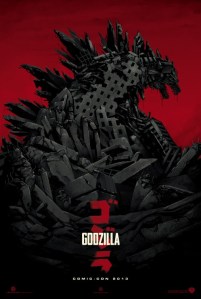 OK, so that intro is maybe misleading as to Bryan Cranston’s character’s involvement in the movie, but then so were the trailers. Gareth Edwards had done one feature film before this, 2010’s low budget sci-fi flick Monsters and some worried that he might struggle to perform on a big budget, big studio tentpole like Godzilla. Aside from anything else, the last time an American movie version of Godzilla had been made, it… hadn’t gone well. Spawning the nickname Godzilla In Name Only (GINO for short), that version of everyone’s favourite giant lizard incensed the Toho faithful so much that the Japanese studio actually had it turn up in one of their subsequent movies, Godzilla: Final Wars, where it was named Zilla and was quickly dispatched by the true king of the monsters.
So it was fair to say that a lot of expectation sat on the film as soon as it was announced – could it possibly live up to it? Well, sort of.
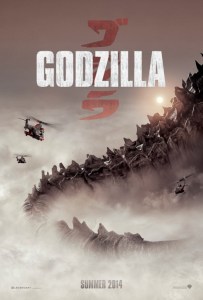 Re-watching this a few days ago, I was mostly struck by the angle Edwards chooses to tell the story – the movie effectively deals almost entirely with Ford’s point of view, and his journey along an increasingly bizarre trajectory which seems to always have him trailing not only Godzilla himself, but also the two giant ‘MUTOs’ with which the big guy clashes. The opening scene, which serves to establish Cranston’s Joe and set up the disaster that will set the events of the movie itself (eventually) in motion is well-enough shot, but the conceit of then skipping forward fifteen years and having had nothing much happen in the meantime feels a little odd. But then again, having an actor of Cranston’s stature, freshly off his star-making turn in Breaking Bad, as effectively a bit part character was also what some might euphemistically term a bold choice.
Still, you can’t deny that Cranston really commits, and to be fair his part requires a lot of heavy lifting to sell the concept and get things in motion, and for that reason alone, it’s clear to see why the director made the choice he did. Having committed to a more ‘traditional’ re-telling of the Godzilla story (Edwards is on record saying he was heavily influenced by the 1954 original) Edwards needed to have strong character actors help to really make that vision work. It feels slightly odd then, by comparison, that he chose Aaron Taylor Johnson to be the main focus character of the movie.
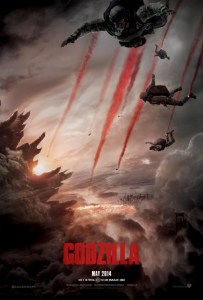 Not that I have anything against Johnson. His nervous, twitchy energy helped elevate Kick Ass from crass distraction to serious movie worth paying attention to, and his performance as the MCU’s Pietro Maximoff/Quicksilver was equally well done, for what little screen time he was afforded. It’s just that when your supporting cast includes Cranston, Juliette Binoche, Ken Watanabe and Sally Hawkins, and they all essentially end up in small roles in the background, one might expect an actor of similar star power and range to be given the lead role.
It’s possible of course that this is also deliberate – Ford is a character who spends most of the movie being a man chasing after events rather than one instigating them. Perhaps in Edwards’ mental map of the movie, he needed someone who could naturally look as overpowered and helpless as possible amidst everything that was occurring around them, and he felt that someone with bigger presence or a more assured reputation might ruin that take. Given what we saw Tom Cruise do to 2017’s version of The Mummy, which ended up killing off its proposed shared universe before it even got started, maybe it was a genius move.
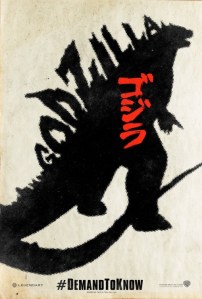 So, though commentators at the time might have gone a little overboard in their complaints that the film spent far too much time with its human characters and not enough with its titular star, it’s undeniable that this is a story which focuses on the humans who have to survive in the wake of the monsters who are stomping around destroying everything, and that’s actually very much in the Godzilla tradition. It’s also very much in that vein that Godzilla himself isn’t seen in full frame all that much until the third act, when he finally confronts the two MUTOs over the ruins of San Francisco. In this respect, it actually works very well, getting to spend time really focusing on the actual aftermath of the creatures’ passing, emphasising their size and power and the destruction they cause. This of course ties in with the original theme of Godzilla, which was infamously a cinematic metaphor for the uncontrolled devastation of nuclear power, and though we live in a different era now, Edwards manages to bring that same sort of feel and relevance to this twenty-first century update. Nuclear proliferation might no longer be the subject that haunts the world as it did all those years ago, and America itself was never on the receiving end of a nuclear bomb, but like many modern filmmakers, Edwards uses an aesthetic and a sense of urban destruction on massive scales which can’t help but conjure up in the minds of any who witnessed it the newsreels of September 2001. That sense of danger, of indiscriminate destruction raining down in such a developed, urban setting is one that is used to equal effect as the excellent FX work of Godzilla himself.
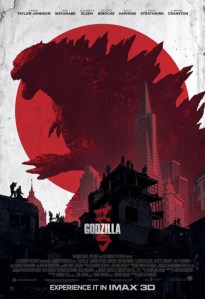 And Godzilla really is majestic here. Emmerich’s 1998 effort wasn’t just hampered by the limitations of FX capabilities of the time, but by the odd design and script decisions made to bring the creature to screen. A lithe, Iguana-based creature, 1998’s ‘Zilla’ never carried the same sort of personality or impact that Godzilla has traditionally employed. That the nuclear breath attack was done away with was something which made almost no sense, and that Godzilla was actually killed by simple man-made weapons was practically unforgivable. Here, we get a stocky, heavily built Godzilla whose face oozes personality. We get the awesome spectacle of the breath attack, powered up slowly with that distinctive thrum as the bone plates on the back start to glow, and we get the sense of total imperviousness (and indeed indifference) to anything and everything humanity cares to throw at him. The sound work is excellent too – the distinctive roar with that fantastic echo effect that comes moments later really adding a chill to the sound that never goes away no matter how many times I watch.
 It’s true that the MUTOs themselves, by comparison, are a little underwhelming. They’re equally as destructive and equally as unconcerned by the humans running around their feet, but they can’t help but feel a little uninspiring next to Godzilla himself. Why the studio and Edwards felt the need to go this route, rather than have one or more of the extensive stable of known and established franchise Kaijus to face off against Godzilla, is unclear. That said, it’s not as if the creatures have no character of their own – the distinctive clicking sounds of their communication with one another is quite endearing in its way, but they are so insectile and alien in appearance, with no real ‘faces’, that they just don’t carry the same sort of personality as Godzilla himself, with his almost canine snout and his bipedal form, deliberately modelled after the original ‘man in a suit’ version from the 50s, and therefore unavoidably harking back to it.
 For what it’s worth, I think the elongated tease that Edwards pulls for much of the movie works to really whet the appetite to see the big guy himself when he finally arrives on screen. The cut away from the scene at the airport is particularly cheeky and works well, as does the appearance of him just as the bunker doors close in front of Elle. When we finally do get to see him, in the final half hour stretch, his every appearance is jaw-dropping. My particular favourite, which shows off Edwards’ other big visual influence, the movie Akira, is when Godzilla appears from the mist, a stark shadow against eerie red backlighting, a string of Chinese lanterns across the foreground of the shot.
Speaking of Elle, Elizabeth Olsen really did draw the short straw in this one. As we now know from the MCU generally and the excellent WandaVision in particular, Olsen has range and depth for days, but this part called for neither, having her main job to be looking worried as she took endless phone calls from Ford on his slow way back toward her and their son. It’s possible of course to argue that many of the cast were ‘wasted’ in their roles but again, there’s only really meant to be one star here, and his name is on the billboard.
 Pacing wise, it tends to the slow – again taking its lead from the 1954 original. There’s little here that really surprises per se – if you are even vaguely acquainted with the Kaiju and/or disaster genre, then you’ll know all the beats and can happily sit there ticking them off as you go. It’s perhaps because of this that Edwards makes so many bold choices with the actual packaging of the thing – the teases of the monsters, the use of big names to play parts that really act around the periphery of the thing. Edwards has to know this is a story that’s basically been done to death a hundred times or more on the big screen, meaning his chance to make a mark on the genre as a whole lies not in the details of the narrative, but in its presentation. On that score, the movie is an undeniable success, with an excellent score accompanying unique and stunning visuals that stay with you long after you’ve stopped watching. Made for the big screen, I will forever be grateful I had the opportunity to see this for the first time in a cinema. It still packs the punch on a home set up, but with this sort of spectacle movie, nothing will ever quite beat seeing it on a massive screen and being near-deafened by giant speakers.
 It might not be all that original, and it might tease its audience perhaps a smidgen too far with its slow reveal and fleeting glimpses of the main draw, but this is definitely the way to do a Godzilla movie in the modern era.
 Doctor Who News Star Trek News
 Sci-Fi Bulletin: Exploring the Universes of SF, Fantasy, Horror and Spy-fi!