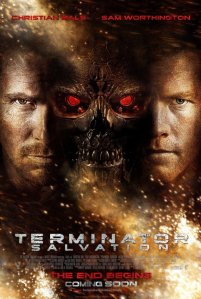
 Though Rise of the Machines was expensive, it had done reasonable box office and scored favourable enough reviews that the intention was there to continue the story. Unfortunately, as is so often the case with the franchise, behind the scenes drama, more bankruptcy and other complications stymied this effort, leading to another re-set as a new set of films was proposed to tell the story from the other historical end, plunging viewers into the midst of the war against the machines itself. With McG on directing duties and Christian Bale attached as the central star, the film already felt conflicted from the outset – could it be the shot in the arm the franchise needed?
All the elements are here for a good movie – Christian Bale, riding high at the time in Hollywood, partway through Nolan’s Dark Knight trilogy and renowned as that most auteur of things – the ‘method’ actor. Helena Bonham-Carter also somehow found herself attached to the project, and Sam Worthington, about to hit screens in James Cameron’s Avatar later that year also had a sizeable role. Director McG – a man of a… certain sensibility, had been in charge of some silly but reasonably successful projects in the form of the Charlie’s Angels movies, and was a fan who wanted to bring a different take to the franchise. Even the setting – in the middle of the post-apocalyptic war against Skynet – represented a serious gear change from what the franchise usually offered. How could it possibly go wrong?
 Well, for starters there’s Bale himself. It’s very difficult to take him seriously as John Connor, who in this film is a sort of weird prophet-like figure who’s immensely disliked and distrusted by the actual command structure of the resistance while commanding a cult-like following amongst some of its line troops. The main issue here is that this doesn’t really make sense. Connor never (on screen) seems to share the reasons behind his ability to predict so much about Skynet’s plans and weapons with anyone, but it’s hard to see why? Surely, if he just produced the tapes he still has from his mother and explained to High Command exactly what had happened, what he had done in his young life and how he knew so much, they’d be queuing up to let him be part of the High Command? Fair enough, the part of his story where he had to explain to them that Skynet sent time travelling assassins after him as he was the future saviour of humanity might have come off a little far-fetched, but surely they’d have to question how he knew so much? In the end, only one of his closest lieutenants bothers asking the question, and he just fobs them off with some half-assed ‘I cheat’ comment and nothing further is said.
 But aside from that, the issue Bale has is that he can’t stop over-acting in every scene he’s in (and his shouting on and off screen has become what many remember most about the film), which grates slightly against a script which pulls the exact same bellyflop as that of its predecessor, namely setting out with a concept which theoretically makes John not the focus of the story but then not really being able to follow through on it. The real story here is supposed to be about Worthington’s Marcus Wright, an ex-convict sentenced to death for murder but now mysteriously finding himself alive in the nightmare of the post-Judgement Day world. The movie sort of wants to be about Marcus, his journey of self-discovery and the salvation (get it?) he finds in helping others and ultimately sacrificing himself for the good of humanity. Except it can’t quite let go of the narrative momentum of having John Connor still be a part of proceedings and the real-world momentum of having the then-Batman playing him.
 Even more frustratingly, you have the late Anton Yelchin turning in a pretty good performance as a young Kyle Reese, but feeling like he’s in the wrong film entirely. McG may be a fan, but this re-working of the mythology about Reese and Connor doesn’t feel like it cleaves all that closely to what we know. Yes, Reese here ends up in a camp, for all of five minutes until John rescues him, except it’s more that Wright rescues him and Connor just sort of happens to be there, and it’s not clear why Reese wouldn’t have mentioned several important details like Wright’s very existence, what it proved about the deviousness of Skynet or how it shaped John as a man and a leader (physically and mentally) to Sarah at any point. Instead he just said that John taught humanity how to fight, which again doesn’t ring true here in a film in which Reese is already fighting on his own and John is way down the pecking order of the Resistance command.
 And then just in case there wasn’t enough confusion going on, the film throws in another plot strand with the mysterious ‘kill signal’ the resistance finds which will deactivate any Skynet machine which receives it and which of course turns out to be another devious ploy by Skynet which sort of intersects with at least one other and ends up making no sense overall. If Skynet (somehow) knows the truth about Reese, why not kill him the second it has him in its grasp? If Marcus is the plant to draw out Connor, why bother having any part of him or his personality actually remain? Why just recreate Marcus but with a stronger body and a chip he can just rip off to regain control over himself so easily? There’s shades here of the T2 weirdness with the ‘read only’ switch in the T-800’s head, and it’s the sort of thing the film ignores entirely because it’s not equipped to deal with it.
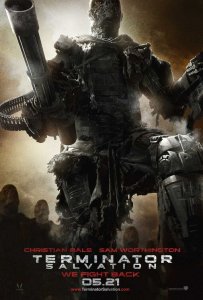 Why this is really a shame is that the film actually does a lot to expand the Skynet mythos. We get to see the actual war being fought, and in daylight. We get to see many different types of machines produced by Skynet instead of just T-800 endoskeletons, Flying Hunter-Killers and Tracked Hunter Killers. We get a human ‘military’ using recognisable weapons and equipment, lending a more grounded feel to proceedings than the odd laser guns of the previous glimpses of the future (which raises its own questions about exactly where they come from). There’s creativity at play here, from the motorcycle-shaped hunters to the giant bipedal harvesting machine and even the smaller snake-like kill droids.
For all the issues discussed above, I like the concept of a John Connor who doesn’t just get his fabled destiny to lead mankind handed to him on a plate. For all his insider knowledge, per Rise of the Machines (which this film has too many links with to be anything other than a direct continuation) he’s just a random waster who’s lived on the fringes of society all his life and happened to luck his way into a military shelter when the bombs fell. There’s no logical reason why the remaining military commanders who presumably made up the first command echelons of the human resistance should suddenly defer to him as their leader. But because the script is so torn between making John a focus and giving the spotlight to Marcus and Reese, it never really gets to explore this, leaving us with just Bale shouting his loudest into various mics at military commanders who won’t listen to him and then the odd spectacle of all resistance forces (not just his own men who you could forgive) deciding to disobey their actual commanders and listen to Connor instead for no real reason that’s ever given. The script essentially wants to have its cake and eat it, having John simultaneously sidelined but also inherently trusted by the men and women he will one day lead without really exploring the reasons for any of it.
 In effect, the film works against itself from so many angles that it destroys any advantages it may have had. Reese’s early story is unsatisfactory because the film really doesn’t give him much to do. Marcus’ entire arc feels oddly underwhelming because although the film spends much of its run time with him, it never really allows him any importance except as a counterpoint to John. And John feels like a weirdly underserved character because it’s clear that the script banks on his importance being clear to fans so it neglects to actually do much of any consequence with him that would help earn that importance.
The film also fails the basic Terminator template set by the opening two movies by failing to have much in the way of any female characters. It’s not that they aren’t there, but they just don’t get much to do that isn’t directly related to the male leads. Moon Bloodgood gets to be a ‘kickass’ pilot who is rescued by Wright and then inexplicably sort of falls for him because he stops her from getting raped (of course) and then is nice to her. There’s a vague attempt to add more to the character by having her give her meds to the attackers she and Wright have just injured in fighting them off, but then when the big reveal is done as to exactly what Marcus is, she just goes all soppy over him, breaks him out and then gets let out of prison for having done this by Connor once he’s made his deal with Wright with no explanation at all.
 As to Bryce Dallas Howard, playing Kate, the part so thanklessly established by Claire Danes in Rise of the Machines, well, even having literally only just sat down and watched the film, I can’t really tell you what her character does beside look sad, comfort John and do some basic doctoring (even though she was a vet in the previous movie – the script serves her so poorly that the only explanation we have on this point is from Howard’s own notes on her character, suggesting in an interview that Kate had studied medical textbooks and spoken to doctors after Judgement Day). Regardless, the absence of a Sarah Connor-type character here is bad enough, but the paltry treatment the two main female characters get is just poor for a franchise with this sort of heritage.
It is a real shame. The elements are there for a real opportunity to be taken. A different setting. No time travel, no need for any of the tired gimmicks. And in terms of its shooting, full of practical effects and in-situ visuals, it has the right tools at its disposal, and a cast that could have done so much more. Considering this was intended as the first part of a whole future war trilogy, it feels odd to realise that it crams so many disparate, confused plot threads into itself and frustrating that it then makes such a mess of each and every one of them. By the time a body double with CGI Arnie face turns up, it’s difficult to care how obvious the FX work creating it is, or how obvious the tricks are used to avoid using it for too long, because the script hasn’t made its mind up about which elements you should actually care about so why should you?
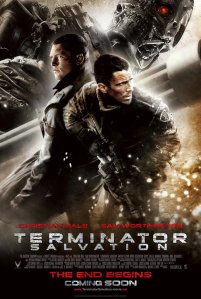 In its favour, Salvation at least avoids the trap of the third film in trying to simply ape what had gone before it, but that feels literally like damning the thing with the very faintest of praise. There’s no salvation here, only disappointment.




 Sci-Fi Bulletin: Exploring the Universes of SF, Fantasy, Horror and Spy-fi!