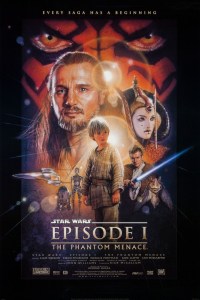
 Sixteen years passed after Return of the Jedi before George Lucas decided that special effects and CGI technology had advanced far enough for him to tell more of the Star Wars saga. In 1999, we went back to the beginning, with Episode I. Finally, the story of how Anakin Skywalker became Darth Vader would be rendered on the big screen, and a generation who had been raised on the adventures of Luke Skywalker and friends as they fought the evil Galactic Empire could not have been more excited. But, wonders Greg D. Smith, could the movie live up to this hype?
As the planet of Naboo is blockaded by the Trade Federation, two Jedi knights are sent to try and break the deadlock. Their journey will take them to the remote planet of Tatooine, where they will discover a very special little boy with an immense destiny.
 There’s a lot about Star Wars Episode I that simply doesn’t work. The CGI and motion capture technology being used at the time was bleeding edge, meaning that not only does its quality suffer from a present standpoint but also that the poor cast really struggled – watching the movie now, eyelines are all wrong as an actor clearly stands and talks to a point in space where they thought a face would be, when it really isn’t. Also, there’s Jar Jar – a character so tone-deaf that it’s impossible to believe that it was put in there deliberately, and whose every feature seems calculated to annoy, from the over-the-top physical comedy to the high-pitched tone of voice and nonsensical style of speech. However, whereas it has become de rigeur to lambast the ‘Prequel Trilogy’ in general and The Phantom Menace in particular, I believe that it’s worth re-examining the movie for what it does get right, and looking at it through the appropriate lens in the way that I believe a lot of critics and fans did not.
 The opening crawl (and indeed the major driving plot) are often derided for being too dull. Nobody cares about a trade dispute or a blockade or the endless long, dull meetings and assemblies and talking that all these necessitate. People are here for Star Wars – action, lightsabers, spaceships exploding!
What people seem to forget is that the war in the original trilogy was a product of its time, and of the events that led to it. Existence is seldom punctuated by constant war – war is the result of disagreement of one type or another. The original trilogy presented us with a war between the Empire – an autocratic regime hellbent on total control of the galaxy through fear – and the Rebel Alliance, a loose confederation of freedom fighters determined to topple the Empire and restore the Republic. What the prequel trilogy sets out to do then is present us with context – a history of the events which brought us to the war we know, while focusing on the journey of a few key players through that time. In this respect, The Phantom Menace actually bears more thematic resemblance to A New Hope than some might like to admit – both involve a tight focus on a small group of protagonists and villains against the backdrop of galactically significant events.
 If The Phantom Menace in fact has a failing, it’s that it introduces a few too many characters into that mix (and yes, one of them is Jar Jar), diluting some of that focus. A New Hope gives us Luke, Leia, Obi Wan and Han. Chewie, 3PO and R2D2 are adorable but less developed sidekicks, and Vader and Tarkin are our main villains. Outside of this small group, everyone else who appears in the movie is only there for as long as it takes for them to advance the plot by word or deed.
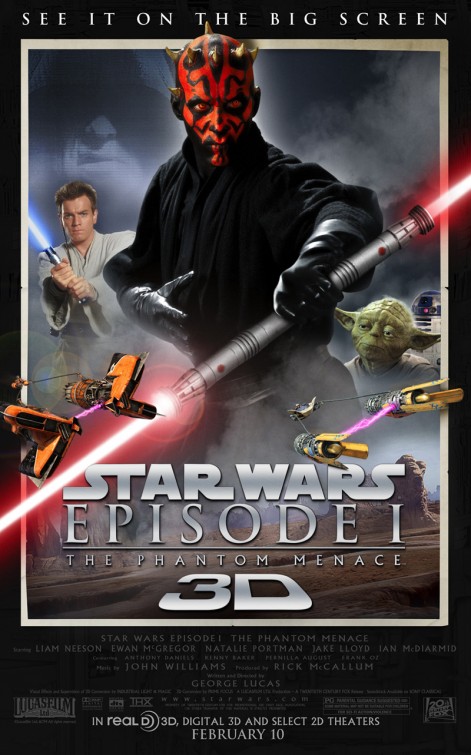
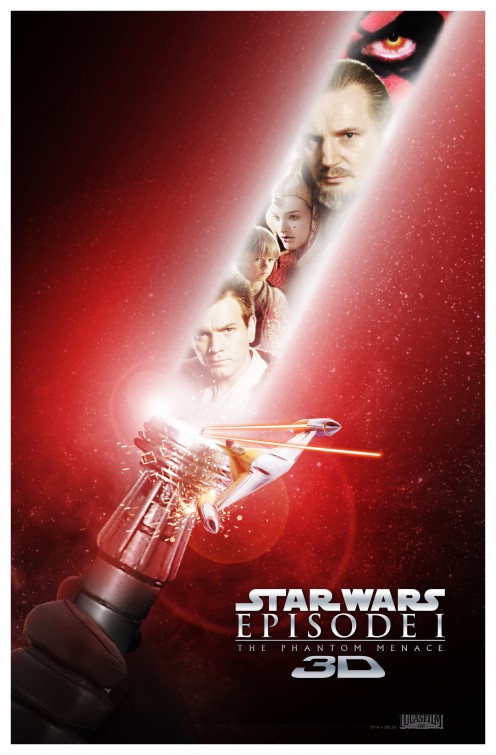
Contrast this with The Phantom Menace, which gives us, on the protagonist side: Qui Gon, Obi Wan, Padme, Anakin, Shmi, Jar Jar, Boss Nass, Palpatine (yes, I know, but at this point he’s on side as far as anyone who hasn’t already seen the original trilogy knows) plus a horde of supporting characters. Against them are Sidious, Darth Maul, Nute Gunray, Watto (to a certain extent), Sebulba(ish) and a bunch of disposable-ish comedy robots who kind of fumble their role as stand in stormtroopers by being granted altogether too much personality with their embarrassing ‘comedy’. It’s one of the fundamental struggles at the core of the movie – the laser focus of Lucas’ storytelling method bursting (and if we are fair often breaking) at the seams as too many characters are forced into it.
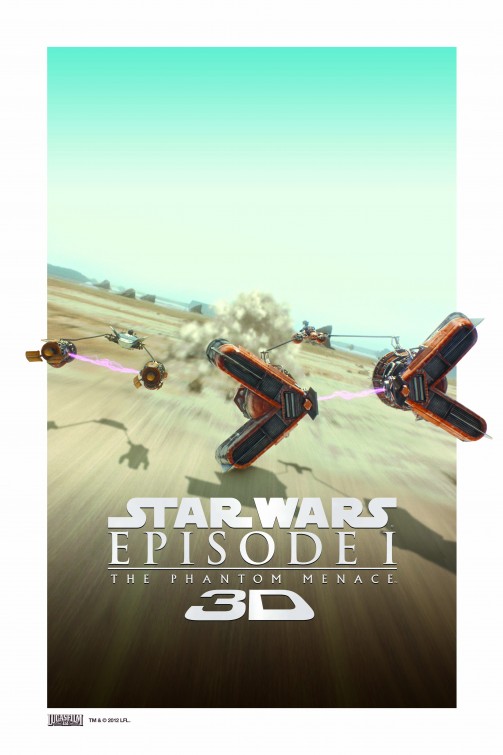
 And it’s not like we don’t have action. The movie opens with plenty of it – the whole sequence of Qui Gon and Obi Wan escaping the Federation, the pod race, the lightsaber duels (one admittedly very short, the other arguably one of the most striking, lengthy and iconically scored fight sequences of the entire franchise), the final battle both on the ground between Gungans and droids and in space between Naboo pilots and droid fighters. Action is not a thing that the movie lacks – where it starts to falter and feel a little exhausting is in asking us to devote so much time and attention to so many different characters in a format ill-suited for them.
As far as Lucas’ signature fairytale storytelling style – that’s all present and correct, but again it showcases the issues of too many characters. Qui Gon and Obi Wan are both vying for the ‘main hero’ slot, while perversely Obi Wan simultaneously shares the ‘prodigal hero who will rise’ place with young Anakin. Padme is present and correct as the damsel/literal princess, but the oddity of the switcheroo between Amidala and Padme confuses this too, effectively giving us the same character twice over but also only once, in a sort of Schrodinger’s Princess effect.
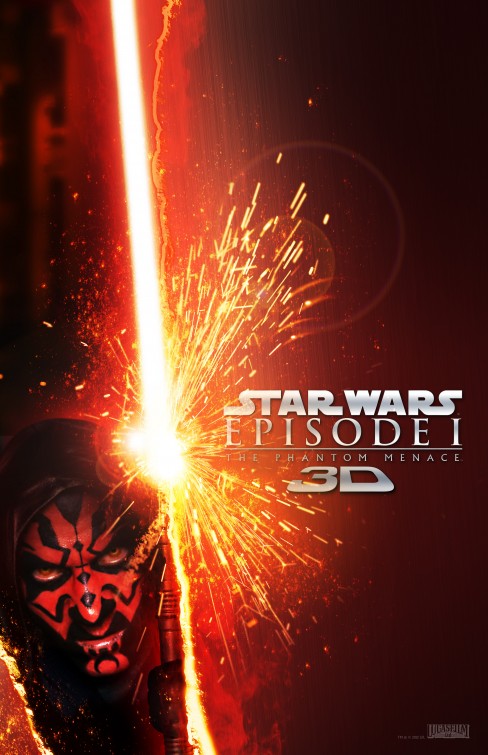
Elsewhere you have the issue of two main villains, neither of which feels adequately developed for all that they share roughly similar screen time. Sidious is a mysterious shadowy figure (except he isn’t because they don’t even make a token effort to disguise McDiarmid’s distinctive voice) who merely floats in various holograms talking remotely with people (and once live turned away from camera alongside Maul). Maul gets virtually no lines at all, and we learn absolutely nothing of him at all. It is possible to argue that this makes him no different to Vader in A New Hope, save that we at least get some background as to what Vader has done via exposition in that movie – here, we are told that Maul is a baddie because the movie says so, and whereas his fighting style is memorable and entertaining to watch, it’s difficult to care much about him, doubly so when he is so swiftly done away with.
 Then you have the secondary ‘villains’ – the Trade Federation under Nute Gunray (more tone-deaf characterisations and accents) and their ‘wacky’ droid army. Whoever thought that what the prequel trilogy needed was more stormtroopers but robotic and zany needs to have a long word with themselves. The droids carry no threat because of the way in which they are portrayed, undercutting the drama and tension of the massed battle scene at the end of the film, as hordes of them advance on the assembled Gungans. For its time, the CGI is impressive, and the assembled armies have plenty of spectacle about them, as do the massed shots being traded and the huge explosions. But we all know that it’ll end in the robots going ‘Roger Roger’ in that comical way of theirs before they fall over again, and so it just feels a little soulless.
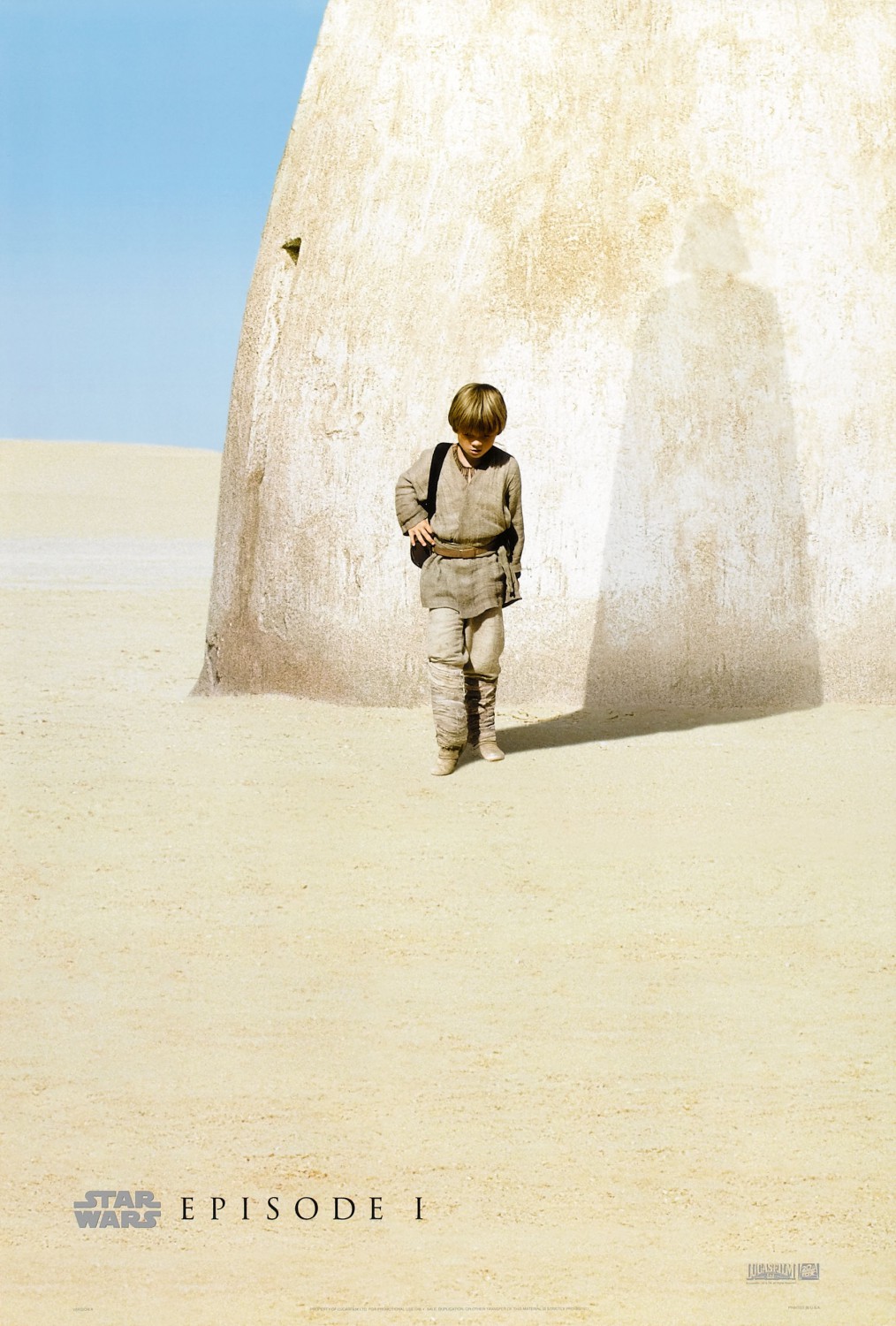
However, if you want a story that tells you how a good man like Anakin Skywalker ended up becoming the most feared and ruthless warrior in the galaxy, this is your starting point. For all that many bemoan Jake Lloyd’s cute-as-a-button stature and over-excited kid delivery, you have to consider the circumstances in which we find little Ani. He’s a slave, as is his mother. They live in relative poverty, owned by a cruel master. This is during the era of the much-vaunted Republic and at the supposed apex of the power and influence of the Jedi Order. Yet neither democracy, nor the noble knights of this more civilised age can stop the slavery and misery in which people like the Skywalkers find themselves. Is it any wonder that a boy growing up in such circumstances should be disillusioned with the order of things?
 We also see evidence of Anakin’s impetuousness and impatience even at this early age. From volunteering himself for the pod race to electing to leave with Qui Gon to become a Jedi knight, and then ending up in the middle of the fight against the droid control ship, Anakin is someone who acts first even though he deeply feels the consequences of his actions. It is not so much that he is thoughtless, as that he tends to act more quickly than his mind can catch up with – perhaps a part of those Force-enhanced instincts that have been left untrained in him for so long. When the Council first meet him, their objection is not a lack of skill, or aptitude – they don’t even argue against Qui Gon’s assertion of Anakin as the Chosen One (a nice title for the convenient prophecy of the One Who Will Save Us All, just in case anyone hadn’t already picked up on the fairytale tropeishness of the tale). Their objection (as will be Yoda’s in years to come) is that Anakin is too old, and too full of fear that might take him to dark paths. Again, we see the rhyming poetry of the narrative – Anakin’s story is not Luke’s story, but the two rhyme with one another in so many ways. Both hold natural affinity for the Force in their blood, but neither ever really has the aptitude to control it because of their emotion. Perhaps the greatest irony of the Skywalker saga as it unfolds before us, is that it’s a tale of men who are all-powerful, but who are absolutely unsuited in their respective ways to wield that power (and that the one woman of their bloodline who has it just doesn’t even bother to use it, instead funnelling her energy into running the Rebellion, often single-handedly).
There are all the seeds required to tell the story that needs to be told here. Those who bemoan ‘all the talking and meetings’ are vastly overestimating the presence of either within the film. Those who object on the basis of the film being too puerile in its sensibilities and humour are forgetting that these are films designed to be for the family, from a time when the appellation ‘family film’ literally meant the youngest child to the oldest adult could all sit down and watch together and be entertained. Those who object to Jar Jar have a point, but it’s really a wider point about the over-saturation of characters, to the point where the fine-tuned focus that is a signature of Lucas’ storytelling style gets lost in the white noise of too many competing threads overlapping one another.
 Were the movie to be done again, it would benefit from different focus. Have the trade federation (preferably with less racist overtones) but keep them firmly in the background, the way that Jabba and Fett were in Empire. Get your two main villains front and centre. Don’t muck around with this whole ‘is he/isn’t he’ nonsense with Palpatine – show us him transitioning into Sidious and vice versa, instantly making each persona more interesting and giving us more resonance and intrigue. Ditch Qui Gon (or at the very least have him be a less-involved character), and have Obi Wan be more advanced: a newly-inducted Jedi Knight who is a little too cocky for his own good. Make Anakin just a shade older, so that he and Obi Wan can be the contemporary-ish mutual bad influence with a good heart on one another that they should be – indeed that the original movies had promised us they were.
It isn’t quite the movie it wanted to be, but neither is it the unlovable mess it’s often treated as. Like the hero whose story it begins, its main failing is a lack of focus. Forgive it that failing, and there’s a faithful, entertaining, if bombastic entry in the Star Wars canon lurking just beneath the surface. Lucas could have played it safe, but he chose to push the envelope, and there’s far more merit in an ambitious failure than a safe success, regardless of what Master Yoda might have to say on the subject.




 Sci-Fi Bulletin: Exploring the Universes of SF, Fantasy, Horror and Spy-fi!