 The world was hungry for more Star Wars and in 1983 George Lucas delivered the concluding chapter to his original trilogy, and in the process not only cemented his own now well-publicised storytelling preference with regards to the poetry of narrative symmetry, but got a bit meta about it as well, as Greg D. Smith explains
As the final stages of construction on the new Death Star are underway, the Rebel Alliance launches a desperate mission to destroy not only this terrible new weapon but the Emperor himself, hoping to topple the Empire in a single decisive stroke. Meanwhile, the Alliance’s greatest hero struggles with his own destiny.
 There’s a couple of old maxims that seem particularly relevant when discussing Return of the Jedi: ‘The more things change, the more they stay the same’ , and ‘Those who do not learn history are doomed to repeat it.’
Both ring true in consideration of the world around us, and both run like a thread through arguably the entire Star Wars universe of films, TV and books, but on its release, Return of the Jedi represented the first time this theme had really been addressed and writ large across the screen for us. Like A New Hope and Empire before it, Jedi feels like a morality fairytale, designed to teach the viewer an important lesson about the nature of the world, and regardless of how you feel about Ewoks, what’s undeniable is that once again, the movie delivers its messages elegantly, making maximum use of all elements of the medium.
The opening sets the tone – again we have the famous crawl, which tells us about Luke’s adventure to Tatooine to save Han, and the Empire’s secret construction of a new Death Star. Critics of the movie (and the franchise as a whole) are not impressed by this, citing a lack of imagination. But when we look at the movie’s overall message of repetition, it starts to make a lot more sense. The Empire, having had their original super weapon blown up by the Rebels at the Battle of Yavin, decide to build another one. Certainly there are differences, not least a defensive shield, but when it gets down to brass tacks, they are basically doing the same thing all over again, and assuming that this time it will work.
 This is entirely consistent with the themes that will go on to be expanded upon regarding the Emperor and his lust for control of the galaxy as the series progresses (hinting that perhaps more of the whole story existed in Lucas’ head early on than his detractors give him credit for): look at how Palpatine pursues Luke with the express desire of using him as an enforcer who could replace Vader. Palpatine’s experience with Vader – the failures as well as the successes – have ‘taught’ him nothing, and he is quite willing not just to go down the exact same path, but with the son of the man with whom he originally trod it. Call it hubris, or simple naivety, but repetition is not something from which the Emperor is ever shown to have shied away.
Jedi also treads a different path from its predecessors by starting with the Villain’s eye view. The opening five minutes of the movie are entirely dedicated to showing us Vader arriving at the new Death Star. The interaction between Vader and the Commander here is fascinating. Never before have we seen any Imperial Officer – not even Tarkin himself – attempt to reason with the Dark Lord of the Sith, let alone talk to him in such frank manner about the expectations of the Emperor. It raises many questions – is this Commander merely naïve? Has he never met Vader before? Even if this is the case, it seems unlikely he would be unaware of the man’s reputation. What it all adds up to is a lingering doubt about Vader’s parting comment – ‘The Emperor is not as forgiving as I am.’ At first blush, one assumes it’s a face value bit of snark, but perhaps there is something more than that? Perhaps somewhere, underneath the armour and the rage, we are already seeing the evidence of the humanity that remains to Anakin Skywalker – a humanity that allows him to be more ‘forgiving’ than his dark master.
 At any rate, the movie opening on the Imperial side changes things, continuing the sombre mood that Empire closed on, and immediately putting the viewer on their toes. The first scene of protagonists involves R2 and 3PO and their appearing before Jabba to plead for an audience for Luke to beg for Han’s release. Again, there’s an economy of production here – rather than bog us down with long minutes of expository dialogue or scenes, the one scene tells us all we need to know – Han is still a prisoner of Jabba, frozen in carbonite, Lando is still on station undercover, the Rebels want Han back, and their efforts are centred on retrieving him. Short, simple, functional.
The scenes that follow form a delightfully perverse first act from the point of view of the audience. We, having the omnipotence that viewership brings, know that the Empire is busy constructing their new improved Death Star, ready to wipe out the Rebellion and half the galaxy with them, yet here are the main figureheads of the Alliance all together expending an awful lot of time and energy on rescuing one man. Of course, as the crawl has informed us, they are not yet aware, and this makes the reason for starting the movie on the new Death Star all the more clear – we would not have this narrative tension as an audience without it. All the while we are rooting for the gang to boost Han out of his prison, we are also wishing they’d hurry up so that they can deal with the real stuff that needs attending to.
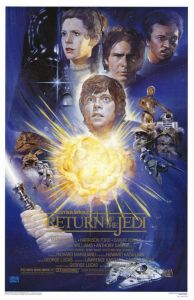 There’s an argument that Jedi undermines a lot of the credibility Carrie Fisher had built for the character of Leia in the first two movies in this opening act, by having her put on the infamous gold bikini as one of Jabba’s harem. To this I would simply point to Fisher’s answer to a concerned parent who once asked her what he was supposed to tell his young son about this: that she’d been forced to wear it when she was captured and that at the first opportunity she got, she throttled the guy who made her wear it, escaped, and put some real clothes on.
The first act rounds off with a check in with Yoda, as Luke returns to Dagobah. There’s a sense in the exchanges here that the dying Yoda is genuinely surprised at Vader’s revelation to Luke. The tone of the conversation shifts, from Yoda matter of factly telling Luke he must confront Vader again, that he has learned all that Yoda could have taught him already, to evasiveness, and then almost incoherent, babbling truths. One after another come the pronouncements – don’t underestimate the Emperor lest he suffer his father’s fate, pass on what he has learned, there is another Skywalker. It’s as if, at the very end, the little Jedi master feels a sudden guilt at all the secrets that he has kept, and seeks to unburden himself before he goes. Between this and the following conversation with Force ghost Ben, there’s a sense that perhaps the motivation of both Luke’s mentors in sending him to confront Vader lies not in any realistic hope that a barely-trained kid has any chance of killing him, but that maybe by confronting his offspring the man they knew might surface from the monster he has become? Certainly, at that point there are few other options remaining to them.
 As the second act kicks in, the whole gang are reunited by the discovery of the new Death Star, as the Alliance plans out what can be done about it. Naysayers who claim it’s funny that the Empire built two Death Stars with the same weakness are – once again – not paying proper attention. The differences are manifest and manifold – there’s no trench run, no million to one shot into a tiny hole, and the small matter of a commando mission to disable the shield first. It’s rhyming poetry, not straight repetition.
At the briefing, Han and Lando finally get reunited properly again for the first time since Bespin, and there’s a genuinely touching moment of the camaraderie between the two as Han insists that Lando take the Falcon to undertake the mission. Lando is one of the iconically cool characters in the Star Wars universe and it’s worth noting that he achieves this status with relatively little screen time. It’s not quite Boba Fett’s ‘blink and you’ll miss him’, but nevertheless, Williams deserves all the plaudits and more for how much he squeezes from such a small role.
And then of course, there’s Endor, and that means Ewoks. Most people who argue that Jedi is poorer than its predecessor cite the Ewoks as a main area of contention. How do giant teddy bears defeat the Empire, they ask? Why do we need them at all? Aren’t they just a merchandising opportunity? Well, first of all, this is Star Wars, set in that far away galaxy. Nobody minds that R2 – an astromech droid who spends relatively little time doing any astro-meching – basically squeaks and beeps and does a variety of daft things yet manages to always save the day. Nobody objects to a golden protocol droid who for some unfathomable reason is brought on every adventure despite being cowardly, mostly annoying and almost entirely useless.
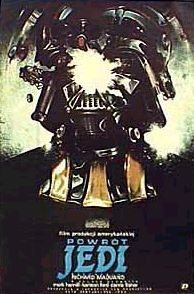 But even setting this aside, the Ewoks represent something vital in the Star Wars universe – a different culture. Not just because they are different looking, but because they are entirely removed from any creatures we have encountered up to that point. Other aliens we have met basically interact with everyone else, using the technology, spending the money and if not speaking the lingo, at least understanding it. Ewoks represent a snapshot of life outside the bubble of both the Empire and the Rebellion. These are native creatures, with their own language, tradition and culture. They don’t have blasters and comm links and lightsabers, they have spears, bows and arrows and loud horns. These are the exact sort of people the Rebellion is fighting on behalf of, and it’s about time that some of them made an appearance in the franchise.
As to whether Ewoks ‘should’ be able to defeat Stormtroopers? They have the advantage of knowing their ground. They have survived this long in a galaxy ruled by the Empire somehow – heck they have survived on their own planet while it’s garrisoned by the Empire as the Death Star II is built. None of that has happened by accident, and I have no issue at all with their being able to overcome Imperial opposition with sheer cunning and weight of numbers.
 But when the Ewok adventures are all said and done, and the fleet arrives and starts getting obliterated by the – as it turns out – fully operational Death Star, there’s only one conflict that really matters, and it’s the one that really embraces the narrative of the repetition of history – the confrontation between Vader and Luke, in the throne room of the Emperor.
As I mentioned before, perhaps Ben and Yoda foresaw that Vader would be weakened somehow by confronting his own flesh and blood. Certainly in the first half of the duel, it is clear that Vader is pulling his blows, because there is no other way that Luke could be holding his own. Luke proves from the moment that he picks up his blade that he’s afflicted with every weakness his father had, as well as every strength, easily able to be goaded by Palpatine into embracing his anger. Though Luke contemptuously tells the Emperor that his overconfidence is his weakness, it’s clear that already he himself is rattled, convinced that his friends have failed.
And you have to wonder at the emotions going through Vader’s mind as the duel unfolds. It is clear that he does not want to destroy his son. It is also clear that he is totally in thrall to the Emperor. Even as he takes Luke before Palpatine, he must at the very least suspect how his master sees this playing out. Luke is Vader’s replacement, not just metaphorically but literally. This is confirmed when Luke first knocks him down, and the Emperor attempts to goad him further – openly telling Luke to kill Vader. Vader has literally brought forth the instrument of his own doom. That he continues to fight suggests either a total apathy about his own survival, or perhaps a hope that in defeating him, maybe Luke will set him free from the Emperor, and then possibly do what he himself has never been able to do and destroy Palpatine as well.
 And then, just to beat us over the head with the circular nature of the unfolding drama, we have Luke’s severing of Vader’s lightsaber hand. As the hand spins off into a pit, mirroring Luke’s own hand on Bespin, Luke stares at the sparking stump that remains, flexing artificial fingers beneath his glove. This, he seems to realise, is exactly the path down which his father walked, both physically and emotionally. Finally, Luke Skywalker becomes the hero he was meant to be, rather than the one he’s been trying to be. His great strength not the ability to use his powers to achieve great feats of arms, but his heart, which allows him to back down from the fight – the one thing of which Anakin was never capable, the one way in which Luke can resist the Dark Side.
It’s a scene packed with emotion, the sparse dialogue perfectly balanced with the intense conflict playing out on screen. The culmination, as Vader picks up the Emperor and throws him down a pit, is spoiled a little in the latest version with he addition of the ‘No’ dialogue that was never required, but it still works. The following moments, as Luke sees his father face to face for the first time, tie things off perfectly. Vader was a monster, but in his final moments, we see what remains of the man, and the humanity in the eyes which are revealed helps both Luke as a character and us as the audience to forgive him.
 From there, the movie wraps itself up – the Death Star is destroyed, the day is saved and the Empire’s dissolution begins. Purists detest the loss of Yub Nub in favour of a bombastic new John Williams piece, and of course there is much additional CGI as the camera pulls us to various worlds in the newer version. I’m in two minds on the matter. On the one hand the original ending could be seen as more realistic – the destruction of the Death Star and the death of the Emperor alone could not immediately topple the Empire and all its armies, and the smaller, more intimate celebration of the immediate victory on Endor is arguably therefore more appropriate. On the other hand, while both events wouldn’t end the Empire, they would certainly have galaxy-wide impact, and the new scenes show that.
It may not garner the lavish praise from critics and fans alike that Empire did, and it inevitably lacks the freshness and impact factor of A New Hope, but Return of the Jedi is a far better movie than it often gets credit for. It deals pretty robustly with the themes set up by the other two films, it never actually gives us the cliched hero riding into the sunset ending that other fairytales might. It’s content to let Luke just win a victory by being him, rather than by being the greatest warrior in the galaxy, just as it’s content for Han to get swept off his feet by the Princess. It’s edgy (you did notice that Ewoks eat people, and that they’re playing with an awful lot of Imperial helmets at the end?), it’s subversive and it plays with the expectations of its audience in a way that few blockbusters are brave enough to do even to this day. As the end of a glorious opening trilogy, it’s pretty much perfect – from a certain point of view.





 Sci-Fi Bulletin: Exploring the Universes of SF, Fantasy, Horror and Spy-fi!