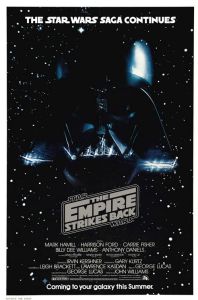
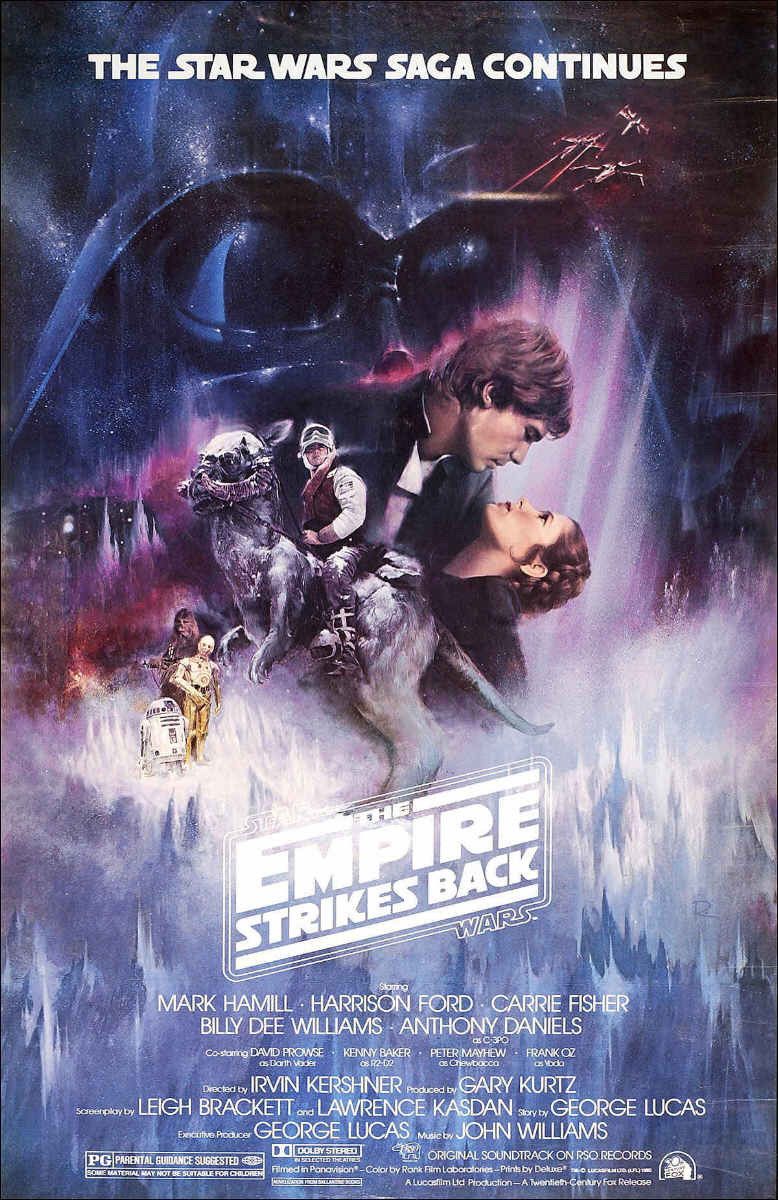
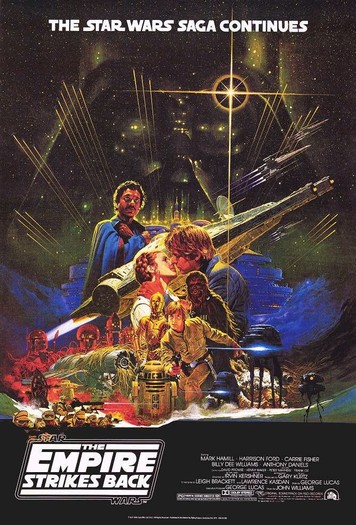
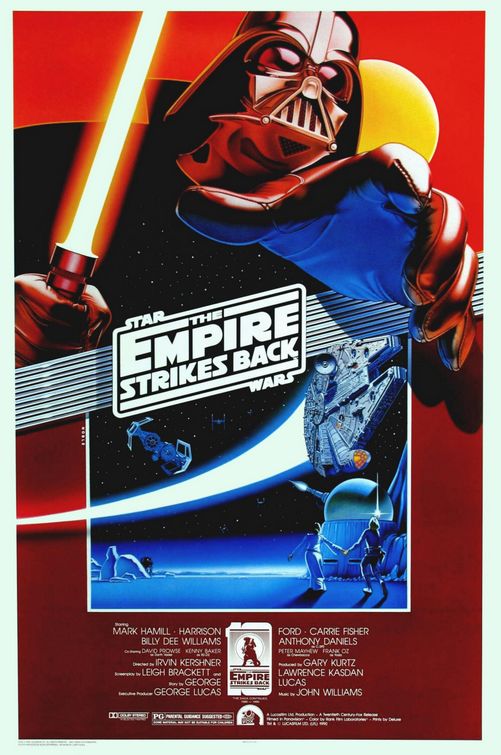
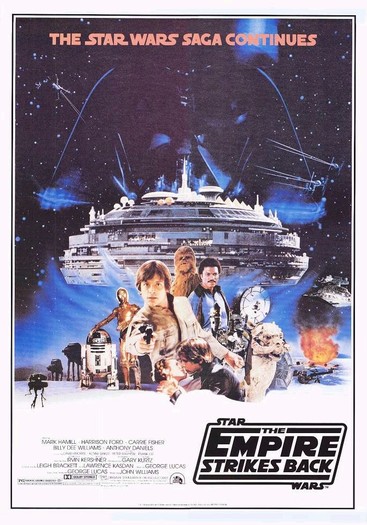
 Following the utterly phenomenal success of Star Wars, George Lucas set about the daunting task of creating a sequel that might live up to its predecessor. With a different director and a darker tone than A New Hope, could this movie possibly live up to expectations? Greg D. Smith investigates.
As the Empire steps up its campaign to crush the Rebel Alliance after the destruction of the Death Star at Yavin, Luke Skywalker gains a new mentor in his quest to become a Jedi Knight. But the capture of his friends by Darth Vader may prove a fatal distraction from his training, and the choices he makes could have dire consequences for the Alliance and the galaxy.
So successful was The Empire Strikes back in achieving its goals, its name has become shorthand among critics and fans alike for a successful second movie. When Christopher Nolan’s The Dark Knight improved upon its predecessor in every possible way, it was Empire that was widely cited as a comparison. It regularly receives praise from critics and fans alike, and is even preserved in the United States Film Registry by the Library of Congress as a result of its being ‘culturally, historically and aesthetically relevant’. This is a film that made a hell of a splash, against all odds when one considers just how much impact its forebear had made. But is it worthy of all these accolades, and does it stand up to the same scrutiny and standards as A New Hope?
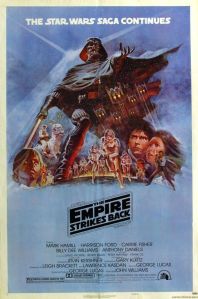 If A New Hope wears its fairytale inspirations on its sleeve. Empire goes one better, taking on the aspects of myth and legend as it deepens and widens the universe in which it sits, while still never losing focus on the handful of characters at the centre of our narrative. In the modern era, where big budget blockbusters often feel impersonal and distant with their enormous battles and dizzying levels of destruction dwarfing the characters, it’s educational to realise just how well Empire juggles scale with substance on a galaxy-spanning canvass.
Take the opening – once the crawl has informed us of the Empire’s pursuit of the Rebels in this dark time for the galaxy, and of Vader’s obsessive pursuit of Rebel leader Luke Skywalker, the action jumps straight into a probe being launched from an Imperial Star Destroyer and landing in an icy wasteland, observed by our hero on his Taun-taun. From there we get the Wampa attack, the worry at Echo base about where Luke might be, Han striking out into the deathly cold night to look for his friend, and the rescue the next day. All of this is personal, small-scale stuff, but it’s taking place against the canvass of a massive frozen world and the evacuation of an entire base and all the people in it as an overbearing military force descends upon it. Not for one second do we ever doubt the scale of the events that are unfolding, even as they form a peripheral backdrop to the stories of our heroes.
 Take Dak. We know that Dak is Luke’s rear gunner in the battle at Hoth. We know that he’s a young, idealistic Rebel soldier who is full of optimism, and we feel the pain and tragedy of his loss when Luke’s snow speeder is shot down. Yet Dak is on screen for a mere handful of minutes, with very few lines of dialogue, and his death takes place against the backdrop of a full Imperial assault on a Rebel base, which results in hundreds, if not thousands of casualties. We see all of this, and we feel the desperation of the soldiers fighting to buy more time for the escaping ships, the dedication of the ground crew at their stations guiding ships out even as the base literally falls down around them, and the bitter tang of defeat as the soldiers finally retreat in the face of the overwhelming firepower of the AT-AT and AT-ST assault. But the movie still finds time to show us all this and get us invested in one named character with a handful of lines. This is the real genius behind Empire writ large – the small stuff mattering equally as much as the big stuff, and neither taking away from the other.
It’s what allows the movie to branch off its protagonists into two groups early on – Luke and R2 heading for the Dagobah system to find Yoda and complete Luke’s Jedi training, and Han, Chewie, Leia and C-3PO ploughing their own path on the Falcon as they try to escape the attentions of the Empire. Focusing in on these two stories never takes away from the wider conflict we know is taking place, but instead helps give that conflict a beating heart and stakes to care about that a film which had merely concentrated on big fights and explosions would have lost.
 In terms of a hero’s journey, Empire is a fairly unique beast, retaining consistency with the character of Luke from the first movie by not really allowing him one. Luke is not that far removed from the farmboy we first meet, for all his bluster. His opening exchange with Han over the comm, referring to a man a couple of decades(ish) his senior who he’s known at this point for roughly three years as ‘Han, old buddy’ smacks of an insecurity clumsily masked by faux-boisterousness. Later, when he competes for Leia’s attentions/affection with Han at the base, it’s the move of an immature man, still trying to prove something. When he arrives on Dagobah, it doesn’t occur to him to be anything other than dismissive of the first person he meets, because it never occurs to him that a Jedi master could be anything other than a massive hulking warrior. When he does discover the truth, he’s insistent that he will stay the course, that he won’t let Yoda down and will finish what he starts. But as time wears on, he proves again and again that this is a promise he can’t keep. His failure to believe means he can’t use the Force to lift his X Wing from the swamp. His refusal to heed Yoda’s warning about taking weapons with him into the mysterious cave leads to an oddly prescient but ‘unsuccessful’ encounter, and as soon as he senses his friends in danger, he drops everything and leaves against Yoda’s pleas to the contrary, just like he promised he wouldn’t to begin with. Like any excitable kid, he’s susceptible to distraction, and it almost becomes his downfall.
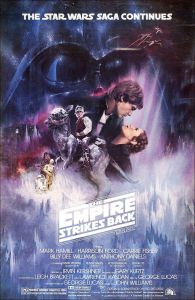 On the other hand, we have the will they/won’t they romance blossoming between Han and Leia, which is so well done, and with which we spend so much time as viewers, that you might be forgiven for thinking that these are the real main protagonists of the story. Leia continues her arc from the first movie for the most part, unflappable in the main, always with both eyes on the bigger picture, but annoyed at herself as much as at Han for the distraction he represents. It’s an interesting flipping of the traditional princess/swarthy hero trope, wherein for once it’s the princess who is the hero in charge of the war effort and determined to win the day, bothered by the notion that she might have to give some of this up for a love interest, and it’s the swarthy rogue type who’s gone distinctly mushy. Seriously, watch the movie again if you don’t believe me – Han makes all the running here. He’s the one who practically forces Leia to follow him down a corridor on Echo Base after flouncing out of the control room. He’s the one who approaches her and instigates discussions about her feelings for him and the tension between them. There’s also the matter of the distinct softening of his character – the Han we meet in Mos Eisley is a ruthless mercenary out for himself and nobody else and willing to do whatever he needs to in order to make some money. The Han we meet in Empire is kinder, more selfless, and capable of great generosity. Sure, he tries to keep up the front with the sarcasm and biting comments, but like Luke, it’s a front for what he really feels like. He’s smitten, and boy does the movie let us know it.
On the bad guy side of things, we get to see a lot more of Vader and his…unique approach to command. Though he cuts a menacing figure in A New Hope, this is somewhat detracted from by the fact that he’s on Tarkin’s leash the whole time. Here, although we do get to see one scene of him bowing to his master the Emperor, Vader is in full, majestic form. Whether he’s choking the life from subordinates who have failed him or jabbing a threatening finger at a bounty hunter, Vader is in charge of every room he enters. Interestingly, the movie also takes the chance early on to show us a glimpse of the flesh beneath the mask, as an officer sneaks a peek waiting for Vader to emerge from his isolation chamber. This is perhaps the first hint of the big reveal to come later, maybe softening that future blow by reminding us that there is – however scarred and battered – a human being under all that armour.
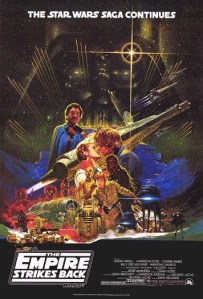 When Han and Leia arrive on Bespin, we get introduced to someone even smoother than Han is trying to be, the effortless charm of Lando putting the audience (and Leia) on instant guard that something isn’t quite right. Again, we see the reversal of the trope common at the time – Han being seduced easily by the friendliness and charm of Lando while Leia refuses to trust him.
Of course, that’s because Lando and Han go back a long way – and decent dialogue combined with great performances once again deliver us this information without the need for lengthy expository dialogue or narrative-breaking flashbacks. Han won the Falcon from Lando. Lando used to be an even bigger rogue than Han, but has now gone straight. Better still, the movie solidly doubles down on this character growth for Lando (a character we have only just met) as the betrayal is revealed and then twists. Lando genuinely wants to do right by his people, and sees no reason for any more people than necessary to be hurt to achieve that. Confronted with Vader altering their original deal, Lando formulates a plan to get Leia and Chewie away, and makes sure to tell all the inhabitants of Bespin to get the hell out before he does anything. It’s a ballsy move, and it illustrates that while he’s grown as a person and cares for others, Lando is still the successful career gambler at heart, content to lose his whole livelihood at the drop of a hat if that’s what the odds dictate.
And then we get to the big one – the epic confrontation of the movie which will change all the stakes again, and which cleaves closely to the theme of keeping things personal. We enter the fight with the knowledge that Vader is there to capture Luke for the benefit of the Emperor and ultimately of the Empire. We leave it, several minutes later, with all those certainties turned upside down, having learned that the most evil character we have spent the last four hours of movies in the company of is actually our supposed hero’s father.
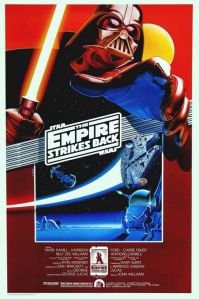 And it’s a fight that represents a journey for Vader too – as it begins, he’s all calm, in control. We know that he knows already who Luke is but he has distanced himself from the fact, happy to simply deliver his son up to the one he calls master. The opening exchanges don’t especially tax him, and he’s quietly impressed by Luke’s early escape from the trap. Then the fight turns more aggressive, with Luke forcing him off the edge of the raised platform on which they’re fighting. When the fight enters its second phase, he’s pragmatically brutal, almost playfully tossing objects at Luke using the Force, like a playground bully demonstrating his superior strength, and if it’s an uncomfortable watch first time around, as Luke is battered by various heavy objects before being blown out of a window, on subsequent viewings, knowing what’s to come, it’s even worse.
But then it’s time for round three. Vader lunges from darkness, swinging wildly, all aggression and power, forcing Luke back. A brief rally sees Luke wounding him, and aggression turns to blind rage, resulting in the severing of Luke’s lightsaber hand and the end of the fight. And then that speech. So often misquoted (it’s ‘No, I am your father’, not the pop culture-embedded ‘Luke, I am your father), it’s a line that resonates not just because of what it represents in the wider plot, but because of how it’s said, and the context in which it is delivered. Suddenly, we get the impression that perhaps Vader was fighting two opponents in the duel we just witnessed: his son and himself. Certainly that sort of internal conflict and distraction might explain how an advanced warrior such as Vader didn’t just instantly flatten a novice like Luke. Luke’s response also helps sell the drama of the moment, and again we are confronted with the personal against the backdrop of so much more – Vader holding out a hand, urging Luke to join him so that they can rule the galaxy, Luke just caught up in the trauma of what the revelation means for him.
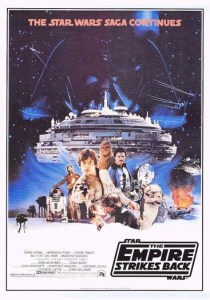 Unlike A New Hope, Empire ends on a low note. Although the heroes mostly make it back home, they’re diminished – Han is captured, Luke is wounded physically and mentally, and there’s a sense that things are about to get a whole lot worse. There’s no medal ceremony, no triumphant celebrations, just the quiet of a medical bay, the reassurance of a hug, the brief exchange between Lando and Luke before the former takes off in the Falcon to go and rescue Han. Everything ends on a knife edge, and everything ends with the game very different to how we began.
It’s perhaps unfair that Empire gets the lion’s share of the praise and attention of the original trilogy. Yes, it’s an excellent movie, and yes it expands on its predecessor in every way. But without that foundation stone that A New Hope provided, Empire could never have been what it was. It’s a movie that continues the good work that Lucas started in 1977, using tropes but flipping the details wherever it can, and telling a far more nuanced and interesting story as a consequence. As Lord Vader himself would have it – ‘Impressive. Most impressive.’




 Sci-Fi Bulletin: Exploring the Universes of SF, Fantasy, Horror and Spy-fi!