 With Abrams’ The Force Awakens successfully navigating the narrow line between fan service and breathing new life and new characters into the franchise, plus the heritage of the original trilogy to think about, the pressure was really on for Rian Johnson to deliver something special for his middle entry into the new Star Wars trilogy. Would he play the safe route as Abrams had done, or take more bold choices with his story? And would we get the answers to all the questions which had swirled around fans minds since that last shot of Luke Skywalker facing Rey on his tiny island? As Solo hits cinemas today, Greg D. Smith looks back at the most recent addition to the Star Wars saga…
In the wake of the destruction of Starkiller base, a vengeful First Order pursues the Resistance hard across the galaxy, seeking to grind the last traces of them utterly. Meanwhile on Ahch-To, Rey tries to convince Luke Skywalker to return from his self-imposed exile to defeat Kylo Ren and save the galaxy.
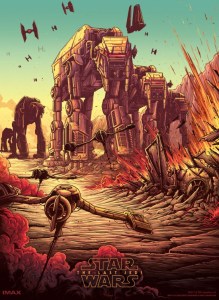 Let’s address the elephant in the room first of all – The Last Jedi was, and continues to be an incredibly divisive film among the Star Wars fanbase. Oddly, critics received it fairly universally well – it garnered high praise across the board from newspaper, magazine and online outlet reviewers, but the response of the viewing public was spread far wider, from those decrying the movie as a betrayal of everything the saga and the characters stood for and demanding that it be struck from the canon, to those who thought it a bold and brilliant new take on the franchise and its themes.
I’ve mentioned several times in this series that Lucas had a certain passion and ambition to his movie-making that meant even when movies didn’t quite hit the marks they were going for, I found there was merit in what they had tried and that I would rather see an ambitious failure than a safe success. Last year, I was lucky enough to see a talk given by Iain McCaig, an artist who has worked, among other things, on the Star Wars franchise. He asked the question of his audience as to what Star Wars meant, what its essence was. After taking a few responses, he opined that where The Force Awakens had been an excellent transition/continuation to start off with, he looked forward to Disney really digging into this question with Episode VIII. As I sat watching The Last Jedi for the first time (and every subsequent time) I kept coming back to that comment. Abrams delivered a great entry into the franchise by spinning a lot of plates and keeping every stripe of Star Wars fan, young ad old (more or less) content. By contrast, Johnson smashes every one of those plates methodically, one by one, but in the process makes you realise that it was never really about plates as he proceeds to juggle flaming clubs instead.
 Maybe that’s a metaphor too far. Allow me to explain.
The Last Jedi is a film that knows you come to it with certain expectations. It accepts that there is a way of doing things that the franchise has stuck to for several decades. It appreciates that there are certain tropes that will occur, certain character beats that are expected, and a shopping list of questions that you have from The Force Awakens which you are desperate to have answered. The key thing is, understanding is not the same as acquiescing – Johnson knows what you want, he’s just not all that interested in giving it to you.
So we have the opening scene, which in five minutes dispenses with everything you thought you knew. Poe? He’s a funny guy, but like a really funny guy, who winds up Hux because he needs him distracted but also (you sense) because he has fun doing it. Then, just when you’re thinking you’re in your groove, Poe is the new Han and you’re going to enjoy a movie of him quipping, charming and shooting his way through any problem that arises, he selfishly continues a bombing run that results in the total loss of the Resistance bomber fleet and several of their fighters. But that doesn’t matter because he blew up the big bad First Order ship, right? Wrong, because this is a Resistance, not an Empire. They don’t have pilots and ships to waste on satisfying Poe’s need for a win to salve his ego. Suddenly, this isn’t the Star Wars you’re used to; cocky, devil may care attitudes don’t win the day – instead they get people killed and demotions handed out.
 And this is the pattern that the film adheres to throughout its run time, teasing you into thinking you know what’s coming next and then brutally snatching it away and presenting you with much a much harder-edged reality instead.
So when we return to Ahch-To, to that iconic moment frozen in time from the end of the last movie, with Rey stood before a stoic Luke, hand outstretched proffering him his old lightsaber. He takes it, as the orchestral music swells gently and then stops, the silence creating an expectant hush as Rey and the audience await his first words. And then he throws it over his shoulder and stomps off. For two years, fans had debated and argued about what Luke’s first words might be, and Johnson bypassed them all in one curt gesture.
Then there’s Rey – who is she? What’s her lineage? Is she a Skywalker or a Solo or (gasp) a Kenobi? Speculation burned the length and breadth of the fandom as to what secrets might be hidden in Rey’s past, and Johnson’s script simply shrugs – she’s a nobody, a nothing. Her parents were drunks who sold her into slavery for booze money and are long since dead and buried.
 Snoke – what was his origin? Where had he come from? What was his major plan? Doesn’t matter, grins Jedi’s script, as he gets neatly sliced in half mere minutes after finally appearing on screen, his past, origins and fiendish schemes all lost forever.
Like a machine, The Last Jedi takes one expectation after another and just feeds them into a shredder, and it’s this that left a lot of fans feeling bereft, all at sea as the Star Wars they thought they knew was peeled away to reveal something which seemed to them to be very different and very confused.
But what struck me about the movie on each viewing was that it does all this while still showcasing a love for and understanding of the franchise for which it often isn’t given credit. Nowhere is this more important than in the film’s treatment of what is arguably its central character: Luke Skywalker. It’s fascinating to me that Abrams got away with one brief, non-speaking appearance of Luke in The Force Awakens with a relatively low level of opprobrium from fans, but Johnson’s deep, piercing investigation of who Luke is, what he stands for and how he can win is dismissed by so many as so much garbage.
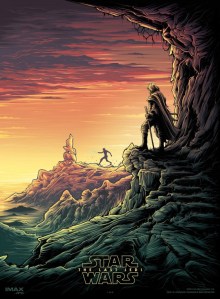 Let us first remember my earlier observation: Luke is not a hero because of feats of arms or outstanding use of the Force in the original trilogy. By the end of A New Hope, he’s duelled nothing more dangerous than a remote with his lightsaber and used the Force once to shoot a torpedo down a narrow opening. In The Empire Strikes Back, he lops the arm off a Wampa, has a fight with a hallucination and then goes and gets his backside kicked by Vader and loses his hand, then uses the Force to reach out to Leia. In Return of the Jedi, he duffs up a few of Jabba’s guards, kills a Rancor, tricks some Ewoks into thinking 3PO is a god and has half a fight with Vader before throwing down his weapon and eventually persuading Vader (by dint of being tortured) to kill the Emperor for him.
I’m not being dismissive here of Luke – he’s a Skywalker, he has that same famous blood running through his veins, the same affinity for the Force that his father did. The point is that Luke becomes a hero when he stops himself making the same mistakes that his father did. Luke is able to set down his weapon, even in the face of massive provocation. He’s able to hold onto a belief in the inherent goodness of his enemy that even Obi Wan and Yoda could not manage.
 And there’s a strong argument that that’s exactly the sort of figurehead that the Jedi Order needs, if it is to be restored. Remember, the Jedi Order was supposed to be ‘the guardians of peace and order in the galaxy’. But in their latter days, as illustrated by the prequel trilogy, they were a shadow of those heady days, with diminished ability to use the Force and forced to act as nothing more sophisticated than generals in a war they had neither foreseen nor properly understood. Part of that failure can be attributed to, and was doubtless exacerbated by, their eager embrace of ‘the Chosen One’ regardless of how much anger and resentment that powerful being exhibited.
Seen in this light, Luke’s failing in the new trilogy isn’t that he fled to exile, but that he ever saw fit to train a new generation of Jedi Knights. His ability – his heroic quality – was not one that would lend itself to that sort of martial training, which he had doubtless based on existing records and the training of Yoda and Obi Wan. When Kylo turned, and Luke realised the magnitude of that failing, he rectified it by taking himself out of the equation. It isn’t after all as if he just ran off – we learn that he has completely cut himself off from the Force while on Ahch-To, presumably reasoning that if he removes himself from the equation, there can be no escalation. It isn’t that he’s insensible to the harm that Ren will do, but that he fears the result if Force-wielding warriors start to clash again. It’s also most likely a recognition that Ren isn’t someone he can stop in the same way he did Vader – throw down your weapon in front of Ren and he’s likely to just run you through anyway. There’s a darkness at the core of young Ben Solo that’s different from that of Anakin simply because there is no aggravating factor on which it can be blamed – he grew up with two loving parents, surrounded by family and in security and freedom. It’s very obvious that he has to have made a choice to go down his path, and equally obvious there’s far less chance of pulling him away from it.
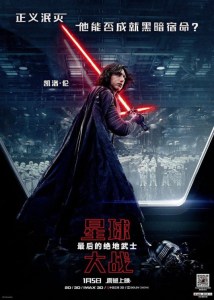 And remember rhyming poetry? Look no further than Rey – all the things that Luke can see about Ren, Rey cannot. She still clings, idealistically, to the idea that Ren has good within him, that she can confront and save him. There’s an echo of Luke’s insistence that he can turn Vader in Jedi, against the firm refusal of Obi Wan. The difference here is that Kenobi’s refusal to see the good in his former friend is born of the bitterness of losing his brother, and the urgent need he feels to have Luke stop him. Luke knows that Ren is unsalvageable – ‘This is not going to go the way you think’. Rey, powerful with the Force but still young and trusting, is misled by her feelings. She can sense that Ren wants her to stand alongside him, that he wants to be rid of Snoke, but like Snoke himself, she misreads those intentions, putting her own spin on them. Just as Snoke senses his impeding murder but assumes those impulses to be directed at Rey, Rey herself senses Ren’s desire to stand alongside her and assumes that desire to stem from a need to switch sides which he doesn’t have.
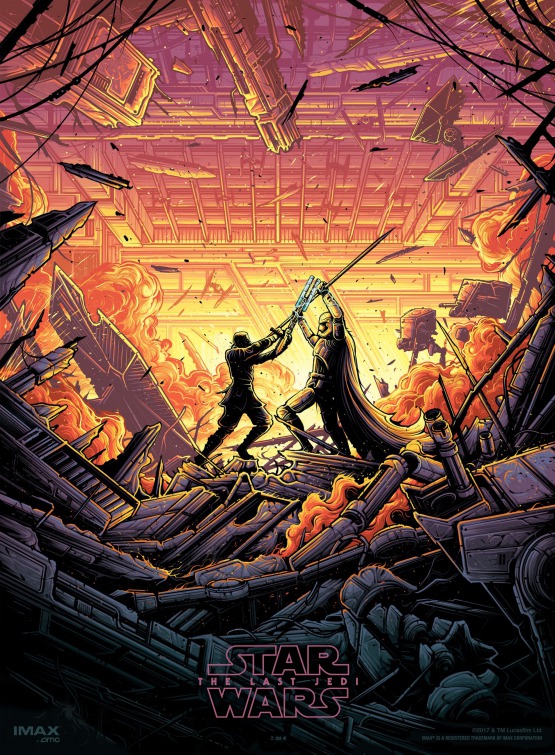
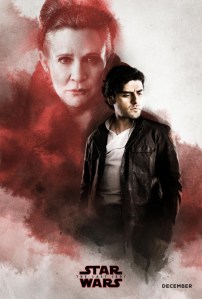 In light of all of this, the final confrontation not only makes sense, but perfectly slots into the character of Luke as we have come to know him. Turning up as a Force projection and distracting Ren and his forces long enough for Leia and the others to escape is yet again Luke being the hero by not fighting. It’s a recognition of his greatest strength, his contribution to be made to the cause (and the galaxy). Ok, so it’s a little late, given all the misery the First Order has imposed on everything, but it’s literally the only way that Luke can (and has ever been able to) save the day. ‘What did you think? That Luke Skywalker was going to come and face down the entire First Order with his laser sword?’ Well, yes, and that’s exactly what he does.
It isn’t a perfect film – whereas I stand by the Canto Bight sequence, I acknowledge that the messages it’s there to convey are delivered a little heavy-handedly and on the nose. Poe’s learning curve from hotheaded pilot to rational, clear-eyed hero and leader is a little more repetitive than it maybe needed to be (how many times do you have to have the character make bad choices at the cost of lives before he gets it, and if it takes that many, how do I root for him as one of the good guys?).
 But it is a powerfully ambitious film. It takes risks narratively and structurally, and whereas I don’t think it seeks to blow up the established order of the Star Wars universe as a whole, it certainly has a go at giving it a thorough shake up, and at indicating that new paths are available for telling stories in a galaxy far, far away. In that respect, perhaps more than any other, I think it feels like the purest distillation of Lucas’ original vision and energy for the franchise. It’s not here to deliver you the story you expected, or to fulfil any standard set of boxes you feel should/must be ticked for a Star Wars movie. But it absolutely is here to tell you a quality, fresh story set in the familiar environs of that far away galaxy. For that reason alone, I admire it. For the way in which it executes that ambitions, from bold narrative choices, a diverse cast, stunning visuals and an unashamed sense of playful humour thrown in to offset the darkness of the events it covers, I love it. It may not quite be my favourite Star Wars movie ever (that honour still reserved for Empire), but the fact I even have to think about it speaks volumes to its quality.








 Sci-Fi Bulletin: Exploring the Universes of SF, Fantasy, Horror and Spy-fi!