Feature: Predator: The Hunt for The Predator: Part 5: Predators (2010)
In the wake of the fairly uniformly negative critical response to AvP: Requiem, as well as its lower box office take, it was clear that a new approach was needed […]



In the wake of the fairly uniformly negative critical response to AvP: Requiem, as well as its lower box office take, it was clear that a new approach was needed […]
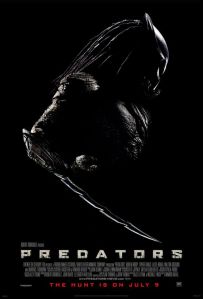 In the wake of the fairly uniformly negative critical response to AvP: Requiem, as well as its lower box office take, it was clear that a new approach was needed if the Predator franchise was to move forward. Enter Robert Rodriguez, who found himself suddenly invited by the studio to develop a script first written by him back in 1995 around the time he was making Desperado. Deemed too expensive to film back then, Rodriguez’s ambitious concept was now seen by Fox as the best way to reinvigorate the property. With Nimrod Antal in the director’s chair and Adrien Brody at the head of an eclectic cast, wonders Greg D. Smith, could this be the shot in the arm that was needed?
There’s one thing that shoots out at you immediately when you insert the disc of this film into the player – the theme music. Blasting out is an updated (but unchanged) version of the classic Silvestri score. It’s interesting, because scoring duties on this one are undertaken by frequent Rodriguez collaborator John Debney, and the actual movie itself doesn’t slavishly reproduce the Silvestri score, though it does reference it just enough.
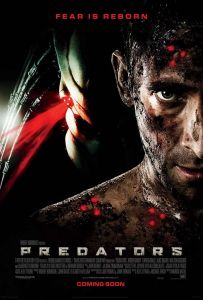 That’s essentially a running theme for the movie as it progresses – there’s plenty of shots, events and sequences which recall the 1987 original, without feeling like the movie is simply spinning its wheels or aping what went before. It’s a balance that so many writers and directors often get wrong in Hollywood, but Antal and Rodriguez (producing) pretty much nail it from start to finish, for good and bad.
Thematically, the movie actually does evoke Predator in a very interesting way. Launching straight into the action, we get Brody’s Royce waking up mid free-fall, his parachute opening at the very last second. As he finally awakes, in the middle of a jungle, various other strangers appear, all unified by one common thread – nobody knows exactly how they got where they are, nor where that might be be. Right from the off, our protagonists are in a hostile environment, unaware of what they’re up against, and forced to rely upon one another to try and survive.
The introduction of each actually communicates the double theme of the movie which the title implies a little quicker than the characters themselves arrive at the conclusion. Royce is a mercenary and former black ops soldier, Isabelle a sniper with the Israeli Defence Force, Stans is a death row inmate with 38 murders to his name, Nikolai a Spetsnaz commando, and so on – all (with the apparent exception of Edwin) are seasoned killers. Like the creatures which hunt them, these are predators who each, in their own ways, engage in the ‘sport’ of killing men.
 Cleverly, the movie subtly hints from very early on which characters will end up lasting the distance, by way of ensuring the ones for whom the viewer will root. Brody’s Royce is ruthless, hard-edged and blunt, but we never find anything out about him which would suggest he’s necessarily a bad person, beyond the sort of standard indifference to death a man in his profession would have. Isabella is a sniper who spends much of the time looking out for the other members of the group, and who feels tortured by the death of her spotter back on earth, despite knowing that to have intervened would have meant her death as well. The others, not just by nature of what they are, but of the stories they tell, mark themselves firmly on the bad end of the moral scales. Trejo’s Cuchillo, a ruthless enforcer for a Mexican drug cartel, blithely shares his tale of kidnapping people for the cartel for ransom, shoving them in barrels and burning those whose people don’t pay up. Mahershali Ali’s Mombasa casually mentions injuring enemies and leaving them to bleed and scream as bait for ambushes. Goggins’ Stans remarks that he can’t wait to get back to earth and rape some women (in one of the more tired aspects of the movie – as if the fact that he has murdered 38 people and was two days away from execution by the state when taken isn’t quite enough to make us dislike the character, we have to have a casual rape reference in there for good measure – Hollywood, please stop doing this).
 All of this adds up to invert the standard horror trope of building up investment in characters and then having their deaths be meaningful and impactful. Instead, you are invited to take some sort of guilty visceral pleasure in the demise of what are fundamentally evil people. When Cuchillo is staked out to plead pitifully for his life, you shrug and think he deserves it. When Stans is pinned down and literally has his skull and spine ripped out in one fluid motion, there’s an undeniable sense of satisfaction at seeing a terrible person get their comeuppance. It’s an interesting approach, and where some might find it spoils things by signposting early on who will live and who will die, I think it works as a choice, artistically and narratively.
The rogue factor of course is Edwin, played by Topher Grace. This is a mostly excellent performance, and some decent writing beneath it, because although the movie presents him as a poor innocent from the beginning, you always find yourself wondering. Every other member of this motley crew is there because they’re a killer. Edwin claims merely to be a doctor, and Royce assumes a simple mistake, but the viewer must always wonder exactly why Edwin is there. What sport would the Predators find in hunting such a specimen? Suspicions become sharper after he abandons Nikolai and then reach their apex when he produces what we know to be a picture of Nikolai’s children to Royce and Isabella to stop them from leaving him behind. The one tiny defect in the whole thing is that, once he reveals himself to Isabella, he becomes depressingly pedestrian, his supposedly sinister speech coming off as a sort of bargain basement Hannibal Lecter and his sudden desire to stay on a planet full of monsters which feels like ‘home’ at odds with his determination to escape up to that point. It’s a shame, though I’m not honestly sure how the letdown could have been avoided, because the truth is that the character is fascinating only as long as he’s an enigma.
 On the Predator side of things, we find ourselves looking at two different types of the creatures. There’s the ‘original’ Predators who we the audience recognise and then there’s the other, larger species who seem more oddly at once more feral – with jawbones and horns adorning their armour – and more sophisticated, utilising quadruped hunting beasts as a hunter might use dogs to funnel the prey, and a sort of falcon type drone device to search out their quarry. What’s apparent from when the gang first discover the creatures’ home camp is that the two factions don’t get along, one of the ‘original’ Predators strung up and left to suffer there. Through the exposition delivered by Laurence Fishburne’s Noland, an Air Cav officer who’s been stuck on the planet for ‘ten seasons’, we learn that there is some ‘blood feud’ between these two types of Predator, that they hunt one another as much as they hunt the various prey who are delivered to the planet.
What’s slightly blurry here is the relative strength of these new ‘super-predators’. On one hand they have overpowered a ‘regular’ Predator, and seem armed with all the same gear as we are used to, albeit scaled up and perhaps slightly more advanced. On the other hand, when they are killed by our protagonists it seems to occur a lot more easily than the deaths of the ‘regular’ Predators we are used to. 1987’s Predator saw one of them kill off two whole spec ops teams, and only get beaten by Dutch because of luck. Predator 2 saw Harrigan face off in an extended bout which was difficult for him even after the creature had lost a limb. Here, one gets blown up by Nikolai in a suicidal detonation of C4 strapped to his waist, another gets killed by Hanzo wielding a samurai sword and the third is eventually killed by Royce with an axe. It’s not that there isn’t buildup and context to all three deaths, nor that they don’t cause their own body count along the way, but more that it feels a little confusing when measured against them being apparently stronger and more capable than their smaller cousins.
 All that said, thanks to the obvious bigger budget and the advances in visual FX and costuming, the Predators are all impressive in terms of movement and action here. Set pieces aren’t drowned in darkness, and we actually get to see what’s going on. The faces of the newer, larger Predators, when revealed, are sufficiently different from the original while still harking back to it – a nice visual link to a thread that runs through the DNA of the movie – and suitably terrifying to behold. The quadruped ‘dogs’ that they use are a little underwhelming but then they aren’t supposed to be the focus of the movie.
Another thing which appeals in the movie is its sense of pacing, which again feels directly borrowed from its originating ancestor. The mistake that the AvP movies, and arguably even Predator 2 make is that they equate more noise and bigger action with improvement. The 1987 original was never afraid to take its time, punctuating long, tense scenes of waiting or quiet character interaction with short bursts of intensive action. Here, Antal takes the same approach – we don’t actually get to see any of the Predators themselves until about an hour into the movie, and action does not dominate. It takes its time to set up its characters organically, and makes the bold step of keeping the audience as much in the dark as they are about what’s going on. This means that we get to go on the journey of discovery with the protagonists – we find out that they’re on an alien world at the same time they do, we work out what’s happened, why they are here, and what they’re up against at the same pace as they do. This helps us to invest in what’s going on, and should emphasise the power and prowess of the enemy they face. Unfortunately, as stated above, the slightly inconsistent nature of the super Predator’s strengths and weaknesses mitigate against this a bit, though not enough to spoil the movie.
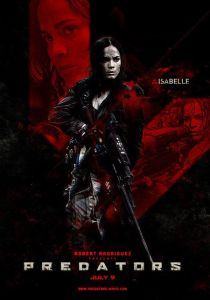 It has other issues as well – in 2010, we were still looking at an action movie in which we had only one female character. Not even just one main cast member either. While this in and of itself might be forgivable, given the nature of the people assembled, narratively speaking, what makes it a slightly larger irritation is that Isabella, despite an introduction as a capable badass, seems to be lumbered with the part of being the emotional conscience of the group. She spends much of her time looking out for everyone and essentially almost becoming a mother hen. It’s Isabella who immediately objects to Royce putting the group at risk, Isabella who shoots Cuchillo to try to put him out of his misery, and Isabella who elects to stay with Edwin.
Lest you think I am inventing this notion from whole cloth, Alice Braga herself said of the role: “My character, funny enough, is the one that is always trying to grab everyone together and like reuniting everyone and stopping the fights and saying that we have strength in numbers.” So basically, the traditional ‘mom’ character, there to stop the boys fighting or getting out of hand. Not to take away from Braga – she researched the part thoroughly, reading a sniper manual and spent the shoot carrying an actual 14 pound sniper rifle, and she is more than the equal of the others when the bullets are flying. It’s just a shame that the rest of the time, the movie defaults to its one female character as the ‘peacemaker’ of the group.
 That said, the diversity of the cast nicely echoes that of the 1987 original. We have an Asian male, a Mexican, a Brazilian (playing an Israeli) and an African American alongside our three white male leads. Fishburne adds to that ensemble, though his part in truth is smaller than it could and possibly should have been. The switch from kooky saviour to deranged murderer-scavenger occurs a little too quickly to be entirely narratively satisfying, and it’s hard to not feel this talented actor is under-used by the movie, but one has the impression that Antal and Rodriguez (and possibly the studio) had a fixed idea of the rough time they wanted the movie to run, and cut parts accordingly. Certainly, from Nolan’s betrayal to the ending, the movie feels a little truncated, as if the deliberate pacing and buildup of its first hour and a bit are suddenly discarded in favour of rushing headlong towards the finish. Again, it doesn’t break the film, rather it makes one wonder what might have been.
Ultimately, the main thing to take away from Predators is that for the first time it feels like we have an actual sequel to McTiernan’s original. Partly that’s down to smart moviemaking, partly down to an obvious love of the source material by the creatives involved, and partly down to subtle and not-so-subtle homages and references scattered throughout. It’s certainly a better film than the three which preceded it, even if it doesn’t quite take the crown from the original.
 Doctor Who News Star Trek News
 Sci-Fi Bulletin: Exploring the Universes of SF, Fantasy, Horror and Spy-fi!