Feature: Predator: The Hunt for The Predator Part 2: Predator 2 (1990)
The law of Hollywood action cinema in the late 80s/early 90s dictated that if a film was successful then a sequel must be made, and although critical reception to Predator […]



The law of Hollywood action cinema in the late 80s/early 90s dictated that if a film was successful then a sequel must be made, and although critical reception to Predator […]
 The law of Hollywood action cinema in the late 80s/early 90s dictated that if a film was successful then a sequel must be made, and although critical reception to Predator had been mixed, the film had made just under $60million in the US alone, going on to gross $98million worldwide, from a budget of just $15million. With Schwarzenegger out of the picture due to a pay dispute, Danny Glover took centre stage in a movie that took the titular big game hunter from the jungles of South America to the urban jungle of a near-future Los Angeles, overrun by gang violence. But, asks Greg D. Smith, could director Stephen Hopkins recapture the lightning in a bottle of the first movie?
Short answer? No. Predator 2 enjoys a cult following, and it’s easy to see why, but in terms of its overall quality it falls far short of its predecessor in many aspects. It is, however, a fascinating movie to watch again with a modern eye, for a number of reasons. Not the least of these is that not only can you see the attempt by a studio to craft a franchise for the titular character, but you can see the beginnings of a shared universe franchise, several decades before Marvel attempted the same with the MCU. And most fascinating of all in hindsight, despite the dip in quality the movie represents, is that it pulled off this ambitious goal.
More importantly, if you had to select a movie that was a perfect representation of the genre at the time, Predator 2 would be an incredibly strong contender. There are shades of many other successful movies of the era in there – the ultra-violence and satire of Robocop, the vision of Los Angeles as a near-future dystopian warzone of Demolition Man, the reckless cop-on-a-mission of Lethal Weapon. There’s even a gratuitous sex scene which then requires the lady involved to just hang around being naked as other stuff happens. Predator 2 has late 80s/early 90s action movie genre sensibilities coded into every part of its DNA.
 Helping this feeling is the casting. Danny Glover takes centre stage in an unusual-for-him turn as an action hero lead. From his introduction driving a car headlong into gunfire to rescue comrades to his laundry list of bad attributes reeled off by a superior, Glover’s Lieutenant Harrigan might well be Martyn Riggs with a haircut, and it’s difficult not to see the comparison (moreso when Steve Kahan – Captain Murphy in the Lethal Weapon films) appears as a nameless police Sergeant and Gary Busey (villain of the first Lethal Weapon movie), turns up as sort-of-villain Keyes.
That odd feeling of cross-familiarity doesn’t stop there though. Maria Conchita Alonso presents a double whammy, being a short-haired Latina with a ball-busting attitude who scares her male peers, recalling Vasquez from Aliens, but also being very recognisable as Schwarzenegger’s co-star from The Running Man. The late, great Bill Paxton does a turn as irritating, overblown storytelling but oddly competent cop Jerry Lambert, who may as well be Corporal Hudson in a different outfit.
As for the Predator itself, this sequel decides to firmly lean into the horror aspect of the character. Like every good horror movie villain of the period, he’s an ultraviolent stalker, following our heroes around the place and picking them off one by one with no real reasoning given beyond ‘because they’re there’. In fairness, this doesn’t differ much from the first movie, but where that took place in a jungle where the protagonists were the only humans for miles around, this movie takes place in the centre of a densely populated city. The idea (delivered by a small info dump from Keyes in the back end of the movie) that the Predators seek out conflict spots specifically, and that therefore a nightmare city of the near future like LA (as often envisioned in countless examples of the genre of the time) would be the next logical place for one to appear is a decent one, but it never really gets properly examined, the film content to just reference it without really putting meat on the bones.
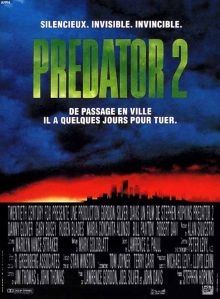 The central conflict happening in the movie between the established Colombian drug cartels and the new Jamaican Voodoo ones (it was 1990, when mainstream cinema could still get away with such broad brush stereotypes) has the feeling of a war – indeed the opening scene of a massed gunfight between Colombians and the police has the feeling of a war movie scene – but it mainly happens as a peripheral backdrop, and the members of either cartel targeted by the Predator seem essentially random. Also, one has to ask what the galaxy’s most accomplished big game hunter finds so appealing about murdering, for example, an old man with a sword, or what sort of odd morality sees it perfectly happy to murder a bunch of innocent bystanders on a subway train who happen to be holding guns but to leave a woman aiming a gun at it alive because it finds out she’s pregnant. That’s…odd.
However, the movie does bundle along at an impressive lick. From the clever opening which suggests jungle until the camera pulls back to reveal the city of LA, it goes at a relentless pace, cliched or otherwise. The sense that the city is riven by violence and that the police are barely keeping their heads above water, let alone controlling things, is palpable in every scene. Glover’s commitment to the role is impressive, even if the script doesn’t give him a great deal with which to actually work. It’s doubly impressive given that, just a year before, he’d been playing Sergeant Roger ‘I’m too old for this shit’ Murtagh pitch perfectly. Here, he shifts gear into a totally believable action lead who seems a good twenty years the junior of that other character. Why specifically the Predator chooses him as a worthy opponent is unclear – even more so why it decides to stalk and kill off the rest of his team. They aren’t hunting it, like Dutch and his team were in the first film. They are far from the only ‘soldiers’ fighting in the warzone that is the city in the film. The fact that it goes after drug gangs, police officers and DEA agents with equal energy emphasises the point that the Predator is literally just a hunter passing through and taking aim at whatever examples of prey it finds, but it might be nice if some of its choices made a little more sense.
Of the rest of the cast, Busey as Keyes is essentially forgettable as he attempts to be the Dillon of the piece (pun intended) but lacks the charisma of Weathers or the directorial sensibilities of McTiernan to pull it off. We never really believe he’s anything other than a bad guy, and the attempt at redemption as he tries to cover Harrigan’s escape and capture the Predator himself is just not reason enough to make him in any way nuanced. It doesn’t help either that of the other members of Keyes’ team the only memorable one is a young Adam Baldwin, playing to type as ‘stern-looking bland-faced military type, who ends up watching incompetently as his boss and colleagues are slaughtered by the creature while Harrigan screams down the mic at them to get out, in a scene that forcefully recalls Ripley’s screaming at Gorman in the APC but without any of the same energy to it.
 Conchita-Alonso and Paxton have fun with their characters, but the former gets very little to actually do beyond shouting bits of exposition and grabbing Paxton’s crotch. One senses that the idea is to replicate Cameron’s idea of a Strong Female Character a la Sarah Connor/Ellen Ripley but it just comes off as a poorly written token effort. Conchita Alonso’s part in The Running Man actually gave her more to do, and that’s fairly damning. Paxton, on the other hand just puts on his best Hudson routine, complete with the hyper-garrulous nature, the storytelling, and the obliviousness to just how much he’s irritating his colleagues, all just about redeemed by the fact that he’s actually good at his job, has the skills the team needs and does the work when he has to. His death scene is another that forcibly recalls Aliens, facing off against an enemy he can barely see in the dark, screaming defiance as he fires wildly, trying to save the others. Again, the issue is that we haven’t got the same level of attachment here – Lambert is trying to save a train full of strangers we don’t know enough to care about and a colleague who barely tolerates him. Hudson was covering the escape of what was left of our heroes – characters we had come to know over the previous hour and a half of the film. It just rings like a false note – a sub-par copy of a brilliant scene, that even Paxton can’t quite save.
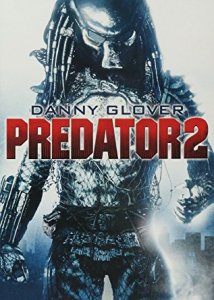 Kevin Peter Hall gets more to do this time around as the Predator itself, and in fairness the movie does give us a lot more information about the Predator’s methods and abilities. I love that the clumsiness of the huge prosthetic fingers vs the precision of the various gadgets is kept from the first movie, and Hall’s imposing stature and physicality add much to the role. What’s slightly less impressive is that here, the Predator seems almost to turn into Batman, with a bunch of handy Predator-Gadgets to help him do his thing. There’s the extending spear, the shrinking steel net, the odd projectile which Danny finds early doors and the throwing disc which Harrigan uses to finish him off at the end of the film. Combined with the tools for cleaning trophies we saw in the first movie, and the odd first aid kit at the end, it starts to feel as if the Predator really does have his own utility belt, which starts to take away from the central premise. The first movie got away with the laser cannon and the invisibility because it never really sold the Predator as anything more than a killer. The fact it didn’t attack unarmed people was almost an aside. Here, the movie attempts to build on the mythos of the Predator as a hunter searching for the ultimate ‘game’, which is all well and good when you’re taking on special forces guys in the jungle, but when you’re stalking simple police officers and gang members with a whole arsenal of ridiculous weaponry and abilities, it’s difficult to square off any concept of this being ‘honourable’.
If the callbacks evoked by certain scenes and characters weren’t enough, Predator 2 throws in some unsubtle visual and at least one audio cues to make sure that the association with the Alien franchise is well & truly cemented. There’s a nice homage to Horner’s classic score buried in there as an audio cue, mixed in with a fair amount of recycling of Silvestri’s own score from the first film, which helps link this very different movie to that one quite well. Then of course there’s the trophy cabinet Harrigan finds on the Predator’s ship at the end of the film, replete with a Xenomorph skull just in case you weren’t getting it. The film feels as if it’s practically crying out for the link to be made in the minds of the audience, and it’s difficult not to imagine that it’s all intentional.
 The problem is, if there’s one word that can sum up Predator 2, it’s derivative. Some of this feeling is not exactly the fault of the filmmakers – one cannot help an actor being strongly associated with a previous role, for example – but much of it is deliberate choice. Scenes which strongly mimic another movie, musical cues recycled from another movie, themes which imitate what’s gone before. The music accompanying the Tony Pope news reports recalls the news bulletins of Robocop, as does the reporting style of Pope himself and the concept of the show. The way that the city is essentially a warzone and the police are becoming slowly militarized could come from any one of a number of similar entries in the genre from the time. The very character of Harrigan could be one of any number of identikit central protagonists from the ‘Cop who doesn’t follow the rules and pisses off the brass but gets tolerated because he gets the job done’ mould.
As I sat and re-watched it, I realised that whereas in many ways it’s an interesting – in fact downright fascinating – film to study in so many ways, and it attempts some very ambitious things, it is ultimately not a good film. It fails to stick to its own narrative too often (witness Harrigan delivering ‘the speech’ to Lambert about how the team comes first, and then how quickly everyone goes off to do their own thing, including Danny who goes off and gets killed almost immediately after). It treats the central antagonist as some generic horror movie villain in the way it goes about its business but then simultaneously tries to invest him with a mythos which feels wholly unearned. It puts a supposedly strong female character front and centre and then gives her nothing to do beyond ‘being pregnant and therefore living’.
On the one hand, it feels difficult to be too hard on Predator 2, because it is so very much a product of its time. On the other, considering the movie it followed, and how many ways that film managed to break new ground and create an interesting take on a crowded genre, it’s difficult to feel too charitable towards it either, It’s far from the worst entry in the genre (or even in the franchise) but its importance lies far more in just how generic an example of its genre it is, despite some of its loftier ambitions. If you’re in town with a few days to kill, it’s just about worth your time, but don’t go out of your way.
 Doctor Who News Star Trek News
 Sci-Fi Bulletin: Exploring the Universes of SF, Fantasy, Horror and Spy-fi!