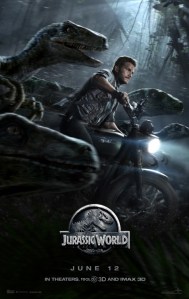
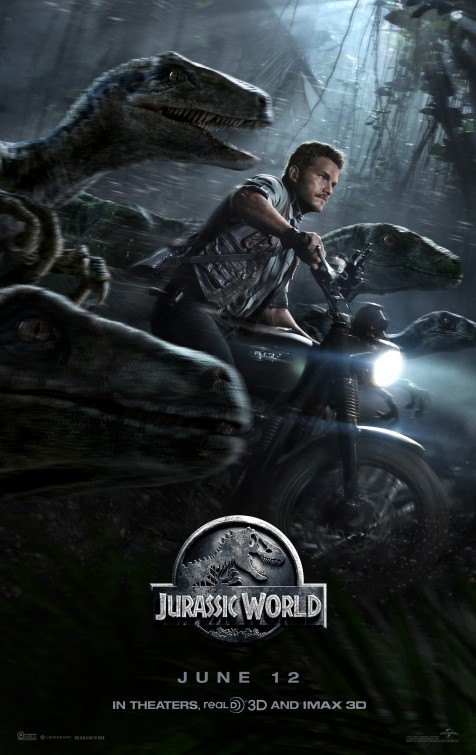
 With fourteen years having passed since the last entry in the Jurassic franchise, it seemed to some that Jurassic World represented just another example of Hollywood’s current trend for reboots and re-imaginings of old properties. Early trailers suggested silliness would abound, as Chris Pratt rode a motorcycle at the head of a bunch of raptors, and early details of plot elements brought to mind some of the awful concepts discussed for the franchise previously. But, asks Greg D. Smith, could Colin Trevorrow pull off the seemingly impossible and make a film about dinosaurs fun and relevant to a new audience?
Over two decades after the original Jurassic Park incident, Ingen have re-imagined and rebuilt a new dinosaur-themed attraction on Isla Nublar, site of the original. But the need to breed better, bigger, ‘cooler’ dinosaurs will prove their undoing.
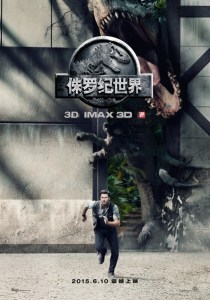 When Jurassic World was first announced, I don’t think there were many people who were all that excited. With nearly a decade and a half having passed since the last – fairly tepidly received – entry in the franchise, it didn’t feel like something that we really needed to see. The announcement of Chris Pratt as the male lead, hot off his run as Star-Lord in Marvel’s Guardians of the Galaxy, lent some credibility to proceedings, but I think that most people expected something silly, tongue in cheek and pastiche.
There’s a line very early on in the movie that manages to really reach out to the audience and reassure us of exactly what we are about to see. Claire (Bryce-Dallas Howard) is speaking to an employee of the new park whose sole job seems to be to act as a point of view character for existing fans of the franchise. ‘That first park was legit’, he says, as he explains why he’s wearing one of the original Jurassic Park shirts with the red, yellow and black logo. It’s a character moment, sure, but it’s also Trevorrow sitting there patting us on the shoulder. ‘I know that I can’t remake the original, and that nothing will ever really get you in the same way it did back in 1993, and I accept that – sit back, and let me show you what I’ve brought for you instead.’
As a statement of intent, it’s a bold one, but it also works. As a fan of the franchise – and the original movie in particular – I instantly relaxed into the movie and started enjoying it for what it was, and boy, what a thing of beauty that turned out to be.
Jurassic movies are always – at their heart – about a family. This is one of the many ways in which The Lost World, ahem, lost its way – although there was an attempt with Malcolm’s daughter from one of his many marriages/relationships in tow, it never really did much with that element, preferring to go for big monsters instead.
 Here, we have Gray and Zach Mitchell, sent to the park to spend time with their Aunt Claire (who runs the PR there) by their parents who are busy getting divorced. Gray is the younger boy – obsessed with dinosaurs and generally a bit of a nerd. Zach is his older brother, with the typical air of general annoyance at his younger sibling and an eye for every young lady he sees. Just like Lex and Tim in the original, these two feel very much a product of their time. There’s a genuine sense of affection between them underneath the layers of sibling bickering, and they feel like authentic takes on kids of their age in today’s world. Gray is wide-eyed with amazement at all the sights from the moment they arrive, Zach is far too ‘cool’ to be bothered and more interested in staring at girls. Gray is worried about their parents divorcing, while Zach alternates between denial that it’s even happening and affecting an air of not being bothered by it. It’s a believable back and forth between them, and it helps tremendously to ‘ground’ the movie.
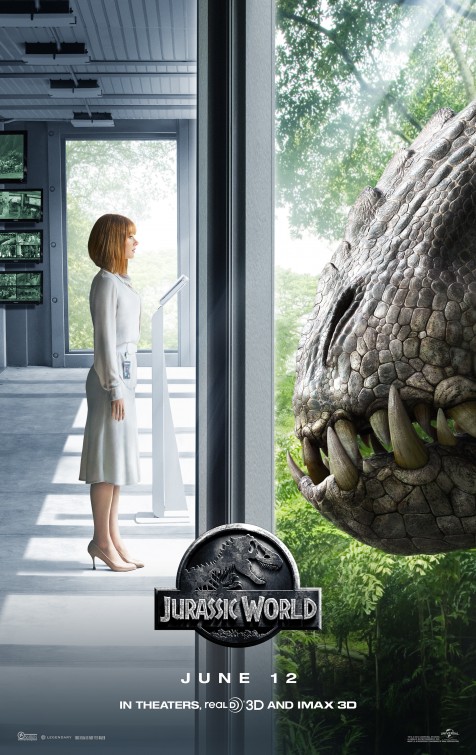
Aunt Claire herself is another interesting character – an aunt who hasn’t actually seen her nephews in long enough that she’s forgotten how old they are or indeed how long it’s been. Shown from the start as an organised confident, accomplished professional within the confines of her job, she’s equally scattered and useless when it comes to personal interactions, as shown by the awkwardness when she first sees the boys, and her similar awkwardness around Chris Pratt’s Owen. Where this could just devolve into another female character falling to pieces when the dinosaurs start getting loose though, with Claire we get a sort of quiet resolve as the professional side of her kicks in. Those who focused heavily on the movie’s release on the fact that she runs away from a T-Rex in heels in one of the closing scenes seem to have forgotten that she spends the entire movie running, jumping, driving and adventuring in those same heels. For all that it seems the movie is about to start mocking her as she ties off her top and rolls up her sleeves defiantly at Owen as he tells her she can’t come with him, it actually goes an entirely different route, and in the process of channelling her inner strengths from her professional life, she starts to get better at the personal bit too. Much as an early exchange between Claire and her sister (a criminally under-used Judy Greer who unfortunately basically gets to roll out her nagging wife/mother role again) grates, the movie gets away with it by how firmly it plants Claire as a character.
 Owen is a character who mainly cruises by on Pratt’s easy charm – there’s nothing really concrete for him to latch onto here. He’s an ex-navy veteran (whose speciality is never mentioned) who now works as a raptor trainer. Why his service career prepared him for this role, what sparked his interest in and evident love and respect for animals, and why on earth he and Claire ever even managed to go on one date is never really explained. Instead, Pratt flashes that winsome grin, wisecracks a lot and the movie asks you just to go along with it. Fortunately, it works, but in the hands of a less likeable actor, it could have been the undoing of the film.
Vincent D’Onofrio is on hand as the human villain of the piece, but lacks either the complexity and nuance of Hammond or the straightforward evil of Ludlow. D’Onofrio is instead just this sort of ex-forces henchman from InGen who seems to be there to try to grab Owen’s trained raptors for the military but then goes wildly off-piste. By the time the film ends, it’s very murky as to what the point of InGen’s plans were, especially with regards to the main Dino villain – the fabulously named Indominus Rex.
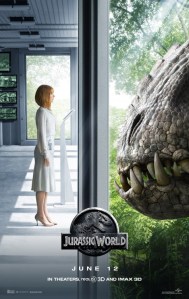 It baffles me slightly why the Indominus was needed. The in-film explanation is that now dinosaurs have been around in the Jurassic franchise timeline for two decades, people get bored easily and want ‘bigger, better, scarier’ dinosaurs. That’s fine, except that the Indominus, in basic appearance, is no larger or scarier than the spinosaurus from Jurassic Park III. Of course, there are the other cool abilities it exhibits – intelligence, camouflage, regulating its body heat and so on – but most of these are presented by the movie as surprises not expected by creator Henry Wu (returning from the original film to here play a far more sinister role in proceedings). So again, we are left with a mandate to make a thing bigger and scarier with more teeth which seems on a par with the spinosaurus which already existed – it’s odd.
Still, there’s no denying that the Indominus is entertaining to watch – it doesn’t get over familiar as the film wisely limits its on-screen time but when it’s there it’s a genuinely terrifying creature that does what it’s supposed to do, i.e. rampage around the place eating people. There’s a haunting shot of a plain full of the dead/dying bodies of giant sauropods which is then somewhat spoiled when Owen says the thing that the scene itself so obviously conveys – that the Indominus is hunting for sport rather than for food – but fortunately the movie manages to avoid the tired cliché of ‘it’s just like men’ that you almost expect it to go down. Nope, all we need to know is that the Indominus is a nasty piece of work, and needs stopping.
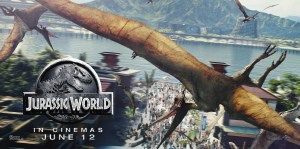
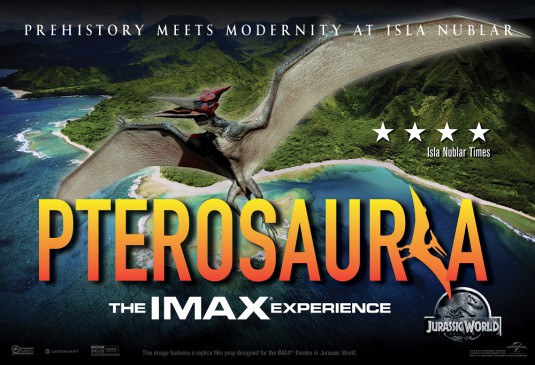
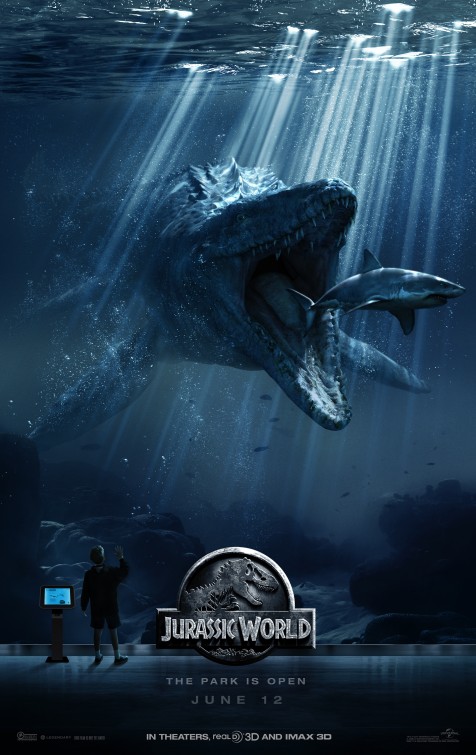
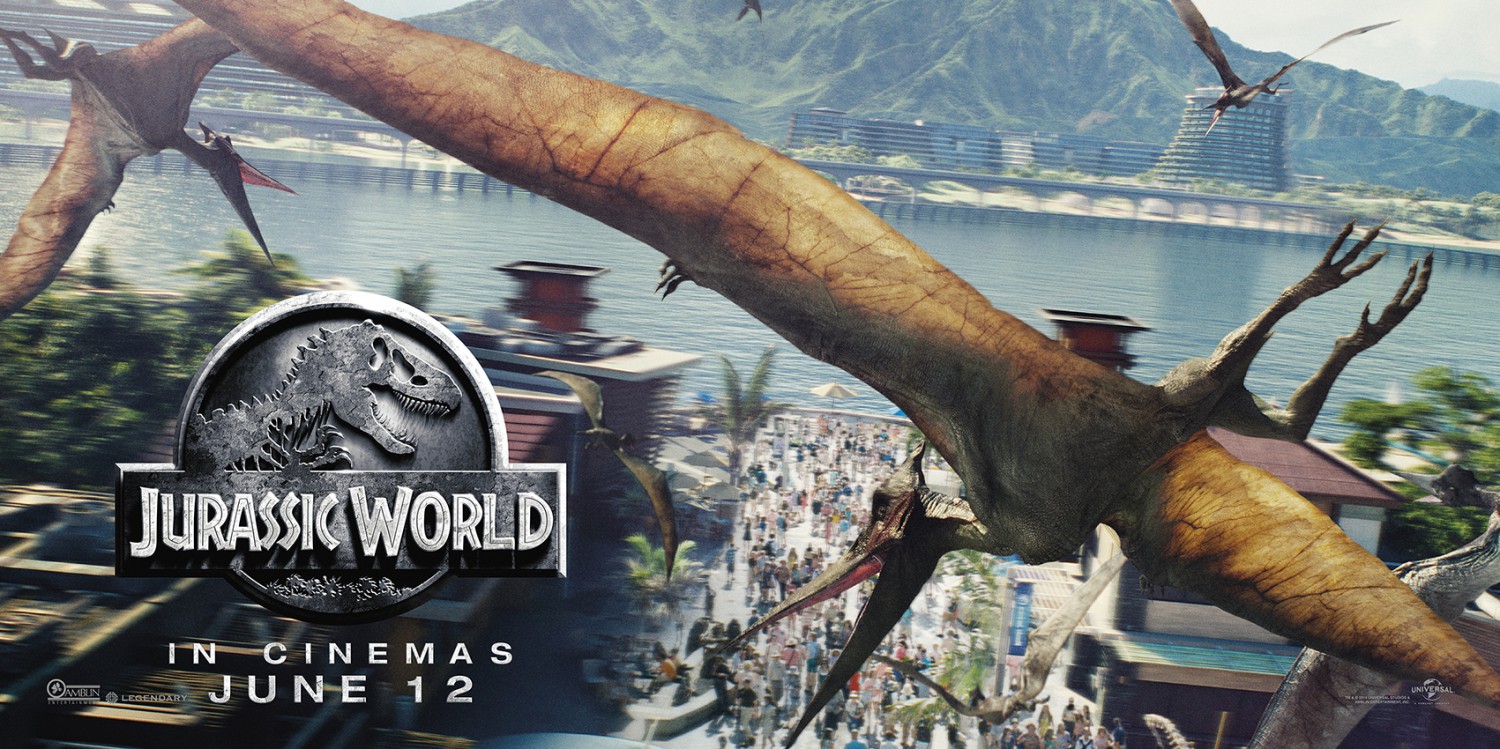
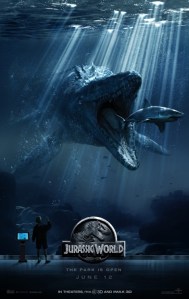 Other dinosaurs are pretty much just there – we have a mosasaurus who gets two cool micro appearances, Owen’s raptors (who are still very much at their murderous, intelligent best) and the T-Rex right at the end which gets to re-establish itself as the king of the walk (and indeed the whole island). Other than that, it’s fairly much just a bunch of herbivores wandering about the place, some baby dinos getting ridden by kids in a paddock, one sequence of pterodactyls and some fancy holograms. The holograms seem mostly like pretty set dressing, but their use at the end as a distraction for a chasing raptor is actually pretty funny.
What the film does very well is occupy the precarious spot between fan fiction and telling its own story. Trevorrow isn’t an idiot – he knows that you haven’t forgotten the previous movies and he doesn’t go for the full hard reboot. At the same time, the movie never feels beholden to those earlier entries. It acknowledges plenty that they exist – the aforementioned line near the start; a visit to the old, now dilapidated visitor centre from the climax of the first movie; the recognisable jeeps; the night vision goggles and so on. It feels referential without ever crossing the line into parody, and it does an excellent job of resetting the board so that stories can start to be told in this universe again.
 It also has its own special take on the original message of the franchise. In Jurassic Park, Malcolm opines that the scientists were so busy with whether they could, they never considered whether they should. Here, the scientists are on that same trajectory but to a whole new level, having created something in the Indominus Rex which is not only a genetic freak in the sense the original park’s creations were, but something on a whole new level – a chimera of various different DNA strands from dinosaurs and other creatures. The fact that they don’t seem to have been aware of most of the side effects makes it even worse. Remember Ellie in the first movie, talking about how they’ve brought back plants they have no understanding of? Yes, they look pretty but they are aggressive living creatures which will defend themselves? Now we have Wu adding cuttlefish DNA to the Indominus mix with the side effect that it can camouflage itself.
So basically, the message of the movie almost becomes as meta as the movie itself. The main critique against movies like this is that the protagonists never seem to learn. Here, Trevorrow turns that from a nitpick in the movie’s logic to the very reason for its being. ‘Yes’, the screenplay seems to scream at you, ‘we know that people never learn, and because of that, the same mistakes will happen all over again but even bigger.’
 The aesthetic of the piece all reinforces that – Jurassic World feels exactly like a giant, fabulously exclusive and expensive theme park would, all bored attendants, long queues in the sun and peeved customers waiting in baking hordes to be told what to do and where to go when things go wrong. It’s almost as if Trevorrow takes every single thing that the movie could fall down on and instead of shying from it, embraces it with open arms and makes it his own – there’s a kind of delicious poetry to it all, and it’s why the film succeeds in spite of the odd flimsy character and odd narrative choice.
Jurassic World, much like its direct predecessor, won’t be remembered as one of the all-time greats. That said, it’s an intelligent, fun, self-aware take on the franchise, and one that deserves to be recognised for getting far more right than any of the previous sequels. It may not quite stand on a par with the original, but then it never tries to, happy to acknowledge that it’s working in the shadow of that magnificent beast, and finding its own way to have immense fun on the way.




 Sci-Fi Bulletin: Exploring the Universes of SF, Fantasy, Horror and Spy-fi!