 Four more years elapsed before the next instalment in the Jurassic Park franchise, during which time the movie went through several script drafts and at least one abortive start to filming before it was finally nailed down. With Spielberg no longer directing, the film was helmed by Joe Johnston, who had been promised by Spielberg years before that he would get to direct a third film in the franchise if such ever arose. So, wonders Greg D. Smith, could Johnston step up and buck the threequel trend, making an entry that was actually good?
When their young son is lost on Isla Sorna, the Kirbys hire Alan Grant and a team of mercenaries to go looking for him, though they may have been less than truthful with Dr Grant about the trip. Trapped after their plane is destroyed, Alan and the Kirbys, together with Alan’s research assistant Billy must fight to stay alive as well as find young Eric… and with a new super-predator on the island, that may prove tricky.
Generally, in the decades before Marvel conquered the silver screen with its MCU, threequels tended to be poor reflections of their predecessors. There are exceptions of course – Return of the Jedi was a decent entry in the original Star Wars trilogy – but in the main, where a movie franchise reached its third entry, ideas were running dry, plots were thin, and everyone was basically doing it for the money.
 For many years now, I’ve been of the opinion that Jurassic Park III landed in that category. However, on a rewatch, not only is Jurassic Park III not anywhere near as terrible as it could (and by rights should) have been – it’s actually a better film than the one that came before it.
First of all, let’s acknowledge that there are parts of the movie which don’t work. Chief among these is that 3D-printed raptor ‘resonating chamber’. It’s a dumb idea on multiple levels, chief amongst which is it necessitates a whole ‘theoretical’ conversation about whether or not raptors were super intelligent pack hunters who communicated with one another. This would be fine except for the fact that Alan Grant has already witnessed real live raptors doing this. The script attempts a fudge, with Grant declaring the creators of Jurassic Park ‘engineered monsters’ and asserting that the only real way of studying dinos is in the fossil record, but it’s weak tea, and basically seems to have been done so that they could have something cool like a 3D printer in there.
This leads us to the second major part that doesn’t work – blowing air into the model to recreate the noises the raptors make and intimidate them away. A) You wouldn’t know what you were saying. B) It doesn’t sound anything like them. C) I thought we just said in that other scene that these aren’t real dinosaurs so why would there be a similarity? And D) It just looks really, really dumb. There’s also a bit where Alan falls asleep on the plane and dreams a raptor talking to him, calling him by name. I have no idea at all how that one made I through the edit bay but it did, and it’s the most often-used clip in videos that argue Jurassic Park III is a super dumb movie because out of context – hell, in context – it just looks really, really silly.
 But honestly, those niggles aside, what you have here is a solid adventure romp that doesn’t outstay its welcome, has some cool new dinosaurs, and has the good sense to keep things simple and stick to what it’s best at.
Sam Neill picks up the hat as Alan Grant again, and wonderfully he hasn’t changed even a little bit. There’s that same gruff demeanour hiding a heart of gold, that same mistrust of technology and machinery, that same unshakeable belief that digging up bones from the earth is the only proper way to do archaeology. Grant in the first movie was presented as an unreconstructed male stuck in a previous decade. He’s no different here, and although nobody actually ever says the words ‘Alan, you’re a dinosaur’, it comes across so loudly as a subtext in nearly every scene he’s in that it may as well be just written on a helium balloon tied to his belt.
William H Macy and Tea Leoni play the Kirbys, and yes I’m lumping them together because they’re less separate characters and more a sort of conjoined unit for narrative purposes. Though they turn out to have been separated/divorced for some time (indeed, their son disappears on the island while parasailing with Amanda Kirby’s new boyfriend), the movie makes it painfully obvious from early on that their tribulations on the island and their shared concern for their son will draw them back together. This is actually less of an encumbrance than it might sound – the movie is so in your face with the characterisation that it may as well announce ‘These two will find love for one another again’ by megaphone, which leaves the script to deal with dinosaurs and chases and excitement rather than any of it being bogged down in a ‘will they, won’t they’ fashion. Both are watchable actors, and to their credit both get on with doing what they’re there to do… which is mostly shout for their son, run away screaming from danger and occasionally make sad, ‘why did we ever drift apart’ eyes at one another. It works, so you don’t question it.
 Alessandro Nivola’s Billy Brennan feels like he was parachuted into the script to try to offer a lighter contrast to Grant for the most part. His main contributions in the film are figuring out that the Kirbys are lying about who they are and how wealthy they are, stealing some raptor eggs to create an excuse for the raptors to be chasing them all, and saving Eric from some hungry pteranodons with a parasail. So otherwise unessential to the plot is the character that after said parasail heroics, he disappears over a waterfall, being harassed by angry pteranodons only to pop up literally in the seconds before the credits roll in a scene which screams ‘The test audience was unhappy with Billy being killed off so we re-shot this bit with him and Sam Neill quickly to make it happier’.
Trevor Morgan gives a decent performance as Eric, the scrappy kid who manages to survive 8 weeks alone on the island (Ben having conveniently died to tie off all the loose ends and leave the Kirbys free to reunite in wedded bliss). Given that after his initial introduction, saving Grant from raptors and showing him his hideout, inside a water truck, he gets very little to do except running and screaming, he does well. It’s the sort of character that would have instantly appealed to all the kids in the audience, by way of his age and his achievements.
There’s the ‘mercs’ as well, but to be honest two of them are disposed of early on and the third is obviously waiting to be eaten by something from then on it so we needn’t detain ourselves with them here. Their part in the film is to get eaten so we know how terrifying and dangerous the dinosaurs are (and in the case of the last one to die, how smart and cunning the raptors are).
As for the dinosaurs, well it’s a mixed bag. As with The Lost World, there’s plenty of CGI work here (and some green screening with the actors) which doesn’t hold up especially well on an HD screen. That said, it’s not awful, just forgivably shonky for the time period. The practical effects work reasonably well, though still there’s nothing here to really rival the original movie.
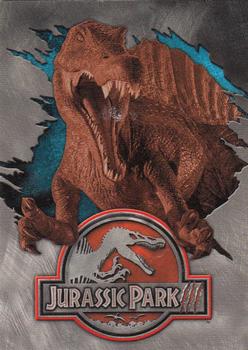
 We get new dinosaurs as well – the aforementioned pteranodons as well as the spinosaurus, the new big bad which cements its role as the king by fairly easily killing a T Rex early on in the film. Both dinos are presented well, and used to decent effect. In true Jurassic Park tradition, the spinosaurus never gets killed off – our heroes just manage to escape, leaving it behind, and unlike with The Lost World, the film is canny enough not to overexpose the audience to this big new beast, enabling it to retain some of its mystery and menace. The pteranodons are genuinely unsettling, and their use is great, introducing some verticality to proceedings as well as giving us a great set in the giant bird cage.
And the raptors – their eventual cowing by a man blowing into a piece of plastic aside – are back to their lethal best. No drunken children impressions here – these raptors are poised, athletic and deadly. When they cripple a man and leave him in the open to try and tempt the others down to rescue him, it’s a trap worthy of a Muldoon-esque ‘Clever girl’, and when they’re chasing the gang, there’s more of a sense of threat, and less of a sense that they might comically fall over or get stuck in something so that everyone can escape a bit. If the movie had just been able to avoid that bit with the damned 3D printer, this might have been the perfect raptor film, but alas, it’s not to be.
And that’s the thing with Jurassic Park III – it lacks just a little bit of focus, which works for and against it. It flits between three different ‘main threats’ on the island (raptors, spinosaurus and pteranodons) so that there’s never really a big bad. That actually works, because this isn’t a movie that’s interested in doing anything than giving you a ninety minute thrill ride. Unlike The Lost World, there’s no pretensions of anything more here, no feeling that the movie feels like it’s dealing with weightier themes than it actually is. It’s a simple 90 minute monster movie, leading us from one chase sequence and/or jump scare to the next, and doing so with a sense of fun and silliness that its predecessor couldn’t have dreamed of.
 It won’t stand in the pantheon of great movies made in Hollywood, or even great entries in its own franchise, but Jurassic Park III knows its limitations and by recognising them and working within them, it cooks up a tasty enough treat to do the trick. Confining the action to the island is smart. Having a small cast is smart. Killing off the extraneous ones early doors – smart. Like Spielberg’s 1993 masterpiece, it knows exactly what it has in the toolbox and (mostly) exactly how to deploy it.
Which isn’t to say that it’s in any way comparable to the original. Jurassic Park is a majestic experience of a film which pushed boundaries both in what was visually possible as well as in what was narratively conceivable. Jurassic Park III has far lower ambitions – Johnston clearly wants to make a monster romp where folks get eaten and jump scares are made, and that’s exactly what he delivers. It doesn’t make the mistake of trying to ape its more authoritative forebear, it just borrows the bits it needs and runs with them. Like the Ingen engineers themselves, it takes the important bits of the DNA, and then uses the nearest convenient substitutes to fill in the gaps.






 Sci-Fi Bulletin: Exploring the Universes of SF, Fantasy, Horror and Spy-fi!