Feature: Galaxy Quest: When Meta is Better
Starring Tim Allen, Sigourney Weaver, Alan Rickman, Tony Shaloub, Sam Rockwell Written by David Howard & Robert Gordon Directed by Dean Parisot Original Cinema Release December 1999 The weary cast […]



Starring Tim Allen, Sigourney Weaver, Alan Rickman, Tony Shaloub, Sam Rockwell Written by David Howard & Robert Gordon Directed by Dean Parisot Original Cinema Release December 1999 The weary cast […]
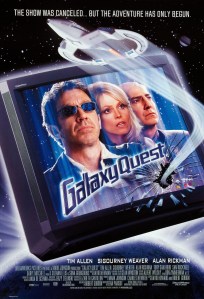 Starring Tim Allen, Sigourney Weaver, Alan Rickman, Tony Shaloub, Sam Rockwell
Written by David Howard & Robert Gordon
Directed by Dean Parisot
Original Cinema Release December 1999
The weary cast of an adored space opera TV series swap the convention circuit for the real thing when an alien race, believing them to be the crew of a real starship, call on them to save them… and the universe.
Back in the day, before the tech bros swung into town, the word ‘meta’ was a largely harmless nugget of four letter cultural jargon. A lot easier to say (and quicker to type) than ‘post-modernism’, it was a simple catch-all for any piece of fiction that was aware of itself, aware of its own mechanics. At its worst, this led to books and movies that were largely dedicated to climbing up their own large intestines, full of nods and winks, determined to show you how clever they were, and only to be enjoyed by audiences with an encyclopaedic knowledge of the genre being put through the meta mincer in question. If you didn’t laugh – or nod along sagely – then it was because you weren’t clever enough. As the film critic, Mark Kermode, neatly phrased it: ‘Post-modernism means never having to say you’re sorry’.
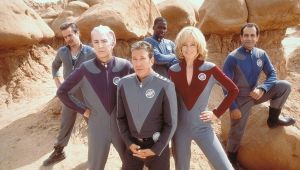 So it was, back in 1999, when I wasn’t humming along to Prince, I approached the cinema release of the new Galaxy Quest with some trepidation. I’d heard it was essentially an extended riff on Shatner era Star Trek, and was braced for enough nods and winks to require the copious ingestion of weapons-grade betablockers. However it had attracted an A-list sci-fi cast including at one end Sigourney Weaver, doyenne of the very serious Alien franchise, and at the other, Tim Allen, aka Buzz Lightyear. Hopefully they weren’t about to sign up to something no better than an extended in-joke. Equally, while I had enjoyed aspects of Schwarzenegger’s Last Action Hero in 1993, it had been overcomplicated and overlong, tying itself in meta knots. I didn’t want that either.
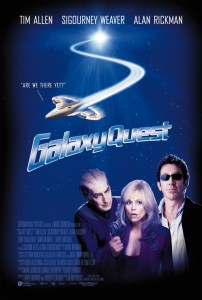 But the rest, as they say, is history. It was a delight. A critical and box office success, it was seen as a love letter to the Trek franchise, even voted seventh best Star Trek movie by fans in 2013. Personally, I think that’s unfair. I’d place it in the top three.
Despite having watched it at least five times in the intervening decades, I hadn’t seen Galaxy Quest on a big screen since its original release, so I was curious to revisit it in its natural habitat when it popped up as part of a Sigourney Weaver retrospective at my local magic lantern emporium. How would I feel about it over a quarter of a century later when cinema goers are lucky to get through two hours of fantasy adventure without some kind of knowing nod to the form to make them – and/or the creatives – feel smug about how clever they are?
Successful though it was, I found the relentless gags about act structure and character arcs in the recent Deadpool & Wolverine not just tedious, but alienating. If a script becomes about itself, why should I care? I’m a huge Black Mirror fan, but the two USS Callister episodes, which owed a humungous debt (to put it very politely) to Galaxy Quest had fallen into the Last Action Hero trap of going on for too long and trying to do too much.
Pleased to report, Galaxy Quest has lost none of its sparkle and charm. The reason it works, where other meta or parodic movies fail, is because it never stops believing in itself. While of course it’s nodding and winking like an electrocuted koala to Trek fans, it never does so at the expense of the characters – all of whom are properly drawn and exist within their own reality, never breaking the fourth wall, nor the bungee of disbelief. More importantly, director Dean Parisot makes sure that the cast take the job seriously. My frustration a few weeks ago with the reboot of The Toxic Avenger was largely down to Kevin Bacon et al ‘camping it up’ as if to say ‘isn’t this funny?’ rendering it completely the opposite.
 The late and extremely great Alan Rickman, playing a faded classical actor now type cast as a sci-fi icon (who can they have been thinking of?), is not only laugh-out-loud funny with nearly every acidly delivered line, but we genuinely feel his pain, and later his joy… so much so, that – perhaps because Rickman was taken from us too early – I brushed away more than a couple of tears at his character’s beautifully pitched emotional denouement.
Galaxy Quest also endures because while much of its pleasure derives from its Star Trek antecedents, it is carefully constructed to work in its own right. It’s not predicated on smug assumptions. It’s a masterpiece of narrative structure and economy.
I had also been concerned that its VFX would be showing their age. But of course, while they actually hold up surprisingly well on the big screen, where you can see the joins it doesn’t matter, as it’s appropriate to the genre. They really don’t have to say they’re sorry.
Lastly, what gives Galaxy Quest real heart is in what it says about fandom. It would have been so easy to ridicule the dedication of fans dressing up to queue for ten dollar autographs, but underlying the movie is a deeper contemplation of how the love for a fictional world creates a kind of reality in itself; an emotional reality that brings people together and makes the world a better place.
 Oh yes, and Galaxy Quest has the best aliens of any movie ever. I’m not prepared to argue about this. If you don’t love the Thermians – with their incomplete grasp of human intonation or the basics of walking – then you cannot be my friend. It’s as simple as that.
Verdict: Meta movies are two a penny these days, but Galaxy Quest is by far the best. It’s as close to perfect as I’ve seen in over half a century of sitting in the dark being entranced by cinema. If it pops up on a big screen near you, especially if you have never seen it, and even if you have, clear your diary for an evening of pure pleasure. 10/10
Martin Jameson
 Doctor Who News Star Trek News
 Sci-Fi Bulletin: Exploring the Universes of SF, Fantasy, Horror and Spy-fi!