Review: Universal Terror: Karloff
Eureka Classics Edition, Eureka, out now Eureka have brought us another themed collection of “horror films” starring the great Karloff, this time comprising Night Key (1937), The Climax (1944), […]



Eureka Classics Edition, Eureka, out now Eureka have brought us another themed collection of “horror films” starring the great Karloff, this time comprising Night Key (1937), The Climax (1944), […]
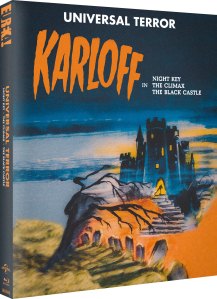 Eureka Classics Edition,
Eureka, out now
Eureka have brought us another themed collection of “horror films” starring the great Karloff, this time comprising Night Key (1937), The Climax (1944), and The Black Castle (from 1952).
All three films have definite points of interest, and are entertaining, but it’s probably worth pointing out from the get-go that this is not a set of horror films. There’s a reason for that, and for why they’re packaged as horror films, but right now let’s look at what the films are.
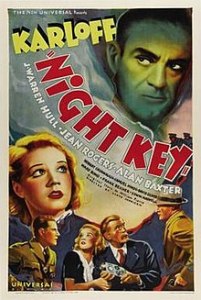 First up is Night Key, on Disc 1, which is the least horror-ish of the set, though it does introduce a familiar SF and horror trope, in the form of the (usually mad) scientist having a beautiful daughter whom the hero is involved with. Here, Karloff as inventor David Mallory isn’t a mad scientist, though – he’s one of the good guys, having invented a city-wide burglar alarm system. He’s good value as always, though of course in plenty of (accurately prescient, in fact) old age makeup. His daughter (Jean Rogers) is indeed involved with clean-cut police patrolman Jimmy (Warren Hull), and pretty much the first half of the film is a sort of mild-mannered comedy about them, with occasional mentions of the Night Key invention, which is of interest to the authorities, rivals, and, of course, gangsters.
About halfway through this then turns into a Warner Brothers gangster movie, with a chilling Alan Baxter giving a well-before-its-time modern style performance of a complete sociopath, as the gangster sadly known only as “The Kid.” Baxter doesn’t do much, physically, but he really sells the cold-bloodedness. Watch out also for the ever-familiar Western star Ward Bond as The Kid’s henchman too, who makes a great impression.
The gangsters steals the Night Key and uses Rogers to force her father to work for them, but Boris isn’t having any of that… You can see how it could have been a full-on revenge movie, or even an SF movie – as some publicity and opinions call it – but with Karloff staying on the good side of the law, it’s actually a solid minor gangster movie with some wit. Karloff is excellent value, Rogers is perfectly pleasant, and Baxter is ice-cold. It is absolutely not a horror film, though, and in fact the publicity at the time all said “absolutely no horror” to clarify that it was Karloff doing something different – to the extent that this is the last movie billing him just by the surname.
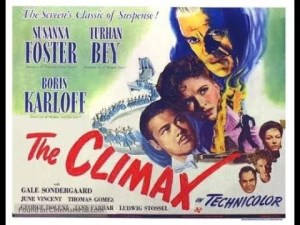 Sharing Disc 1 with Night Key is 1944’s The Climax, which moves into colour, has a story by Curt Siodmak and direction by George Waggner (who would reteam to greater success in The Wolf Man later in 1944), and may seem strangely familiar to anyone who saw the 1943 version of Phantom Of The Opera with Claude Rains, as this movie was originally intended as a sequel to that, and so reused its sets, costumes, and even some performers. In particular, Susanna Foster returns as her leading character from the previous film, with a quick name change when it became no longer a sequel.
Plot-wise, this is more of a Svengali/Trilby kind of dynamic, as the Vienna opera house has a resident medic, Dr Hohner (Karloff), who a decade earlier murdered his opera star wife in a fit of jealousy. Now Angela (Foster) joins the company and he becomes obsessed with her voice, and determines she should sing only for him – which is something he can arrange as he is a master hypnotist who can wreck her ability to sing at other times. Unfortunately for Dr Hohner, Angela is also smitten with Franz Munzer (Turhan Bey, perhaps best known to SF fans as Centauri Emperor Turhan in Babylon 5), which stokes Hohner’s jealousy further- and he already killed one opera star wife for the same reason…
Ostensibly the film is based on a 1909 play by Edward Locke, but really it’s just the names and title that come from there. It didn’t do anything like as well at the box office as Claude Rains’ Phantom had, but one can only wonder if that was down to the change of title and credits, as it’s certainly an effective psychological horror, with the charming but deranged Karloff giving one of his best villainous performances as what we’d now call a controlling abuser. In fact, this movie holds up better in the modern day for exactly that dynamic – the stalking, obsession, control, gaslighting psycho who seems nice – and is probably more effective a horror film now than it was in 1944.
It’s a visual treat, with lush sets and costumes all in rich velvety colour, and music and dances play with style. The cast are all on top form, with Foster doing her performance from Phantom, and Turhan Bey making an immediate impression as intelligent and believable in his role, and Gale Sondergaard being as crisp as ever. Even lower down the cast, everyone does their best, and that’s always something to be appreciated.
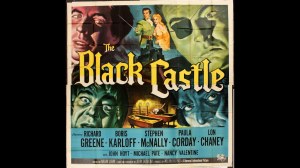 Finally, 1952’s The Black Castle gets Disc 2 to itself, and returns us to monochrome. Genre-wise, this is an intriguing mish-mash, with some horror elements (the burial alive bookending sequences), Gothic romance, Robert Louis Stevenson style adventure, and even gets perilously close to the Carry On Don’t Lose Your Head end of the Scarlet Pimpernel spectrum. That weird mixture is one it shares with the previous year’s The Strange Door, which had the same vibe and director – Nathan H Juran – and most of the same cast (and was released in a previous Eureka set). It shouldn’t work, it should be a confusing mishmash, but… It totally works and is all the more entertaining for it. This is in no small way helped by the impressively familiar cast.
In essence, It’s about what happens when a British Lord (Richard Greene) travels to Germany to find out what happened to a friend of his, and to find out if the evil Count Von Bruno (Western star Stephen McNally, making an impressive villain, whose waistcoats are gorgeous) is, well, an evil Count. Which he obviously is: eyepatch, Lon Chaney Jr as his butler/torturer, Boris Karloff as his medical adviser – whose wardrobe is straight from about 300 years earlier than the film is set – which works to mean you always notice him – the trail of dead wives, you get the idea. Watch out also for a near-unrecognisable John Hoyt (Star Trek’s first ship’s doctor) and Michael Pate as two hench-counts who get straight into a swordfight with Greene at the local Inn. It’s a nice swordfight too, using the Hollywood sport fencing style with swords more appropriate to it – i.e. Georgian smallswords.
It’s nicely paced, with Greene swiftly encountering McNally’s forced trophy-girl, (baby) crocodiles in dungeons, poisonings, drinking songs, Most Dangerous Game style hunting trips, and backstabbing. It’s a glorious mix, with a great cast, and fun pacing and direction.
Visually, though monochrome it’s probably the best looking of the three, in terms of picture quality, being deliciously sharp and with lovely contrast, though all three films are in the best quality they can be, with 2K scans of the fine-grain negatives of the monochrome entries, and the interpositive of The Climax.
What about the extras? There are commentaries on all three films. Disc 1’s films are given informative commentaries by Jonathan Rigby and Kevin Lyons, and these are very eye-opening on some fronts, both with their love of Siodmak’s work, and explaining how The Night Key ended up being included in horror packages, revealing that it had been used with other non-horror films to pad out TV Universal Horror package deal rights, and so became incorrectly catalogued as horror, leading to its bad rep from viewers who expected something else. Disc 2, The Black Castle has an equally informative but even more fun commentary by the ever-listenable Kim Newman, and Stephen Jones, which is a good evening’s entertainment on its own,
There are also trailers, and stills galleries – with some interesting colour still of the sets and costumes from The Black Castle – as well as the usual lovely O-Card slipcase on the first 2000 copies, and a nice informative booklet by Karloff biographer Stephen Jacobs, which is nicely told and illustrated.
Overall, a strange mixture of films and genres, with only one genuine horror film, but an array of memorable casts, and Karloff showing a much more interesting range than he always was worried about being perceived as having. He’s great in these, the prints are nice, there’s always something different or unusual to the films, and the commentaries are all wonderful. Eureka really should have called it something else than a “Terror” or “Horror” set – it’s really more an “Unfairly Forgotten Karloff Gems” set. 8/10
David A McIntee
 Doctor Who News Star Trek News
 Sci-Fi Bulletin: Exploring the Universes of SF, Fantasy, Horror and Spy-fi!