Review: Creeping Horror
Eureka Classics, Blu-ray Eureka, out now A quartet of lesser known horror titles… With so many of the big name Universal Horror, Gothic, and SF backlist already having been […]



Eureka Classics, Blu-ray Eureka, out now A quartet of lesser known horror titles… With so many of the big name Universal Horror, Gothic, and SF backlist already having been […]
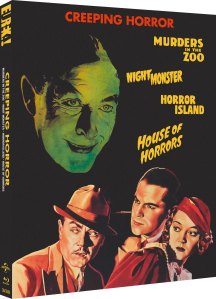 Eureka Classics, Blu-ray
Eureka, out now
A quartet of lesser known horror titles…
With so many of the big name Universal Horror, Gothic, and SF backlist already having been released in these sets, or the rights belonging to other distributors, we’re getting an odd mix of the B-movies made by their various “horror” units these days, and in this case the term “horror” is, shall we say, open to interpretation a lot of the time. The titles here are especially misleading, vague, or misleadingly vague too…
So, this month we get a foursome consisting of Murders In The Zoo (1933) and Night Monster (1942) on Disc 1, followed on Disc 2 by Horror Island (1941) and House Of Horrors (1946). The films are a mixed bag, with a couple of forgotten and underrated classics, and at least one wince-inducing attempt at comedy adventure that makes the average Scooby-Doo outing look like Halloween.
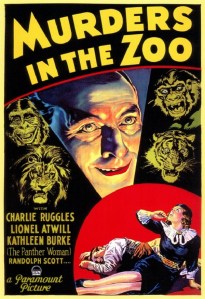 First up, 1933’s Murders In The Zoo is more of a mystery, with a clearly-bonkers from the (outstandingly conceived) opening sequence Lionel Atwill bringing a supply of animals to a newly-opened zoo, at which a series of murders are occurring, and the likes of Randolph Scott (in one of his earliest roles) must try to solve it. This isn’t a bad movie, with a nice credit sequence tying up the actors’ roles with different animals, but top-billed Charlie Huggles as a cowardly press agent is somewhat annoying in the comic relief role. That said, it’s unusual that the comic-relief role is vital to the plot, not just a throwaway nuisance, and director A Edward Sutherland manages to make good use of him, while at the same time making the most of the excellent Atwill, and taking advantage of the pre-Code freedoms to give us that astonishing opening – a helluva non-speaking guest role – and some other bits of sadistic enjoyment on Atwill’s part, such as throwing a woman into a pool of crocodiles.
Of the films in this set, this probably has the lowest picture quality although, of course, it has been restored to look better than any previous print, but its use of stock footage in the otherwise captivating opening sequence makes it look as if it’s going to be of lower quality throughout. Thankfully this isn’t too much the case. Very oddly for a Universal Horror set, this isn’t a Universal film, but a Paramount one, which is curious.
The big issue modern audiences might have it is the use of animals, both caged so close to the cast in the dinner party sequence (bonus points for the lion that turns away to show its arse because it’s not got a seat at the table – it is a cat, after all), and at the climax, in which most of the cages are filmed being opened separately, but is followed by a shot in which various big cats are in the same studio space and you can see a lion take a swipe at a jaguar (which dodges).
In general it’s an entertaining movie with some shocking pre-Code nastiness and some rubbish attempts at humour. There are few extras – just a photo gallery, hard-of-hearing subtitles, and a commentary by Kevin Lyons and Jonathan Rigby.
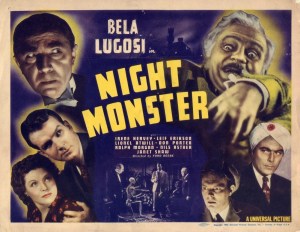 The other film on Disc 1 is 1942’s Night Monster, starring a very good cast of Universal contract players. More interestingly, this seems to be a UK premiere for the film, it never having been released theatrically back in the day, nor having been on VHS or DVD. Therefore it’s probably the most surprising and intriguing of the set, and also one of the best.
The most recognisable faces here are Bela Lugosi, clearly enjoying himself as chilled-out butler, and Lionel Atwill (again), also clearly enjoying himself as the most blustering of a group of doctors invited to a house in the swamps – which are reportedly haunted by sings of a monster, which we are never shown – but not for the sake of their health. Leif Erickson also appears as a cheerful and stalkery chauffeur, while the actual main stars are Ralph Morgan, Don Porter and Irene Hervey, with support from a very non-Indian Swami played by Nils Asther, and a rather odd splicing in of the director’s father-in-law.
The film is talky and slow to start, what with the addition of the director’s father-in-law hanging around doing nothing, but soon enough Leif Erickson is trying to force himself on women, the maid is mysteriously murdered, and the Swami uses a séance to teleport a skeleton carrying a box with a jewel from an ancient Greek tomb… At which point the plot kicks into gear as the various doctors start getting murdered – off-screen, with only a dead hand shown afterwards, which in fact is an interesting part of the proceedings, being a thematic visual nod to the perpetrator.
This one is actually – once it gets going – a pretty good occult mystery whodunnit, not a true horror film. It takes influences from old dark house films, noir, but most of all from the sort of literature that uses an occult backdrop in the normal world; even a touch of the MR James or Ambrose Bierce where the séance scene and nature of the “monster” are concerned. In the last matter, it has a feel of something The X-Files would have done. The cinematography is excellent for a movie of this genre and period, and pretty much everybody in the cast is clearly engaged in putting their best into it, which is relatively unusual, and makes this a forgotten gem.
Obviously it’s a nice crisp new restoration, with photo gallery, Subs for the hard of hearing, and a brief and uninformative trailer. This time Kim Newman and Stephen Jones provide the more bouncy commentary.
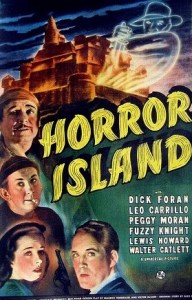 Disc 2 starts with Horror Island (1941), which you’d expect to be good because it’s directed by safe regular and The Wolf Man director, George Waggner. Prepare to be disappointed. Yes, the cinematography and direction are excellent, prime Waggner, but from the opening moment when Leo Carrillo walks on stage with a stripey jersey, bandana, wooden leg, and huge hoop earrings – he’s only missing a hook for a hand, but is the main sidekick in the film, so that can be excused – we know we’re in comedy pirate treasure-hunting mode.
Long story short, he, Dick Foran (as Bill, an inveterate debtor) and Peggy Moran are in a race with the mysterious Phantom (Foy Van Dolsen) and the cops, to find the pirate treasure to which Carrillo and the Phantom each have half a map. The comedy is hugely variable, with Fuzzy Knight as Foran’s assistant in particular just not having the chops to deliver the gags well. At least Foran and Moran are OK. It looks good, in terms of restoration, cinematography, direction, and action scenes, but is totally a Scooby-Doo precursor and in no way whatsoever a horror film. Probably best served with a bottle of rum or three.
It has much the same extras as the other films in the set, this time with a Kevin Lyons and Jonathan Rigby commentary.
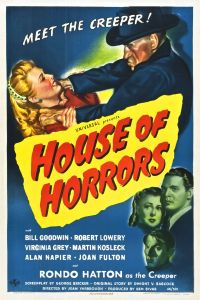 Finally, we get another little-known gem, misleadingly billed and titled, in the shape of House Of Horrors (1946), which is really a full-on crime movie with a mix of noir and what would become giallo elements. Here, A number of art critics are murdered, starting with Alan Napier of Batman TV series fame, and cop Bill Goodwin, reporter Virginia Grey and suspect Robert Lowery must track down the killer – the notorious Creeper (Rondo Hatton).
Though Hatton is top billed, reprising his role as the Creeper from Sherlock Holmes: The Pearl Of Death, the actual main character is a sculptor played by Martin Kosleck. All the characters are given great layers too, whether they be playing off the crazed girl reporter trope like Virginia Grey, having an off duty likeable life like the detective, or getting more layers of depth than a horror – or even crime – villain of the period would usually get. In particular, the Creeper is given quieter moments and a partner, as well as touches of an intriguing misophonic backstory, in addition to being used as a looming monstrous killer. Likewise, demented artist Kosleck is charming and loves his cat, when not sending the Creeper out to murder people. Director Jean Yarbrough has really pulled out the stops here.
Of the various so-called Creeper movies, whether starring Hatton or not, this one best fits as a Holmes sequel, even though relocated to New York. It’s by turns surprisingly nasty – the Creeper has a penchant for murdering random women on his off-hours – and also surprisingly witty, with some tragic elements and twists. It’s a really good gruesome crime thriller, just (again) not a horror movie.
This one has a great commentary by Stephen Jones and Kim Newman, who get really into the ins and outs of the Creeper movies, and Rondo Hatton’s career too, and of course there are subs for the hard of hearing, and a photo gallery, and it looks and sounds great.
As an overall set, this is maybe not the best that Eureka have done, but it has a UK premiere, two forgotten classics, and only one real clunker – and that’s passable entertainment after a few drinks. Both commentary duos are great in their own ways: Stephen Jones and Kim Newman are more like a convention bar sort of event, relishing the films and getting into what they see as well as the background stuff, while Kevin Lyons and Jonathan Rigby, while also obviously enjoying the material, stick a little more to being facts-based about which actors or crew were in which other movies, and so on. Both teams talk extensively about Lionel Atwill’s career and fate on Disc 1 too, which is something they’ve done on other sets too.
The new restorations of all four films look and sound perfect, with the unavoidable exception of the opening of Murders In The Zoo, which consisted of elements of various qualities to start with. As usual with Eureka, the first 2,000 copies come with an O-card slipcase, as well as a Collector’s Booklet written by Craig Ian Mann and Jon Towlson, which is a nice piece though it covers some of the same ground as the commentaries. Having two films per disc, though, does cut down on the on-screen extras – there are no video essays, radio adaptations, or suchlike here, and that’s a shame, as something about Atwill or especially about Rondo Hatton and the Creeper would have been most welcome.
Verdict: Good fun, though. 8/10
David A McIntee
 Doctor Who News Star Trek News
 Sci-Fi Bulletin: Exploring the Universes of SF, Fantasy, Horror and Spy-fi!