Review: The Cat and the Canary and The Ghost Breakers
Eureka Video, out now Eureka Classics bring us a double bill of spooky Bob Hope films, both of which were based on plays from a couple of decades earlier, and […]



Eureka Video, out now Eureka Classics bring us a double bill of spooky Bob Hope films, both of which were based on plays from a couple of decades earlier, and […]
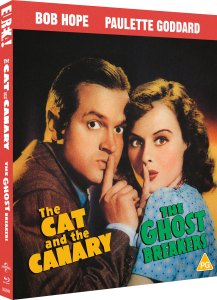 Eureka Video, out now
Eureka Classics bring us a double bill of spooky Bob Hope films, both of which were based on plays from a couple of decades earlier, and which had come along to spark the first nostalgic successes for a genre that had peaked and died out around a decade earlier.
First up, it’s September of 1939 and a momentous event happens: the launch of a legendary comic career with the release of the definitive version of The Cat And The Canary. Some stuff happened in Europe too, but that wasn’t nearly as much fun. The Cat And The Canary had started off as a play in 1922, then become a wildly successful play, and was filmed as a silent by Paul Leni in 1927, and in fact has been filmed officially four times, and unofficially dozens of times – it’s the ur-form for the old dark house spooky murder mystery film. (The Old Dark House itself being one of the homages).
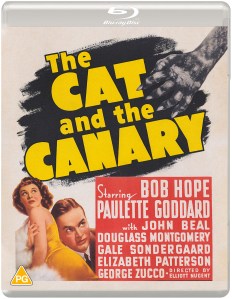 The plot is simple: a group of relatives, including Bob Hope’s nervous but intelligent Wally, are summoned to a spooky old remote mansion in the Bayou for the reading of will by the family lawyer (George Zucco, who would go straight from filming this to playing the definitive Professor Moriarty in The Adventures Of Sherlock Holmes) that will make one of them (Paulette Goddard) rich, encourage one of them to try to kill the others, and all the while there’s a maniac on the loose, having escaped from a neighbouring asylum. Throw in lots of secret passages, codes, a hidden treasure, and a suspicious psychic/witchy housekeeper in the perfect form of the Spider-Woman herself, Gale Sondergaard.
You’ll know the kind of thing to expect even if you’ve never seen this actual film or any of the official versions, because it so perfectly encapsulates the genre. What makes this version the definitive one is blending gorgeous lighting, clever direction from Elliott Nugent, awesome casting and acting, witty and likeable comedy, and, in the last act, true horror, in a Jekyll and Hyde kind of slasher way. It is a hugely likeable piece of mystery comedy, largely due to Bob Hope and Paulette Goddard, though really Gale Sondergaard is the most strikingly magnetic of the cast, which led to her being typecast in such roles. Nugent’s direction is knowing and tense, allowing for both great wit and full-blown psychotic turns alike, while making the best use of Zucco and Sondergaard’s sinister qualities.
What’s momentous here is we see the switch from screen comedians being all about broad physical comedy to vocal comic acting with dialogue and wit and charm. We also of course see an example of the Universal/Paramount rivalry, with Paramount muscling in on Universal’s rep for horror.
Normally this is where a discussion of the commentary and extras would go, but in this case, the two films have the same commentary team, effectively making it a two-part commentary whose themes continue from this movie into the next, so let’s look at that film next.
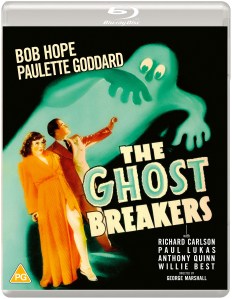 Second up on the disc is The Ghost Breakers, another old dark house type mystery – well, eventually it is – based on a 1913 play. Greenlit to reunite Hope and Goddard with ghostly goings-on, this time rather than being potential benefactor from a will, Hope’s character, Larry Lawrence, is a radio crime reporter being hunted by gangsters and cops after a murder, who hides in Goddard’s luggage to escape. Goddard, meanwhile, has inherited a Cuban castle, and is being made all sorts of offers and warnings about the place and its spooky caretaker – and its ghost and zombie (Noble Johnson, who, despite playing a mute lumbering monster, gives it wonderful cunning and intelligence)!
This is a more disjointed effort from the same screenwriter, Walter DeLeon, starting off as a gangster movie, veering into screwball comedy, before finally being that Scooby Doo plot of a haunted castle and a criminal to be uncovered. That said, it has some good moments: the effects are great, and a blackly comic mood maintained well by director George Marshall (who had made Destry Rides Again, and would later helm How The West Was Won). We have a guest shot from a young but good value Anthony Quinn, and Hope and Goddard’s chemistry is even better and more natural than in the previous film. Unfortunately it’s also the uncomfortably casually racist movie you’re likely to see this year, thanks to the vastly underrated Willie Best as Alex, or as he’s billed in the credits, “Larry’s Boy” in what was then a common stereotypical cowardly servant role.
Best was a talented comic actor, however, and at least manages, with Hope’s backing against studio expectations, to turn things around somewhat so that Hope is as cowardly as Best, and Best actually provides a satisfying resolution. It’s still a very uncomfortable watch in his scenes, though, as it was on a level actually pretty outdated and out of favour even by 1940.
The effects and sets are very good, especially the ghost, and the cast are all very good, with plenty of fine witticisms and one-liners. This one, even more so than The Cat And The Canary is the ur-Scooby Doo show, and between them the two films basically create that format, which remains current to this day in movies and TV.
Both films are nicely restored and have never looked better – The Ghost Breakers being an entirely new 2K master – with lovely sound quality too, in their original Academy aspect ratio. They’re accompanied by a pair of excellent commentaries by Jonathan Rigby and Kevin Lyons, which flow together well into one double-length chat on not just the making of the two films, but the history of the plays, staged versions, cast members switching roles between stage and screen iterations, racism in the cinema of the era, and so on. In all, a fascinating commentary package.
There’s also a video chat with Kim Newman about the plays and the context in which the films came about, which is a great piece, and trailers for both films, which featured specially shot footage with Bob Hope being who 1940s audience were gonna call… As is becoming common in this year’s Eureka releases, a radio version of The Ghost Breakers is included too.
As usual, the first 2000 copies come with a very pretty O-card slipcase and a booklet, this time written by Craig Ian Mann, which is a good piece focussing mainly on the films’ place in the Universal/Paramount/RKO trifecta of studios willing to release mainstream movies in the fantastical and darker genres, though is there is some overlap with the commentaries and Kim Newman’s piece in terms of the spooky old house genre too.
Verdict: The best versions of both movies, with great entertaining and eye-opening commentary too. If you’re a fan of the genre, or of Bob Hope, or classic comedies, this is a must-see, but the second film especially is more stereotypically racist than audiences under 40 are likely to have seen, so brace yourself. 8/10.
David A McIntee
 Doctor Who News Star Trek News
 Sci-Fi Bulletin: Exploring the Universes of SF, Fantasy, Horror and Spy-fi!