Review: Prophecy: Eureka Classics Edition, Blu-Ray
Eureka, out now Something is in the woods… Prophecy is a kind of forgotten 1980 movie that has started to develop a cult following. It’s an odd mix – part […]



Eureka, out now Something is in the woods… Prophecy is a kind of forgotten 1980 movie that has started to develop a cult following. It’s an odd mix – part […]
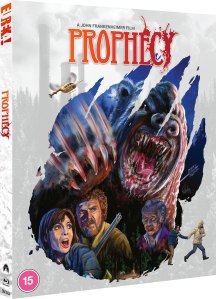 Eureka, out now
Something is in the woods…
Prophecy is a kind of forgotten 1980 movie that has started to develop a cult following. It’s an odd mix – part eco-thriller, part creature-feature – from David Seltzer, writer of The Omen, and John Frankenheimer, director of the original The Manchurian Candidate and French Connection II, among others.
The plot concerns exploitation of Native American land by loggers, who poison the waters with mercury, in the end creating a vengeful mutant creature which local elders think might be their mythological protector/threat made flesh. It didn’t do that well at the box office, perhaps because on two different levels it falls between stools: it’s not quite sure whether it wants to be a serious ecological thriller, or a woodlands adventure horror; it also comes a point when animal-based creature features like Jaws or Grizzly are falling out of favour, and full-on ecological messaging isn’t yet there, because horror is going the stalk-and-slash route. It therefore ends up becoming a really well shot, if slightly crudely preachy, eco-thriller for two thirds of its runtime, and then a rush of fanged but predictable fun in the last half hour.
Watching after 40 years, it actually turns out to have more subtlety than that. The characterisation is OK despite obvious race-bending and Robert Foxworth’s curls, everyone seems to be putting in the work, there are some lovely landscapes and atmospheric shots – the creature advancing across the misty lake in one shot being gloriously atmospheric to a degree that it’s a real shame that isn’t hailed as an iconic film moment – and while the Native American mythology is as muddled as the mythic elements of The Omen were, there are surprising Lovecraftian references to enjoy.
It’s not a classic, despite the Frankenheimer connection, but it’s not a dud either; it has kind of the tonal quality of First Blood – which Frankenheimer was originally engaged to direct before Ted Kotcheff took over – with solid characters in dramatic conflict in the backwoods, and a giant annoyed mutant wildcard. In that respect, it’s a very pleasant surprise.
The picture quality good, though surprising not as sharp as it possibly could be, but the sound mix is really nice and crisp. Extras include nice little interviews with creature actor (and director of Friday The 13th Part VI) Tom McCullough, and screenwriter David Seltzer, both of whom have fascinating tales, and the latter of whom has the marvellous expression regarding embellishing stories “I remembered too much,” as well as a teaser trailer which is just a logo and voiceover, and TV and radio spots from the US release.
For commentary fans, there are two. One is by film historian Richard Harland Smith, which is rather dry, but conveys great behind the scenes information about the making of the film. The second is by Australian filmmakers/writers Lee Gambin and Emma Westwood. The latter takes the leading role, with most of the commentary, but unfortunately there’s something really weird about the sound quality on this commentary, and specifically Westwood’s part- she sounds tinny, echoey, and notably distant, and it seems clear that she’s doing her part of the commentary over phone or Zoom into the recording booth where Gambin is (as he sounds closer, clearer, and, well, like a normal commentary recording). Their commentary focuses, for at least the first half, on racial issues between countries’ original inhabitants and the descendants of more modern settlers, as well as the ecological issues. They’re actually really interesting and important issues, but introduced in a rather clumsy manner, literally starting with Westwood leaping into “Before we start, we’re Australian and want to be as understanding and apologetic as possible about our ancestors’ messing with the original inhabitants…” Which is guaranteed to annoy the type of person who hates so-called “wokeness” – and to be fair winding them up is always worth doing – but has zero whatsoever to do with the Native American side, and, because of the sound issues over her calling in remotely make her sound like an actual gatecrasher, crashing a meeting. That’s a real shame, considering that in general there’s great stuff from both them from about five minutes in. It would have played better if they could perhaps have re-recorded with both of them in front of the same mic, or at least adjusted them to match in post.
As usual with Eureka, the first 2000 copies have a lovely poster, this by Darren Wheeling, and a booklet. The booklet has a nice background to the film, written by Craig Ian Mann, an interview with Venita Ozols-Graham, and an awesome poster gallery.
Verdict: Overall, no classic, but a decent movie with a good pedigree that play better now, separated from the pop-culture expectations of the time – with a package that is worth the effort of getting into. 7/10.
David A McIntee
 Doctor Who News Star Trek News
 Sci-Fi Bulletin: Exploring the Universes of SF, Fantasy, Horror and Spy-fi!