Review: Encounter Of The Spooky Kind
Eureka Masters Of Cinema Edition, out now Big Guts Cheung claims he’s fearless – but soon the truth is revealed… Also known (in the US) as Spooky Encounters, the […]



Eureka Masters Of Cinema Edition, out now Big Guts Cheung claims he’s fearless – but soon the truth is revealed… Also known (in the US) as Spooky Encounters, the […]
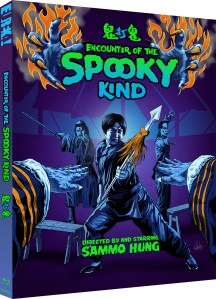 Eureka Masters Of Cinema Edition, out now
Big Guts Cheung claims he’s fearless – but soon the truth is revealed…
Also known (in the US) as Spooky Encounters, the Chinese title of this is actually “Ghost Strikes Ghost” (which is a bit more of a hint for how the finale will play) and it has a vital place in the history of Hong Kong cinema, for founding the supernatural kung fu horror comedy genre, and indeed influencing the Western world’s style of horror comedy by way of Sam Raimi’s Evil Dead trilogy and Dan O’Bannon’s Return Of The Living Dead.
There had been kung fu comedies before, of course, and straightforward Asian horror films, most notably in Hong Kong’s case from the Shaw Brothers studios (who had even collaborated with Hammer Films on Legend Of The 7 Golden Vampires).
Traditional historical kung fu movies were on the wane at the box office – Shaw Brothers were being hit hard at the time by Golden Harvest’s kung fu comedies starring the likes of Jackie Chan and indeed Sammo Hung himself, and Hung was concerned that this genre had also started to become tiresome to audiences. He wanted to make something new, and as Alien had been the biggest hit in HK cinemas the previous year, mixing horror and SF, Hung decided to mix horror with kung fu comedy. The result was a film that would kick-start a hugely popular new genre in Hong Kong, and influence the genre in the West.
The plot is fairly simple: “Big Guts Cheung” claims to be fearless, but actually is not, as his friends try to prove with pranks. However, when his boss hires a wizard (Chan Lung) to kill him because he’s almost caught having an affair with Cheung’s wife, Cheung finds himself having to face up to assorted demons, vampires and zombies, as well as the corrupt local Chief Constable (Lam Ching Ying) and his guards, but fortunately has the aid of the wizard’s apprentice (Chung Fat), who, in a reversal of the usual trope, has fallen to the good side. The mix of genres ebbs and flows here, with the more straight horror sequences early on, albeit led in by comedy, before returning to a more comedic kung fu lone-man-against-corrupt-authorities line, albeit keeping the supernatural elements to maintain tension and generate good gags.
The goriest part is actually the opening sequence, which is also veined with funny dialogue, which in 1980 was a new thing for a kung fu movie. From there on in, we’re introduced to the wonders of Daoist priest-wizards, who would go on to become a trope in the genre, and a fantastic cast, with everybody in it either a long time Hong Kong actor or a future star. An uncredited – and unrecognizable – Yuen Biao plays both the hopping vampire, and the later reanimated corpse. Chung Fat had played henchmen and villains in many movies, but here makes the most of his chance to play the second-billed good guy, the original screen Daoist ghostbuster, and a good job of it he makes too, and it’s shame his career faded after this. The ever-reliable Lam Ching Ying (here two years before his mind-blowing turn in Prodigal Son) would go on to become known as the “Chinese Peter Cushing” for playing this type of vampire-hunting role from Mr Vampire onwards, and henchman Wu Ma – here the white-faced guy who tries to lure Big Guts to his doom – would become famed as the – yes, you guessed it – ghost-busting Daoist priest/wizard in the A Chinese Ghost Story trilogy. Even Mr Vampire director Ricky Lau has a role in this, as one of Sammo’s coworkers.
The horror sequences here all work, as does the comedy – in fact even more so, in the comedy’s case, thanks to the newer more accurate subtitles – and there could never be any doubt that the action would work under the direction of Sammo Hung, who is a better director than often recognised. His skills in this line easily match his expertise in physical performance because he’s known to study and research everything that he does. This also extends to the subject matter, and before filming he made a study of both Daoist magical belief and the horror genre, Eastern and Western, so that these elements would be as believable to his audience as the more familiar elements of martial arts. And he’s right, it does show.
With the exception of the mirror-pull gag, the few optical effects are pretty simple and obvious, but the practical effects and the use of lighting and colour palette give the horror sequences a good grounding in reality, while the comedy is a mix of slapstick and puns with some nice character touches courtesy of novelist Huang Ying who collaborated with Sammo Hung on the screenplay. But this is still at heart a king fu movie and there are some fantastic set-pieces to be had. There’s the horror set-piece of the haunted house at the start, and the shenanigans around the hopping vampire. There’s the comedy set-piece of the reanimated corpse leading to the best sight-gag in the film, and then there are the tofu-restaurant fight scene that feels very Jackie Chan-ish while still bringing something new and impressive for Hung to perform (and in the process inspire Evil Dead 2), the sword and spell fight between the two wizards that would give any lightsaber duel in the Star Wars prequels a run for its money, and of course the climax involving Hung channelling the Monkey King and some awfully unsafe-looking fire stunts. It’s a visual symphony of awesome moments, backed up by top-notch performances from pretty much everybody, even if the very final moment is a bit of a bum note, especially coming immediately after the perfect final gag.
That final shot was shocking in 1980 and still is, and does leave a sour taste, even though you can totally see why it happens. It’s a difficult bit that I suspect the new release will spark some debate about among fans.
Speaking of symphonies, Hong Kong action films of the period were notorious for sampling – and wholesale ripping off – musical tracks and scores from Hollywood movies, but it’s worth mentioning that Encounters Of The Spooky Kind has an original score by frequent Frankie Chan, who has scored several of Sammo Hung’s movies, including Prodigal Son, in which he also played the main villain. Chan’s music references elements from other scores, but subtly, however his greatest achievement here is to blend Eastern and Western styles of horror score by means of riffing on the one piece of recognisably famous Western music that does get used in the film, namely Bartok’s “Music For Strings, Percussion, And Celesta,” which is probably best known to genre fans from its use in Kubrick’s The Shining, and in the Doctor Who story ‘The Web Of Fear’. Chan makes good use of it as an influence, as well as by including it.
This film has never looked so good than in this new 2K restoration. It’s crisp, clear, shows no sign of damage. Colours are pleasing naturalistic and all the detail of the print is gorgeous. Of course there is a slight downside to this quality and clarity in that a few more of the wires used from some stunts and effects are visible. In the UK this edition is also the film’s uncut release, restoring the onscreen beheading of a live chicken.
The disc contains several different audio versions: original and VHS Cantonese mono tracks, which sound identical in the vocals but have some musical variations, and original 1980 and newer English dubs, neither of which are particularly good, nor as accurate as the subtitles. The subtitles are very good, very accurate, and even manage to capture a good half of the puns and references.
There’s also the US video opening titles as a separate extra, which wouldn’t have been worth including a whole other copy of the film for, and a nice little interview about the film and his work process with Sammo Hung from a few years ago.
The main extra feature on the disc is a commentary by former Tai Seng exec Frank Djeng. It’s always good to hear a commentary on a Hong Kong film from a native Cantonese-speaker, and Djeng does a great job at pointing out actors playing multiple roles, which lines are contemporary (rather than 19th Century) Cantonese slang, filling in details about the various mythological figures referenced, and noting locations and the other films that members of the cast have been in. Unfortunately it’s soon made clear that Djeng is recording – at the Easter weekend this year – before the new subtitles have been added to the film, because a good forty percent or more of the commentary is him translating Cantonese lines and phrases for us, which the audience can now see rendered accurately in the subs. Which at least is a good way to check the accuracy of the subs.
As is usually the case with Eureka’s releases, for the first 2000 copies there’s a booklet – in this case a text of background to the film written by James (thankfully not Jamie) Oliver. There’s also a double-sided poster
Verdict: In summary, a great influential-on-several-genres movie that has never looked or sounded better. Despite what some will find to be uncomfortable moments of chicken sacrifice and the final thirty seconds, this is a funny, thrilling, exciting mix from a master of the kung fu genre. It’s a landmark film in the history of both horror and Hong Kong movies, and so is well worth revisiting, especially in such an impressive edition. Definitely a must-see for fans of Sammo Hung, kung fu movies, and horror fans who appreciate what they think Sam Raimi brought to the table. 9/10
David A McIntee
 Doctor Who News Star Trek News
 Sci-Fi Bulletin: Exploring the Universes of SF, Fantasy, Horror and Spy-fi!