Review: Candyman (2021)
Starring Yahya Abdul-Mateen II, Teyonah Parris, Nathan Stewart-Jarrett, Colman Domingo, Tony Todd Directed by Nia DaCosta Universal, out now A visual artist seeks inspiration in his cultural roots There is […]



Starring Yahya Abdul-Mateen II, Teyonah Parris, Nathan Stewart-Jarrett, Colman Domingo, Tony Todd Directed by Nia DaCosta Universal, out now A visual artist seeks inspiration in his cultural roots There is […]
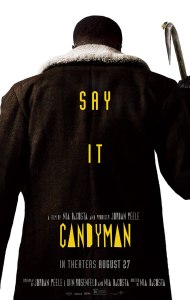 Starring Yahya Abdul-Mateen II, Teyonah Parris, Nathan Stewart-Jarrett, Colman Domingo, Tony Todd
Directed by Nia DaCosta
Universal, out now
A visual artist seeks inspiration in his cultural roots
There is much to admire in the latest iteration of the Candyman series, which has the invigorating stamp of producer and co-writer Jordan Peele all over it and is impressively directed by Nia DaCosta, who also shares the writing credit along with Win Rosenfield another of Peele’s regular creative associates.
I haven’t seen Bernard Rose’s 1992 original but I’m reliably informed that this is what is known as a ‘spiritual sequel’, so not quite a reboot, but nor is it simply a new instalment in a franchise. I admired Candyman for this as well. It stands up confidently as a film in its own right, which suited this reviewer, but it also means I’m not the guy to come to if you want comparisons.
There are more things to admire. Candyman 2021 is a cerebral film, brimful of ideas. Don’t leave your brain at the door, because you’re going to need it. Peele, DaCosta and co have fashioned a new genre: Gentrification Horror. The movie doesn’t just satirise the gentrification of Chicago housing projects, but at heart it’s about the gentrification of history itself. Yahya Abdul-Mateen (recently so impressive as Bobby Seale in The Trial of the Chicago 7) plays Anthony McCoy, an artist facing critical accusations that he is now privileged and middle class pretentiously exploiting his cultural roots. Determined to disprove this, he sets about creating an artwork about the Cabrini-Green Projects, centred around the Candyman ‘myth’ significantly entitled ‘Say My Name’… which of course people do, with not so hilarious consequences.
At this point the film starts to layer meta upon meta. Does the act of turning the horrors of societal racism, U.S. black history and racial violence into art neuter the history itself? Artists want to believe they are exposing truths, exploring raw emotion, expressing the unsayable, but does the very act of putting it in a gallery render the history ‘safe’, doing precisely the opposite of what liberal culture thinks it is doing? Not least because that very history is ongoing. And crucially, will anyone attempting to turn the relentless cycle of racist violence into art – into intellectual entertainment – be punished for doing so?
In which case, given that this is, itself, a movie…
I loved all this mind bending stuff. I admired its intellectual chutzpah. I also admired the flair with which it was executed. With nods to David Cronenberg and a particularly breathtaking nod to Alfred Hitchcock, Nia DaCosta shows that she is a formidable directorial talent, and I am really excited to see what she does next. She really knows how to move a camera, and how to use the frame to brilliant effect. Her visual riffing on the power of the mirror and reflections could have been clichéd but here is inventive and constantly surprising.
But… but… but…
I scare very easily, and aside from one or two ‘eugh’ moments Candyman didn’t wig me out once. For a horror movie it really isn’t frightening at all. Perhaps it’s because the creative team are more interested in all the big ideas it’s exploring. Perhaps it’s because the black history – the black experience – it is talking about is, in reality, far more shocking than any fictional horror.
About two thirds of the way through I reconciled myself to this, assuming it to be the point, but with half an hour to go, the movie takes a narrative lurch, and with an eye-watering grinding of gears, Candyman suddenly remembers that it’s supposed to be a horror film of some sort, and we get dollops of body-shock, assorted gore, and some randomly incongruous over-acting, but by then it’s too late and it felt oddly cursory.
Verdict: Candyman is definitely worth seeing. It is visually arresting in places, and it has important things to say. Admirable, intelligent… but nowhere near as scary as it should have been. 7/10
Martin Jameson
 Doctor Who News Star Trek News
 Sci-Fi Bulletin: Exploring the Universes of SF, Fantasy, Horror and Spy-fi!