Review: 28 Years Later: The Bone Temple (updated)
Starring Alfie Williams, Ralph Fiennes, Jack O’Connell Directed by Nia DaCosta Sony – In Cinemas now Spike (Alfie Williams) is fighting for his life as a reluctant member of the […]



Starring Alfie Williams, Ralph Fiennes, Jack O’Connell Directed by Nia DaCosta Sony – In Cinemas now Spike (Alfie Williams) is fighting for his life as a reluctant member of the […]
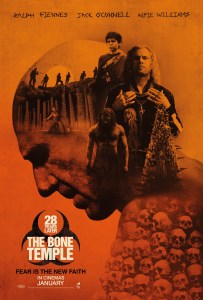 Starring Alfie Williams, Ralph Fiennes, Jack O’Connell
Directed by Nia DaCosta
Sony – In Cinemas now
Spike (Alfie Williams) is fighting for his life as a reluctant member of the Fingers, Sir Lord Jimmy Crystal (Jack O’Connell)’s child soldiers. But nearby, Dr Ian Kelson (Ralph Fiennes) is contemplating suicide, and becoming closer to Samson (Chi Lewis-Parry), an Infected Alpha…
Nia DaCosta’s entry in the 28 Days later franchise has a strong case for being the best movie in the series so far. It’s more propulsive than 28 Days Later, swapping that movie’s sweet, sad ruined re-wlded UK for something on the verge of something extraordinary: salvation.
That concept is explored in microcosm through Spike’s relationship with the Fingers. Williams is an ensemble player here, Spike’s main character status suppressed by the monstrous power of O’Connell’s Jimmy. He’s still great, and gets a surprising amount to do, but this story is about Spike reclaiming control of his life and that requires him to be in the background a little. It also gives some of the other Jimmys a chance to shine, with long term genre stalwart Erin Kellyman scoring especially hard as the reluctantly principled Jimmy Ink. The Jimmys are victims, but they’re also monsters and the movie’s hardest moments come from them. There’s an extended war crime, as they commit ‘charity’ on a group of farmhouse survivors that’s the nastiest beat the series has committed to date. It’s a hard, excellent sequence that reminds us just how much trouble Spike is in, how monstrous the Jimmys are and how alive the UK is. Because if you pay close attention to the sequence, you notice something interesting. Survivors…
That persistence of life is key to the movie’s main plot, which is in turn a three way battle for the soul of the UK. In one corner is O’Connell’s amiable, ruined child despot Sir Jimmy. In another is Lewis-Parry’s colossal Samson, a man swimming up through three decades of atrocity and viral madness to return to himself. In the third is Fiennes’ Kelson, a gentle, funny, broken man whose brilliance is balanced by his frailty. All three get scenes together which are highlights of the movie, but it’s Lewis-Parry you remember. He gets two moments here which hit harder than anything else, and they’re quieter than anything else we’ve ever seen in this franchise.
Verdict: From the opening, frantic reluctant duel to the closing scene, this is a movie about hope and what we have to do to return to it. If we get the third movie (and supposedly it’s in production) I can’t wait to see how it ends. If we don’t, this is a surprisingly perfect, surprisingly sweet ending to the series. Brutal, relentless, brilliant. 9/10
Alasdair Stuart
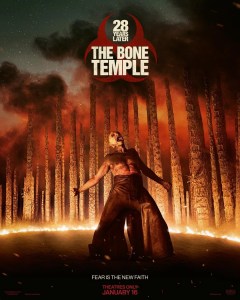 Following the events of 28 Years Later, 12-year-old Spike is inducted into Jimmy Crystal’s murderous gang, while Dr Kelson makes a discovery that could change the course of the apocalypse.
As the record will show, I was greatly disappointed by Danny Boyle’s long awaited return to the ‘28’ franchise last year. While it had its moments, 28 Years Later was structurally all over the place, consisting of two very similar first acts, before lurching into a portentous third, that buckled under the weight of its own emotionally implausible seriousness. It was both humourless and not frightening in any way. Consequently I returned for part two – The Bone Temple – more out of duty than expectation…
…which perhaps was the optimum way to experience it, as an hour and forty-nine minutes later I realised I had had the best post-apocalyptic ride for many a long year.
Things kick off with young Spike (Alfie Williams) fighting for his life as a rite of passage in front of Jimmy Crystal (Jack O’Connell bizarrely channelling Ewan MacGregor at his most effete) to earn his place in Crystal’s gang of Jimmies – so called because they are all dressed in track suits and blond wigs in honour of the disgraced DJ Jimmy Saville – albeit in the colours of the pre-school Teletubbies (the programme Jimmy C was watching when the infection struck). The Jimmies – who in other respects are a reincarnation of Alex’s Droogs from A Clockwork Orange, only a lot less charming – are a Satanist cult, travelling the country doing extremely nasty things to people… and when | nasty, I mean proper, full-on, 18 Certificate horror nasty. It’s wonderful stuff, if you have a taste for gross-out violence suffused with distinctly unsettling humour. Unlike the first 28 Years Later movie this is properly scary, hide-behind-your-fingers stuff, and unlike 28 Years Later, The Bone Temple doesn’t fall into the trap of taking itself too seriously.
This counterpoint of hard core horror and humour continues as we return to Ralph Fiennes’s iodine smeared Dr Kelson, the architect of the titular Bone Temple. We find him humming Duran Duran to himself as he goes about his merry bone collecting ways before an encounter with Samson – the growling, roaring, massively endowed Alpha from the previous film – which promises to turn everything we have learned about this zombie world (yes!!! I know they’re not zombies!!!) on its head.
When the two strands finally come together in a battle for supremacy between Kelson and Crystal, it leads to an eye-poppingly satisfying denouement. It isn’t just brilliantly cinematic – it’s brilliantly WTF cinematic. Neither Ralph Fiennes nor Iron Maiden will be seen in the same light ever again. Not since Jim Broadbent’s rendition of Like A Virgin in Moulin Rouge has an actor leapt into the deep-end so deliciously.
What distinguishes 28 Years Later: The Bone Temple from its predecessors is the stamp of its director Nia DaCosta, new to the franchise. The two 28 Years films manifest as almost diametrically opposed visions of the same world. I was intrigued to see how many of the ideas seeded in Boyle’s movie had been unceremoniously dumped. There’s no mention of an uninfected Europe. We’ve forgotten about the zombie baby from part one. There’s no sign of Spike’s dad (Aaron Taylor-Johnson) nor mention of his old community. The gimmicky use of iPhone cinematography is thankfully dispensed with. The annoying chubby zombies have been deftly jettisoned. By rediscovering humour and irony, the characters have become believable once again, and the horror is properly contextualized so it can truly ping. The differences are so marked it’s hard to believe that Alex Garland is credited with authoring both scripts, not least because of Bone Temple’s structural elegance.
Verdict: 28 Years Later: The Bone Temple is undeniably bonkers – but it’s watchably bonkers; hugely entertaining; warm and humane at times; and genuinely scary when it needs to be. 8/10
Martin Jameson
 Doctor Who News Star Trek News
 Sci-Fi Bulletin: Exploring the Universes of SF, Fantasy, Horror and Spy-fi!