Review: 28 Years Later (updated)
Starring Alfie Williams, Aaron Taylor-Johnson. Jodie Comer, Ralph Fiennes and Edvin Ryding Directed by Danny Boyle Sony, out now 28 years after the rage virus devastated the UK for a […]



Starring Alfie Williams, Aaron Taylor-Johnson. Jodie Comer, Ralph Fiennes and Edvin Ryding Directed by Danny Boyle Sony, out now 28 years after the rage virus devastated the UK for a […]
 Starring Alfie Williams, Aaron Taylor-Johnson. Jodie Comer, Ralph Fiennes and Edvin Ryding
Directed by Danny Boyle
Sony, out now
28 years after the rage virus devastated the UK for a second time, the country is quarantined, and survivor enclaves have been left to fend for themselves. Spike (Alfie Williams) is a teenaged boy on Lindisfarne, brought to the mainland by hyper competitive father Jamie (Aaron Taylor-Johnson) to make his first kills and become a man. But Spike’s mum Isla (Jodie Comer) is seriously ill, Jamie won’t say what it is, or what the fire in the distance is.
There’s no doubt that Danny Boyle’s return to the ‘28’ franchise is a movie with a three act structure. The trouble is, it has two first acts to kick off the zombie action but then skips straight to a third act which really doesn’t have anything to do with zombies at all. Oh, and in case you were about write an email in green ink – yeah yeah yeah, I know they’re ‘infected’ and not technically zombies. Excuse me while I pretend to care.
I quite liked the first Act 1. Twelve-year-old Spike (played by the wonderfully talented newcomer Alfie Williams) being taken on a ritualistic coming-of-age journey to the infected mainland with his father is a perfectly decent set-up. Will they survive the numerous zombie attacks, we ask ourselves? Will their roles be reversed? Will the father have to learn from the son? These are questions that ought to be the engines for the whole film but unfortunately, after forty-five minutes or so, all three have been answered rather disappointingly: Yes, no, and no. At which point the movie starts all over again. Having asked the audience to invest in this relationship for the whole first act, Aaron Taylor-Johnson’s Jamie effectively disappears at precisely the point where things might have become a lot more interesting, and Alfie sets off on a new quest with his sick mother, Isla (Jodie Comer).
I quite liked the second Act 1 as well, except… about half way through, I realised I didn’t feel in any way scared or threatened by the zombies, especially the chubby little slow ones, but even the running zombies started to demonstrate an incompetence comparable to an imperial stormtrooper failing to shoot fish in a barrel. The problem with whizzing the iPhones around for the zombie kills is that it’s the camerawork and editing that is jolting the audience rather than genuine jeopardy being earned by a compelling narrative.
Having pooh-pooed the distinction between true zombies and Boyle’s ‘infected’, there is a powerful scene on a train that explores just that, and is arguably the most original and intriguing idea in the whole film. I also rather enjoyed the post-Brexit satirical nod that the rest of Europe was doing just fine, and it was only Britain that was infected by Rage. Sadly, of course, the real-life Alphas leading UK’s current afflictions look more like Nigel Farage rather than hunky hippies with enormous Mr Happys.
So then we skip to the third act, where we meet Ralph Fiennes, a sort of benign Colonel Kurtz, doused in iodine, offering a sort of ritualistic post-apocalyptic Dignitas service, complete with a lightweight memento to be going home with. Sorry. I know some people have found this section profound, but I simply couldn’t take it seriously. There’s a moment that many people have report as deeply affecting, but I just wanted young Spike to show a bit of gumption and, as any normal 12-year-old might, respond with a phrase I shall represent tastefully by its more acceptable online contraction: WTAF?!?
Perhaps the reason I failed to engage with this section of the film is that it seemed to belong to another movie altogether, swapping the zombie apocalypse for an earnest – and emotionally unconvincing – meditation on mortality.
There’s also a key moment where I couldn’t help muttering to myself: ‘You’re gonna need some glue for that.’
Anyway, the movie ends with a tacked on coda, appearing to veer into Clockwork Orange territory, setting us up for the next in the current trilogy, which looks as if it will adopt a completely different tone from anything we’ve seen before.
Verdict: 28 Years Later is a visually pretty film (the word ‘pretty’ doing a lot of heavy lifting there) and there are certainly moments to admire – some of which may touch your heart (or not, as in my case) – but structurally it is all over the place. I think that would be hard to dispute. 6/10
Martin Jameson
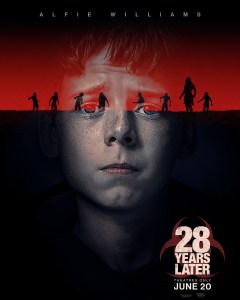 The long awaited third part of the trilogy is wilder odder than anyone was expecting, across every possible axis. For a start, it’s both the third movie in a trilogy and the first in a second trilogy. The Bone Temple, directed by Nia DaCosta and already finished, is due for release in January and a third movie not quite scheduled with Danny Boyle returning to the director’s chair the year after. It’s a brave choice, and this is a film made almost entirely of brave choices. But only almost.
We’ll get to that. First though, like the original this is a movie shot at least partially on consumer grade cameras, in this case iPhones, but unlike the original, it’s beautiful. Boyle has always had a Raimi-like sense of visual invention and he uses montage, drones, iPhone footage, CGI and archive footage to incredible effect here. There’s a terrifying chase across a flooded causeway against a clear night and starfield that’s one of the most beautiful shots I’ve ever seen, CGI or not. That arrives maybe twenty minutes after a montage cutting footage from versions of Henry V, the previous movies and B-roll together against the terrifying reading of Kipling’s poem Boots first heard in the trailer. Deaths are hit with a stutter step of cameras, a not quite freeze frame as someone else dies. It all works. Visually this is the most interesting Boyle has been, possibly ever.
This beautiful ruin of a world is the canvas for Alex Garland’s story about a UK isolated from everything and everyone, especially itself. NIMBY culture has combined with survivor’s guilt to ensure that survivor communities know each other but barely trade. The Lindisfarne colony Spike and his parents are part of is barely thirty miles away from Doctor Kelson (Ralph Fiennes) and his eternal bonfire but no one goes there. It’s partially conservatism and partially survival. Spike’s nightmarish first run onto the mainland includes collapsing buildings, an enormous herd of deer and encounters with the two new types of Infected: Alphas and Slow-Lows.
Alphas are vital to the movie and the one part where it creaks. The justification is that the virus infects some people very differently, boosting their muscle and skeleton to create colossal, hulking figures with more intelligence and far more focus and strength than most Infected. The movie has been a little disingenuous about the Alphas, presenting everything in the trailer as though there’s a single Alpha. This is not true, although the design of the Alphas is close enough, and the excellent Chi Lewis Parry voices them both.
The Slow-Lows are where the movie loses me and loses me hard. They’re Infected, but they’re Infected who crawl because they’re too fat to run. Their sole characteristics are that they eat everything and they’re fat. That’s it. That’s where we are. It’s 2025 and evil fat people Infected are a thing that an entire cadre of creatives thought was a good idea. It’s not even low hanging fruit, it’s rotting fruit that no one should touch and yet here we are. Likewise the weirdly Caucasian Lindisfarne colony and the franchise’s depressingly bad record with female characters. There are three women in the movie. Two of them are mothers. One of them is a homewrecker. That’s it.
These bad choices stand out more because of the calm, sad intelligence and kindness of the rest of the script. British cinema classic Kes is the movie I found myself thinking of most often in the first half, thanks to Taylor-Johnson’s well-meaning blowhard Jamie and Williams’ brilliant, quiet, kind Spike. There’s a desperately sad moment where Spike confronts his dad about something awful where both men are vulnerable, neither back down and the power dynamic shifts. Williams is terrified, resolute, furious and Taylor-Johnson is blustering, guilty and ultimately together enough to realise he’s in the wrong and hates it. They’ve got nowhere to go, trapped on an island that’s trapped by an island. A familial tragedy long before the tragedy of the third act comes into play.
That leads to the third act and a very specific type of horror, as Spike takes Isla to Kelson in the hopes he can help her. Jodie Comer does not know how to turn in bad work and her performance here is heartbreaking because of how without front it is. Isla’s dying, and she’s pretty sure she knows it and she’s certain she doesn’t need to tell Spike until there’s no other choice. Comer and Williams are incredible together, and this act pops with the sort of sweetness and gentle familial oddness that Jamie is too terrified, too macho, to be open to. Williams is superb as a determined, focused boy forced to do things no one should by his love for the one parent who actually sees him. These are his movies and I’m thrilled to see where he goes with the performance.
 That third act is odd in the best of ways. Fiennes’ Doctor Kelson is polite, kind and gentle, the sort of man Spike is becoming instead of the sort of man Jamie needs to see reflected in his son’s eyes. His careful, penitent approach to the dead opens the door to a sequence that will be very, very hard if you’ve lost someone recently. There’s a beat, and you’ll know it, where Comer and Fiennes communicate silently that will absolutely break your heart and another where an innocuous line from Fiennes will wreck you all over again. What makes it work is how honest it is, how open and kind. This is a movie about grief, and trauma and survival. It’s about what happens after the world ends and Spike begins his journey there as this chapter closes. It’s hard, and beautiful, and horrible and I’m still thinking about it.
And the movie still isn’t done. The closing sequence is a set up for The Bone Temple, tying everything we’ve seen together and pointing it towards something which looks a lot like it’s going to explore one of the most horrific real life moments in recent UK history. I have no idea if it’s going to work. I’m depressingly certain that director Nia DaCosta not Garland will carry the can if it doesn’t.
Verdict: But I have no idea what happens next and that seems appropriate for a movie so unapologetic and unique. Unlike anything I’ve seen so far this year. Haunting, mostly, in the best of ways. 9/10
Alasdair Stuart
 Doctor Who News Star Trek News
 Sci-Fi Bulletin: Exploring the Universes of SF, Fantasy, Horror and Spy-fi!