Review: Nightmares in a Damaged Brain
Severin Films, out February 26 A homicidal mental patient flees an experimental drug program, leaving a trail of carnage from the peep shows of 42nd Street to the gore-soaked shores […]



Severin Films, out February 26 A homicidal mental patient flees an experimental drug program, leaving a trail of carnage from the peep shows of 42nd Street to the gore-soaked shores […]
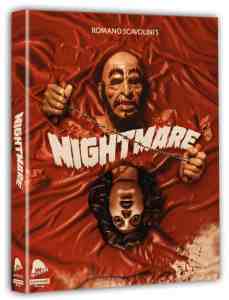 Severin Films, out February 26
A homicidal mental patient flees an experimental drug program, leaving a trail of carnage from the peep shows of 42nd Street to the gore-soaked shores of Florida.
Before diving into a review of this release, here’s some context. In 1982, video distributor David Hamilton-Grant served time in prison for releasing Romano Scavolini’s grubby horror movie Nightmares in a Damaged Brain through his World of Video 2000 label. Though the movie had been shown in UK cinemas, that version had been shorn by nearly a minute, while the video version was uncut. It was found to be obscene under Section 2 of the Obscene Publications Act, and to date, Hamilton-Grant is the only person to have served time for distributing a ‘video nasty’.
Forty years later, with the ‘Video Nasty’ hysteria far behind us, it’s now possible to buy a legal, uncut 4K version of the movie without the fear of a knock at the door. Unfortunately for Hamilton-Grant, it was a poor hill to die on, as it’s not a great movie. The 39 films that originally formed the list of ‘Nasties’ included classics from the likes of Argento, Fulci, Hooper and Raimi, but Scavolini’s movie is not particularly well-made and is a prime example of grindhouse sleaze, the archetypal definition of a ‘nasty’.
George Tatum (George Stafford) is the patient who is believed to have been cured of his psychopathic tendencies, but it’s not long behind he’s slicing and dicing his way through victims. The blood and rubber body parts don’t convince, but there’s an unnerving savagery in the execution and the cheapness of the production adds to its verisimilitude. It’s a tough watch on many levels, hard to appreciate as anything other than a perfect example of a particular form of film making.
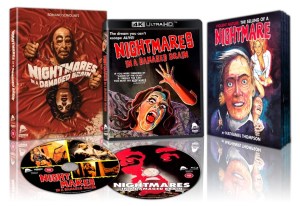 Severin’s transfer has been scanned from the internegative and the best print sources to create the most complete version ever assembled and features two audio commentaries and trailer. For me, the greater interest is with the excellent supporting material – a feature-length documentary about David Hamilton-Grant (72 minutes), an interview with Scavolini (71 mins), a discussion with multiple cast and crew (39 mins), Tom Savini, deleted scenes and an eight-page booklet.
Verdict: Judged on its own merits, this is an unremarkable, nasty film. But it’s impossible to divorce it from its contemporary notoriety, and this bumper package creates a fascinating time capsule. 8/10
Nick Joy
 Doctor Who News Star Trek News
 Sci-Fi Bulletin: Exploring the Universes of SF, Fantasy, Horror and Spy-fi!