The Woman: Interview: Director Lucky McKee
Look at the world today, wouldn’t we all love a large storm cellar? A dusty dungeon to store all the essentials of life? Bottled water, dried pasta, vodka, common sense… […]



Look at the world today, wouldn’t we all love a large storm cellar? A dusty dungeon to store all the essentials of life? Bottled water, dried pasta, vodka, common sense… […]
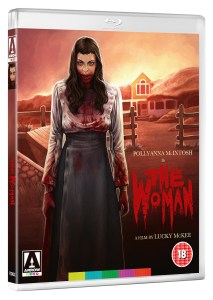 Look at the world today, wouldn’t we all love a large storm cellar? A dusty dungeon to store all the essentials of life? Bottled water, dried pasta, vodka, common sense…
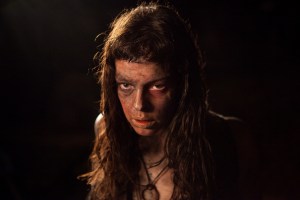 Communicating with one another from our separate dungeons!
This is the world today, people shouting at screens getting more and more angry with the speed of their broadband. I only just managed to finish watching The Woman a few minutes ago as it kept buffering! Too many people lunchtime drunk on their sofas losing themselves in Netflix.
Was that the first time you’ve seen it?
Yeah, I remember it coming out but – and this is such an awful thing to admit – I wasn’t sure it was going to be my thing. Of course, now I’ve actually seen it I realise how skewed my expectations were.
What were your expectations?
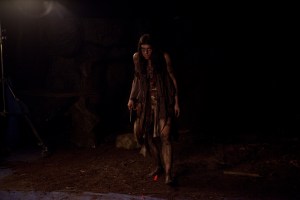 Well – and this will make anyone who knows me squint in disbelief – I wasn’t quite sure how much I needed to watch a movie about a woman chained up in someone’s cellar. I thought it was just going to be grim and exploitative. Of course, it’s anything but, in fact it kicks back at exactly that sort of filmmaking.
It comes down to my personal approach to material. It’s about the character first and foremost, about showing things without condoning them, about showing the world for how terrifying it can be, which I think it is for a lot of people on a daily basis.
Most people have dealt with abuse in their life, be it mental or physical. I wanted to represent what it’s like to feel trapped, to be imprisoned in an isolated environment.
A lot of stuff springs from what you know, what you experienced growing up. I didn’t go through anything as awful as the characters do in the movie but I had my own traumas growing up and I transposed those to the film.
As far as representing women: it’s just trying to be as honest as possible, to do what I can to connect with what they’re going through.
It’s also how I work, I put myself in the thick of it, to try and share what the actors are going through while we’re shooting.
I surround myself with people who keep me in check too, people who have a good moral compass. (laughs) I like to be able to look at myself in the mirror every day, you know?
There are certain lines I won’t cross. For example: dealing with children and a really heavy subject matter it’s important to film in a way that we’re not putting the kids in the middle of anything that’s inappropriate. That was hard. It was a real balancing act. We were working to a low budget – the movie was made for under half a million dollars – we didn’t have a lot of resources.
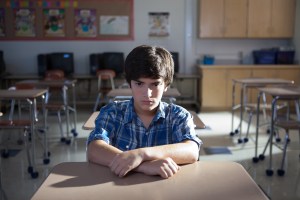 On the subject of lines not being crossed, the film is astonishingly careful in how it presents itself. The moment when Chris Cleek spots The Woman is a brilliant representation of the male gaze, for example (and through the sight of a rifle no less). The violence too, while extreme, utterly brutal, never feels like it’s there just to thrill or titillate. It serves a purpose, even if that’s purely cathartic.
There’s something therapeutic about getting that stuff out, you know?
That’s one of the great strengths of the genre, isn’t it? We can talk about the real world but turn the volume right up.
Absolutely, and a guy like Jack Ketchum, his stuff is brutal and really intense. It often deals with abuse, the human monsters, people are the scariest things…
What I always loved about his work is that he’s not afraid to talk about things that a lot of us would be. Most of us have nightmares or thoughts that we wouldn’t want to share, to talk about. He would have the bravery to write that stuff down. Collaborating with him, the connection you get from that makes you not feel so crazy!
Both my partner and I write horror and we have a lot of friends in the business. We go to conventions, rooms full of people who the night before evoked pure hell on a page or screen, but are now just the gentlest, least crazy people you could know. Well… crazy in the cracking open the power tools and going to a mall sense, we’re writers, we’re obviously mad by most definitions.
I do a lot of conventions too and you meet all these people who directed movies from your childhood, Tobe Hooper, Tom Holland… and you’re expecting monsters but they’re the nicest, kindest people. Don Coscarelli… I mean, he’s just a giant bear, you just want to hug him. But then, we all have a place to put the dark thoughts, don’t we?
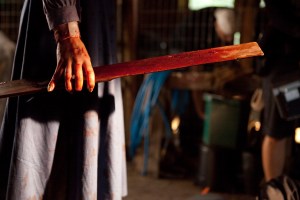 Talking of Tobe Hooper, something occurred to me while watching the movie and it was about the aesthetic of horror. Hooper was so good at that. The difficulty of putting the unbearable on screen and making it possible to watch. You don’t want to water it down, or glorify it, revel in it, but you don’t want to make it so grotesque, so visceral that an audience can’t endure it.
There are films that go too far for me, the end of Aronofsky’s Mother! I didn’t want to see that! Which is fine, you know, I’m not saying he shouldn’t do whatever he wants but, I’m sat watching this movie with my newborn baby on my lap… this is just… no.
It’s whatever personal and moral compass you have. I do everything from the gut, I’m intuitive, I’m not an intellectual, it’s about whatever feels right. And, as I say, surrounding myself with people I trust, who have a good view of the world and will challenge me if I do skew too far in the wrong direction.
I have a slightly unpopular opinion for a horror novelist in that I think the screen will always be where the genre thrives best. As much as I love horror on the page it’s a different, less primal, less immediate experience. It works on the higher brain rather than the terrified animal. You don’t drop a book because it’s made you jump!
My chosen form of expression is cinema so I tend to agree, the one thing that’s great about prose though is that you can occupy someone in a way that’s unique, you can experience all their senses whereas cinema is really biased towards the aural and visual.
Upstream Colour, the Shane Carruth movie… He almost makes you feel the texture of things, almost. I think Malick does that to a degree too, but generally that’s the obvious distinction.
The power of the visuals is immense though. I recently watched a Von Sternberg movie I’d never seen before called Underworld from 1927. Watching what these directors were doing at the end of the silent era working at such a high level, the music and image together, so powerful…
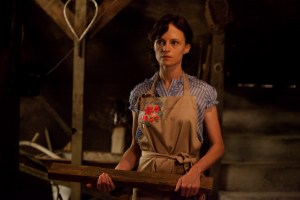 A perfect manipulation of the audience.
There’s no better music than sitting in a theatre watching a horror movie and hearing the audience tense up, terrified!
On the subject of music, the score for The Woman by Sean Spillane is a vital part of the tone of the movie.
Sean and I went to the University of Southern California together, I think he was a literature major while I was studying film. We both ended up in bands, mine was terrible but his was really good. They got on the Sub Pop label and toured with some big bands. I loved the songs that he wrote and had always wanted to hear what a solo album from him would sound like. So I invited him to the shoot. I’d picked out some of his songs I wanted to use anyway, but set him up with his own space to work and he sat there creating while we were making the film. I’d listen to his demos on the way in every morning, the whole crew was listening to his music. It was a wonderful experience.
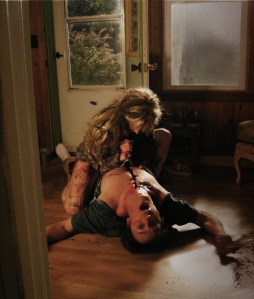 I believe you also showed the crew rushes while you worked?
At the end of every week I’d make a clip show to show everyone. It kept them pumped up, gave them a sense of what the thing was looking and feeling like. I think stuff like that gets people motivated, makes them feel like they’re working on something cool.
A film shoot is a very full on experience. It’s like going to camp, all these crazy long hours and these intense relationships and then everyone goes their separate ways. Whatever you can do as part of that to make things work easier…
You had a phenomenal cast. Obviously Pollyanna McIntosh as the Woman, a wonderfully feral, intense performance; Sean Bridgers as the real monster of the piece, this terrible everyman filled to the brim with sadism and resentment; Angela Bettis, so numb, frozen, until finally she’s pushed too far…
Ninety-six percent of the work is done when you pick the right people, you know? They bring a lot to it and they were super sharp and had their unique take on the characters. My job is to make sure they feel safe to try things, even if it means they might fall on their face. I need to be supportive.
Angela brought so much more to that character than I could have imagined when we wrote it. That character could – if handled badly – be the least interesting on the screen but she brought so much depth to it.
The kids always surprised me too. They’re not encumbered with a lot of things we are, they’re not afraid to really let go… Like Shyla Molhusen [as Darlin’ Cleek, the youngest of the family] tasting the blood at the end… Amazing.
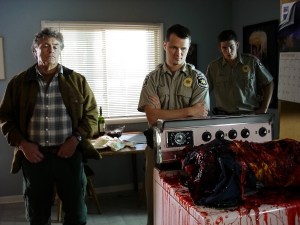 Annoyingly, I like to ask this of everyone. I have the – possibly misguided – idea that it might be useful to some readers. What’s a piece of advice you’d give an aspiring filmmaker?
Don’t try to do everything yourself, realise what you’re good at and really drill into that. Film is a collaborative art, I think a lot of people think directors are dictators, moving chess pieces around but that’s not the way it works, you know?
People amplify what you do. You’re a spark plug. You’re there to give them the energy to give their best work. Be collaborative and surround yourself with good people. I think that applies to most things in life.
Well, I have to ask now. What is it that you’re good at? (I know, that’s a really evil question.)
It’s a terrible question! I don’t know… Getting in the mood, getting excited, making things personal. Being honest, making stuff from the heart. That’s the goal anyway, I’m, not sure that’s a quality…
It’s a quality we could do with a hell of a lot more of.
****
Of course, the other thing that Lucky McKee is really good at is making powerful, compelling horror movies. Our nightmares are the richer for it.
The Woman is available on Limited Edition Blu-ray from Arrow Films. A two-disc set that also features the earlier movie Offspring. Read our review here
Thanks to Thomas Hewson for assistance in arranging this interview.
 Doctor Who News Star Trek News
 Sci-Fi Bulletin: Exploring the Universes of SF, Fantasy, Horror and Spy-fi!