The Reckoning: Interview: Neil Marshall and Charlotte Kirk
Neil Marshall’s latest film, The Reckoning, is out now to download on Vertigo Releasing. Marshall co-wrote the script with his partner and the movie’s star, Charlotte Kirk, and the pair […]



Neil Marshall’s latest film, The Reckoning, is out now to download on Vertigo Releasing. Marshall co-wrote the script with his partner and the movie’s star, Charlotte Kirk, and the pair […]
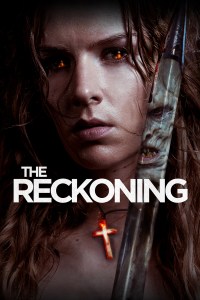 Neil Marshall’s latest film, The Reckoning, is out now to download on Vertigo Releasing. Marshall co-wrote the script with his partner and the movie’s star, Charlotte Kirk, and the pair chatted with Paul Simpson about its genesis.
I love Witchfinder General, Blood on Satan’s Claw, those sorts of movies so it was nice to have something that leans into that folk horror genre. Were they influences on you?
Neil Marshall: Definitely. If it’s an English sub genre it’s not a particularly well populated English sub genre so it was good to contribute to that. I wasn’t consciously trying to do a folk horror because I know that there’s been quite a few folk horrors happening recently and it’s like OK, I wasn’t trying to join that crowd so much as do something more inline with Witchfinder General.
What was the genesis of the project?
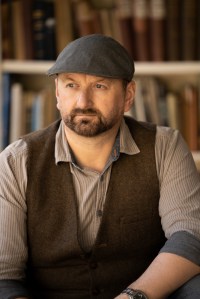 Neil: My old friend Ed Evers-Swindell who made a film a couple of years back called Dark Signal that I executive produced – we’ve known each other as movie fans for twenty odd years – he came to us with this rough outline for a story which would be a little bit more Carrie-esque, a witch hunter of that time which resulted in [the character] really was a witch. She’s after everybody with her eyeballs and stuff like that by the end. There was just something about that just didn’t click with either of us. I liked the setting, I liked the concept but I was not really into the story that much, so we kind of took and ran with it.
Getting into research about the period a bit more what we found was that there was enough true story to do something that was a bit more worthwhile. I wanted to say something with it because my feeling was that witch hunts are as relevant today as they ever were. They’ve taken a different form – cancel culture or whatever – but witch hunts are still around and misogyny is still around and we haven’t come an awful long way since 1665 really. And also to dive back into doing something, a more independent horror film in the vein of Hammer Horror.
So there were all these elements and Charlotte at some point said, ‘What if there are no witches in this witch movie?’ That really hit the nail on the head.
 Charlotte Kirk: That’s when it clicked for you. We were halfway there and you were, ‘OK, I like it but there’s something missing,’ so I said ‘Well, we don’t want to say there are no witches, because we want to leave it ambiguous, but there’s a lot of people who think she is a witch and the devil is literal’ but it’s not going to be flying around on brooms and be on the nose.
Neil: We didn’t want to be on the nose. We wanted to get rid of all the hocus-pocus elements that were in there and make it a bit more grounded.
There was 500,000 maybe a million women who were burned at the stake or hung for crimes of witchcraft and I felt an obligation to tell that story.
Charlotte: The truth, yes.
Was there a particular case that you’ve taken from or is it more this is the way that somebody like the Witchfinder would have acted towards someone like Charlotte’s character?
 Neil: Exactly, it was more of an amalgamation of various stories.
Charlotte: Because Sean [Pertwee] isn’t like the Witchfinder General or anyone specific, is he? He’s not based on anybody?
Neil: No, he’s a fictional character but clearly he is based on the real Witchfinder General. There were other witchfinders at the time.
I wanted to tell a fictional story based on real events. All these things that happen in the film – the witch pricking, the pear of anguish, the burnings – stuff like that did happen.
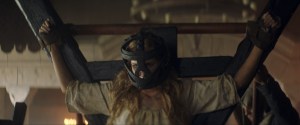 Charlotte: But the writing that comes up towards the end about the last woman burned at the stake and she was covered in tar, set on fire, that was a real thing.
Half the battle with the torture stuff was finding things that really happened but that weren’t lethal because of course Grace had to go on and live. So that was really tough: we wanted to make it as real and as authentic as possible but the dunking and the other stuff that they used for witch trials back then, they were all lethal, pretty much.
I was thinking of the sequence where the pear is inserted and then we cut and then see that huge amount of blood all over her yet she’s still, basically, able to kick the shit out of everybody not that much later.
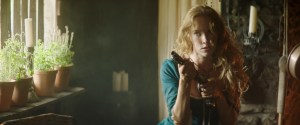 Charlotte: That’s movie magic (Laughs).
Neil: Often women, or people in general, were a lot tougher then.
Charlotte: Yes, that’s true. (Laughs)
Neil: They didn’t have Nurofen to hand.
Charlotte: That is true, that’s really true yes.
The “fantasy sequences” – are we meant to infer that they are her fever dreams throughout? Or is there anything else in there? I particularly the bit where everybody going round her – it almost felt like a Garden of Gethsemane moment, where she’s being tempted and tortured at the same time.
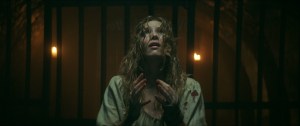 Neil: We wanted to leave that ambiguous. When people read the scripts, some assumed the devil was a literal manifestation and others thought it’s clearly her losing her mind and having fever dreams and suchlike. I don’t want to say one way or the other for sure. Let people interpret it the way they see fit according to maybe their own beliefs, who knows?
But certainly the strongest argument is for fever dreams. She’s being deprived of sleep, she’s going through physical and mental anguish and torture everyday. Of course it’s going to have an effect on her and her mind, and that’s what we wanted to explore.
It was the idea that, for her, she can deal with the physical pain, she can deal with them sticking the spikes in her. She goes to her safe place, her mental safe place to get through it all. What scares her more is going back to the cell at night and how she’s going to be tormented in a totally different kind of way.
Charlotte: I think every time, when the devil appeared and Joseph came along, that’s the thing she couldn’t handle: her loving husband was potentially this monster.
There’s a couple of jump scares in this, but it’s much more psychological.
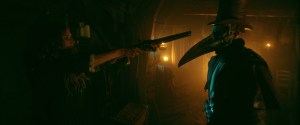 Neil: To not just fill it full of cheap jump scares and things like that was definitely to make it more of a mood piece and a psychological piece and a slow burn but deliver a few [jump scares] because people like that kind of thing. There are a few moments
It’s my least gory film, almost deliberately so. I just wanted to show a bit more restraint and suggestiveness. There are a couple of moments just to please the fans.
Charlotte: And it has a really satisfying ending as well because I think when you have that slow burn, you get to the end and it’s really satisfying the last fifteen twenty minutes, it takes it all back.
You’ve earned it by that point. That’s often the case with a lot of these things: act 3 is the violence and quite often the characters haven’t earned that with the audience. Talking about the jump scares, I think the one that really threw me for a moment was the abusive husband…
Charlotte: Everyone reacts to that, very much so.
Neil: That usually gets a big cheer (laughs). I had to deliver something a bit bloody at some point.
Did you feel pressure that you had to do that?
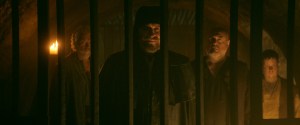 Neil: I don’t know if it was a pressure that I had to do it but certainly I wanted to do that. I wanted to give the audience something visceral that they could cheer for at that point because there has been a lot of punishment for these characters and a lot of abuse and to see them fight back in such a way just gives the audiences a release.
I wanted to make it satisfying; as you say, it’s like she’s earned the revenge. Not just her character has to go through that to get there but the audience goes through it with her. So you want to give them a satisfying revenge as well. So, these things are a bond.
When you were writing it you were aware you were going to be starring in it, Charlotte, so did that alter the way it was scripted? Would you have needed to have written out motivation or suggested more stuff if you were writing it for somebody else to play?
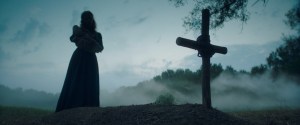 Charlotte: When I was writing it, I never thought of me acting it. At the beginning I didn’t know if I was going to play it or not and then when I knew I was going to play it, I really wanted to separate the two, completely.
It’s my first writing that I’ve done in terms of co-writing the script, so I really wanted to just focus on just the writing. Of course it gave me a profound understanding and connection with Grace but the flip side to that is when we were shooting it, I wanted to forget about the writing process and look at it with a fresh pair of eyes, as if I’m just picking up the script for the first time. I think otherwise, you might become selfish and be ‘I want to put this in there and this in there and this would look good’ and ‘Oh I’d love this emotional bit in there because of that’. So I just wanted to focus on what I want to see? As a writer, put myself in the writer’s shoes, what do I want to see?
You write movies that you want to see and it was such a great contrast because I was looking at it from an actor’s point of view, Neil was looking at it when we were writing from a director’s point of view so it was such a good contrast and balance for us both to do this.
I’ve now been converted but before this I was not really into the horror world at all. I wasn’t looking at it as a horror film, I was just thinking of the structure and the characters and the story really.
Neil: Now you’ve come over to the dark side.
It’s good, we have cookies. (Laughs)
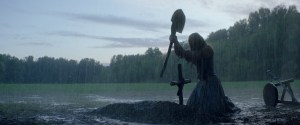 Neil: It’s the same for me really. When I’m writing a script, I’m not writing scenes that I know how I’m going to film. I’m setting myself challenges of writing scenes that work and only later on do I think ‘How the hell am I going to film this?
Charlotte: Yes, making it very difficult for yourself.
Neil: What was I thinking?!
But once you are aware that you are going to have another part in it, as a director or writer, do you take shortcuts in the script because you know that you know what you mean? If you were to publish the screenplay would another actor and director be able to pick up the same things from there that you intended because you knew what you wanted to do with it?
Neil: That’s a very good question. I don’t know if I consciously know the answer to that. I can’t think that I approach a film, when I’m directing it, thinking ‘Well, I know what this scene means so I’ll just do it whatever way’ because it’s going to mean that regardless.
Charlotte: No but sometimes you take shortcuts.
Neil: You’ve got to get the point across. How do I translate what I intended in the script to the audience through the images we’re creating and the story we’re telling but I can’t say that I do it consciously. Unless it’s something really tricky then you’re like ‘Oh God, how are the audience going to understand this?’
Charlotte: But I think now, moving forward I would definitely think about it more. I don’t think it was the right approach just thinking of it as a writer then just thinking of it as an actor. At the same time, again maybe subconsciously I did because consciously when I was writing it maybe I was thinking ‘Oh, I don’t know if I can do that’ or ‘I’m good at that so…’. It’s a really interesting question.
What was the greatest challenge that you had on the movie?
Neil: Finishing it (Laughs)
Charlotte: I think the time was pretty intense, we only had 25 days to shoot it.
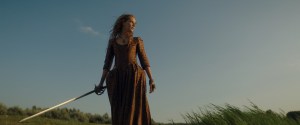 Neil: It was fast and furious trying to do something that was period and with effects and lavish costumes and sets, lots of complex setups in 25 or 26 days was intense. It was not the easiest production, from a behind the scenes point of view, from a financial point of view. We were wrestling with things like that at the same time, so there were times that we were scared the film might not even get finished but one way or another we got through it. Certain scenes, setting fire to the house or throwing Charlotte in a lake at the end were challenging for sure.
Charlotte: It was worrying. We didn’t have any accidents but it was dangerous stuff.
Neil: It’s always scary: when you’re using fire on a set it’s always scary. You always have to be cautious. We did two full body burns, we set people on fire and that’s always scary. You’re very conscious of the fact that somebody’s life is in danger and do everything you can to keep it as safe as possible – but there’s always at the back of your mind, what happens if the curtains catch fire or something? Where are we all going to go? What’s going to happen?
But these things didn’t happen, it was all good.
The Reckoning is available to download from Vertigo Releasing
 Doctor Who News Star Trek News
 Sci-Fi Bulletin: Exploring the Universes of SF, Fantasy, Horror and Spy-fi!