The Power: Interview: Corinna Faith
Corinna Faith’s first feature film, The Power, premieres today on Shudder, and the writer and director of short films such as The Beast talks to Paul Simpson about the challenges […]



Corinna Faith’s first feature film, The Power, premieres today on Shudder, and the writer and director of short films such as The Beast talks to Paul Simpson about the challenges […]
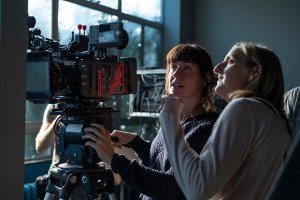 Corinna Faith’s first feature film, The Power, premieres today on Shudder, and the writer and director of short films such as The Beast talks to Paul Simpson about the challenges of setting a movie during the power cuts caused by the miners’ strike in the 1970s…
What was the inspiration for the setting of The Power?
I was interested in setting something in that era because I’d watched a lot of horror films that I enjoy from that time so I just thought in an academic way it’s an interesting point in history to set a film. But actually it was mostly because at the time that I was deciding what to write, all these stories of institutional abuse were emerging in the news in our country and I just found it very disturbing.
I always want to write from a place that is emotionally resonant for me and I found it heart-breaking the idea of these lost lives and lost souls in these big institutions and people being unheard for such a long time.
 I found that very resonant so I wanted to take it as my territory, which I thought worked well for a ghost story. Then, I was researching the era, I came across an image of a woman working as a telephonist a secretary in the pitch black with an oil lamp. I didn’t really know that much about the blackouts but I was really struck by the combination of the gothic oil lamp with her in her 70s clothes and I just felt that it really joined together a lot of my interests.
It was a very classic ghost story image but in an unusual setting and timeframe.
It’s a period where things were changing a lot and I don’t think we realised how much things changed in the 70s, things that we take for granted now.
Yes, during my research the thing that struck me the most was how it felt more akin to post war Britain than to the 80s. Most of my childhood was in the 80s – and actually a lot changed that is a bit more related to how we are today in the 1980s – but the 70s yes, everything was so stark and there were unapologetic divides in sexual politics and class politics. It was just much harsher than I had realised so it’s an interesting time to tell a story.
Did you find it difficult to put yourself into that mindset? Because it’s almost as different from us now as writing about the Bridgerton period.
 To be honest, no, I didn’t find it difficult at all because I think sexual politics-wise is it that different? It was very upfront and, as I said, very unapologetic then but extremely similar to a lot of things that happen now, but maybe things are couched in different terms or presented in different ways.
That was the other reason I thought it was an interesting time to tell a story about females working in an oppressive environment and being silenced because it’s obviously very pertinent still.
Did you draw on any actual incidents at hospitals for it or is it just more the feel of what was going on at the time?
It was the sense that there were countless stories in institutions across the land really, whether it was boarding schools or orphanages or churches. I chose that setting because I thought it was an interesting place to set a ghost story but it could have been any institution really.
The use of light is something that I noticed, not just in The Power. You seem to have a source which isn’t necessarily centre frame but it’s there. Is that something that you’re consciously doing when you’re designing shots in your mind or is it just something that is part of you and your feel when you’re directing?
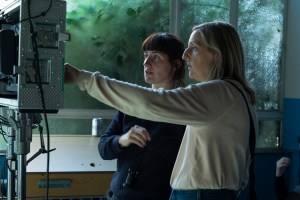 I think light is something that I’m absolutely fascinated by and inspired by, and this is a story about a loss of light and what it’s like to not have very much light and what it’s like to be in different types of dark. So yes, it’s something I think about a lot but on this film, the collaboration with Laura Bellingham my D.P was key and massive and a very rich and rewarding process.
My question to her was, ‘It could get exhausting to set a story in which it’s dark a lot of the time, so how are we going to mark the changes between the different types of dark at different points in the story? And how can we have spaces in the story to have a breather and have a type of light as well?’ We were constantly thinking about moments where the light would give us a bit of a reprieve and trying to create a variety of dark experiences.
And the light sometimes is false hope as well – it’s very much a tool in the arsenal.
Yes, that’s true.
When you’re writing to direct something yourself, do you write purely as a writer or do you write knowing that you’re going to be directing it and at the back of your mind you’re already thinking ‘This is how I’m going to do it’?
 I think I do write it very much as a director, in that I see every single thing that I write, and if I can’t see it, I’m stuck and I can’t really write the scene, so I have to wait and work it out until I can actually see it. I’m playing it out in my head visually, which I guess is the director’s side of my head [but] I try to make sure that I don’t limit myself. I don’t think purely in budgetary terms or in practical terms too early – then later in the process I’ll look at it in a purely directorial way and try and make sure I haven’t got excess things in the scene that I’ve added as a writer, but that I know that when I get to set won’t be important or won’t have time for.
It’s an interesting conversation that I have with myself.
Do you find yourself on set going, ‘Why in the heck did I do that?’
Yes, I did that every day (laughs). Yes definitely: there’s a lot of stunts and things in this film which was quite a big ask. It was quite hair-raising for a first feature to deal with all of those. That was something that felt absolutely fine to sit and write in my cosy house but actually trying to execute them was another thing.
Obviously a film is written in the script, it’s written again when you’re directing it and it’s written yet again when you’re editing it. How much is the final film different from what you originally envisaged?
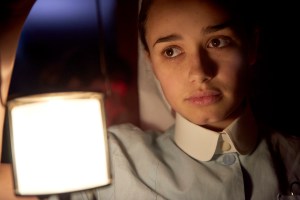 I think I’m pleased that atmospherically it is what I wanted it to be; that was something that was really important to me. I just wanted to have moments in the story where you could imagine and feel what it was really like to be in that big space and for some of the atmosphere of the building itself to come through, and that did survive all of those iterations.
In terms of what I actually got to shoot, it had to be streamlined and simplified constantly, so that was very different to the script. In terms of the edit we discovered that there was some real story and energy level holes towards the back third that felt absolutely fine to read but when they were actually shot in the very minimal way that we had to shoot them, it didn’t ramp up in the way that you wanted it to as a watch. That was a very interesting process for me but luckily we had some pickups so we were able to go and fix the holes.
It’s handy when you’ve got that opportunity obviously.
It was a first for me, having pickups, yes so that was great.
Would that have made a difference to you directing it if you’d had at the back of your mind that you would have that opportunity or did you know that that was built in?
I did think I’d probably have something, but I’m glad that I wasn’t able to use any of that time or money until right near the back of the edit, because I would have used it for totally different things at the beginning of the shoot. I would have used it on all the things that I was having to drop, all the scenes I was looking forward to shooting that I felt really bereft that we’d dropped but actually we didn’t need. What we did shoot is what we actually needed.
It’s quite a knack to be able to get that tautness; unfortunately, it doesn’t always come across particularly in horror. You can see what the director is trying for but it doesn’t necessarily translate but with this there is always that feel. The movie this reminds me of is The Innocents, the Deborah Kerr version of The Turn of the Screw.
 That was a big reference for me that film, that’s probably my main reference actually.
Did you go back to the original story or did you just look at that film version? Because the Henry James original version has some incredibly creepy stuff in there that’s never really been fully filmed.
Yes that’s true.
I’m familiar with that book and I already love that era of writing. I didn’t focus on [the book] in prep for the shoot. The Innocents, the film, was something I went back to quite a lot before we shot in terms of the scale and the way that some of the set pieces aren’t necessarily structured in the way that things are now. So sometimes you’ll see Deborah Kerr’s response to something scary before you see the scary thing which is interesting and a kind of a flip on the way it’s often done right now.
 That gave me a toolkit to try each set piece in a different way: sometimes we see something before she does but sometimes we just feel what she’s seeing beforehand. I love the sense of scale of that film, the space that there is always around the character was a reference for me with this.
There are some incredible images in that film of things that you can’t quite make out, that are quite ambiguous, that are scary because your eye can’t quite read them. That was another thing I found inspiring for this.
Working with Rose as Val, did you have a lot of conversations with her beforehand about the character or did you allow her to pull it from the script and let her come to you with questions?
 It was a bit of both, but she was really keen to do loads of research and preparation for it herself. I sent her lots of film references, types of films that she hadn’t necessarily seen, more as a flavour really, but she did loads of research on her own. She really wanted to run with this part and make the absolute most of the opportunity, which is why she was so fantastic to collaborate with
It was brilliant in that regard. We treated it like a team. I tried to empower her as much as I could and build as much trust as possible because it’s a very raw role and a scary place to push herself into, and very visceral and physical, so she had to be very brave.
She very much had to be onboard for it to come through the camera.
Definitely.
I think the thing that I really liked was the fact that you have a feel of her life beforehand. You know that she exists rather than just being a character in a drama, which again doesn’t always come across in these sorts of things – they are avatars rather than characters – and she feels more like a character.
Yes, that’s good. Any horror film that does work for me, or any film generally, if you don’t feel anything for that character – whatever it is that’s allowed you to feel that; it could be a bunch of things – it’s never going to have much emotional impact. Certainly that’s what I want from watching a film and that’s what we tried to do.
What was the biggest challenge for you on the movie?
 It’s not necessarily a challenge but I think it’s dealing with an incredibly fast-changing landscape because of COVID through the end of our post production and into a new reality that is here right now however temporarily. Not being able to have a cast and crew screening physically together, not being able to get together and show my gratitude for the whole process and reconnect with everyone. Everyone being broken down in quite an isolated way – that is a challenge because when you’re making your first feature, that’s not how you see it panning out. You hope that there will be a physical element to the whole thing.
So that’s been a challenge but the shoot itself was as difficult as I thought it would be, but also much more rewarding than I realised it would be.
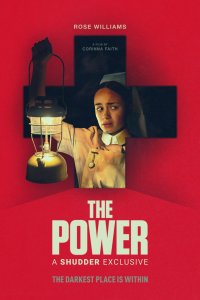 The Power is now available to stream on Shudder. Click here to read our review.
 Doctor Who News Star Trek News
 Sci-Fi Bulletin: Exploring the Universes of SF, Fantasy, Horror and Spy-fi!